
Bilkis Bano's Fight for Justice: 25 Years Later, Back to Square One
Suspending life sentence of Bilkis Bano's rapists adds yet another cushion of impunity for the guilty.
advertisement
In The Trial, Franz Kafka had argued, “It's often safer to be in chains, than to be free”. While in a different context, these lines reverberate the sense of discomfort that has been running through the minds of every woman in India since 16 November 2026, when the apex court of India, in all its clemency, suspended the life sentence of the 11 men convicted of gangraping a 19-year-old pregnant woman in the aftermath of the 2002 Godhra riots in Gujarat.
In India, as per national data records, an incident of rape is reported every 15 minutes, but the conviction rates remain alarmingly low.
Out of every 100 reported rape cases, less than 28, estimately, result in a conviction. This implies that the gap between the occurrence of crime and accountability of the miscreant is as wide as the gnawing fear that every woman in India carries in her heart, on the road and at home.
Technical Loopholes
The latest order joins a catena of judgments in this fateful case where the gravity of the crime and its societal impact have been cast aside to uphold the overt principles of restorative justice.
The Supreme Court in the present case was seized of a special leave petition by the convicts of the 2002 gangrape, who were granted remission by the Gujarat government in 2022, which was de facto upheld by the Bombay High Court. The Supreme Court, in 2024, pertinently kept aside that order, for being per incuriam and non-est in law.
This trapesing of judicial diktat upon convicts guilty of the gravest of crimes—at a time when 74 percent of India’s prison population comprises of arrestees awaiting trial, including students languishing for nearly a decade without trial for offences related to political protests and dissentient activities—makes one wonder whether the scales of justice are indeed balanced or does it tip towards a particular side.
Prisoners' Reform Over Accountability?
Indian judicial premise has its fulcrum upon the principle of restorative justice, furlough and parole, and are critical tools in enabling scope for reform.
However, as laid down by the Supreme Court itself in the matter of Laxman Naskar vs Union of India and Ors (2000) 2 SCJ 158, the threshold for exculpatory measures is high. These include:
Whether the crime was an isolated incident with no broader societal impact;
Whether the convict poses any risk of recalcitrance;
Whether the convict is no longer capable of committing further crimes;
Whether further imprisonment serves any useful purpose;
The socio-economic status of the convict’s family.
The 16 November order centers the suspension of life sentence on two primary factors; one, the physical handicap of one of the prisoners and the duration of seventeen years of incarceration of the convicts. These bear undertones of the ‘good behaviour’ paradigm that the remission policy relies upon. Noticeably, what it does not align with, is the guiding principle of Laxman Naskar.
Is the judiciary then leaning more towards the subjectivity of ‘prisoner’s reform potential’ rather than the objective precept of ‘class of crime’?
Further, given that remission policy is squarely ascribed to the executive, can this type of judicial resonance, deviating from the previously established points of law, obliterate the path to complete justice and accountability?
A Sisyphian Fight
Yet another interesting facet to this judgement is the emphasis upon the jail time of seventeen years.
Yet again, the Supreme Court, in Laxman Naskar as well as the Central government’s 2022 policy on remission, punctuates the fact that the 14-year period of imprisonment is not a default ground for remission or parole and must be decided on a case-to-case basis.
The men, now granted yet another opportunity at life, had snatched away the lives of fourteen people, including an infant, and inflicted an irreparable bodily and mental harm upon a woman. The rest of her life came to be defined by the brutal crime that she became survived.
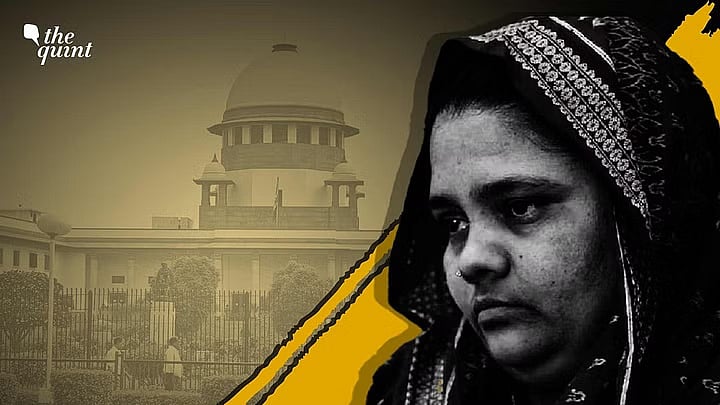
Bilkis Bano, a young mother, who was forced to knock on the doors of justice 25 years ago, is now a wisened woman. She has steadfastly fought on for justice all these years. Only to be forced to start anew.
(Yashaswini Basu is a Bangalore-based lawyer. She holds a law degree from SOAS, University of London. She tweets at @yashaswini_1010. This is an opinion piece and the views expressed are the author’s own. The Quint neither endorses nor is responsible for them.)
- Access to all paywalled content on site
- Ad-free experience across The Quint
- Early previews of our Special Projects
Published: undefined