
A Phone Call, a Song, a Meal: Remembering My Day With Asha Bhosle
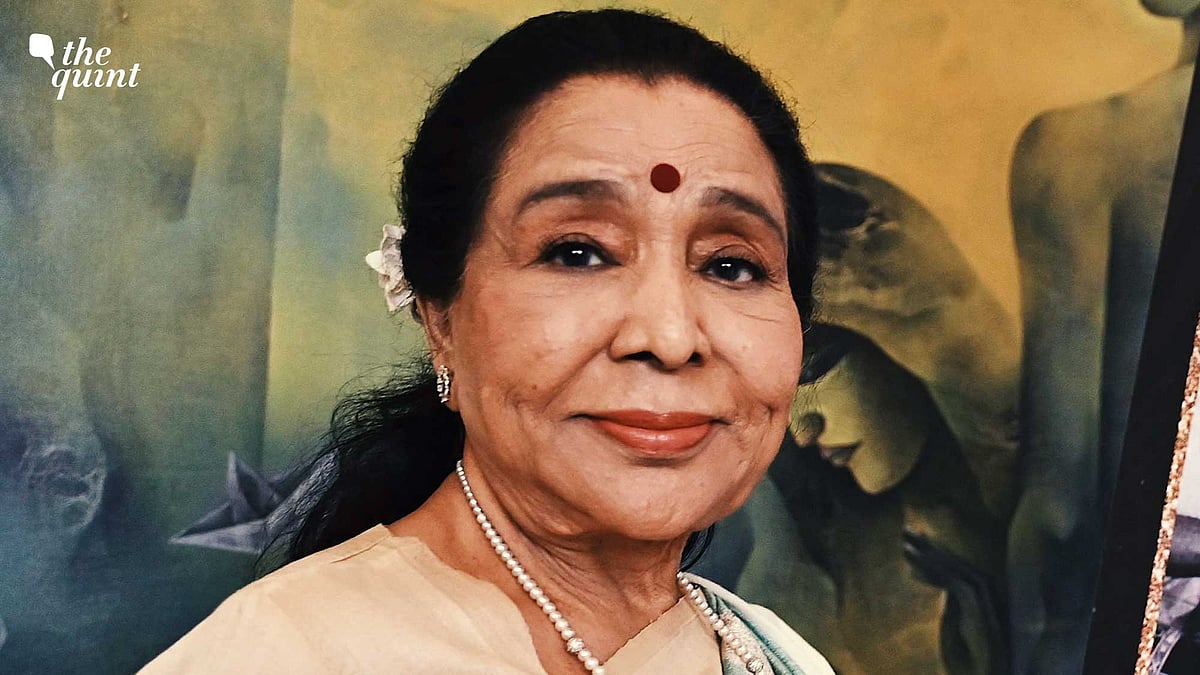
Asha Bhosle was not only a global icon, but also an exemplary homemaker who took delight in hosting her guests.
advertisement
If there was ever a remarkable personification of versatility and unyielding tenacity, it was undoubtedly Asha Bhosle.
When the Guinness Book of World Records crowned her as the artist with the highest number of recorded songs, it corrected a long-standing oversight. She was indeed the 'Queen of Female Singers' whose record of 12,000 songs was not just a number, but proof of her indomitable energy. Till her last, despite failing health, her singing notes brimmed with liveliness and a purity that was exemplary.
She may have been an iconic voice with spectacular attainments, but in my memory, she was a disarmingly humorous human being of limitless energy whose songs, along with Rafi Sahab, had been companions of my silent introspections, solemn evenings, and countless celebrations since childhood.
The year was 1998 when I got a chance to spend a memorable day with Ashaji.
A Phone Call to Remember
My encounter with Ashaji came in the context of the 1998 national elections. Doordarshan and the Election Commission of India had commissioned a series of short message films to educate the public about the importance of voting.
Since I had the privilege of writing and conceptualising these films for Times Television and Pritish Nandy Communications, I built the theme of “India 1998: The Choice” around the tagline: “Voting is not just our right, but also our duty.”
I must confess that working with renowned artists like Zakir Hussain, Pandit Jasraj, Kamal Haasan, sportsmen Michael Ferreira, and industrialist Kumarmangalam Birla were blessed moments of my creativity. Yet, in my heart, I longed for Ashaji to deliver one of the messages. I was a great fan of her singing and admired her chutzpah and guts.
But the officials at The Times of India, who were entrusted with coordinating the project, dismissed my insistence for her participation as impractical, even naïve. However, my persistence made them concede defeat as they arranged a telephonic conversation for me to apprise her of the content. And till date, her words echo in my ears as vivid and distinct as the moment when they were first uttered.
After acknowledging my greetings, she said, “Look, I do not work in ad films.” I immediately replied: “Ashaji, as a lifelong admirer, I request you to hear the script of the message film, and then decide whether or not you wish to convey the message to the masses.”
To fend me off politely, she even gave a few excuses like ill-health and lack of time.
Mind you this conversation was taking place around eight o’clock in the evening. Anyone familiar with Mumbai knows how overwhelming the fatigue can be at that hour. Yet, conversing with Ashaji filled me with a renewed sense of energy. For some inexplicable reason, I saw a ray of light amid the darkness. Choosing my words carefully, I spoke once more.
'Why Would I Sing Without Music?'
It seemed my words had touched her heart. After a brief silence, she asked: “Can you narrate the script right now?”
What followed remains etched in my memory with cinematic clarity.
Although unprepared for such an unexpected question, I began narrating the script that had been crafted with her personality in mind. However, she raised an objection immediately after I suggested that the film would begin with her humming the song, ‘Sare Jahan Se Achha Hindustan Hamara, Hum Bulbulein Hain Iski, Ye Gulsitan Hamara’, without a musical accompaniment.
She interjected: “Why would I sing without music?”
I explained: “Didi, my intention is to depict you as a successful and renowned Indian homemaker. Obviously, humming within a domestic setting never has music in the background.”
Pursuing further, I added:
My argument made a deep impression on her for she softly asked: “And what happens next?”
Encouraged, I unfolded the metaphor that lay at the heart of the film: the necessity of precision in rendering the musical notes in a Raga and the equally delicate responsibility of choosing the right representatives in a democracy. Just as a single misplaced note can distort an entire composition; likewise, a misguided choice can alter the course of governance.
There was silence after I finished my narration but, after a moment, she agreed not only to perform, but also host the shoot in her own home.
After the call ended, it was difficult to believe that I had not only conversed with Asha Bhosle, but had also secured her consent for my project. Those that may have seen that message film on television would recall that it ended with her crooning of the popular pop song of that era—“Iske Aage Aur Kya Kahein Hum? Janam, Samjha Karo” (What more can I say? My love, please understand).
A Homemaker at Her Finest
On the day of the shoot, she was so pleased with the results that she asked me to stay back for lunch with her.
Her family had prepared a non-vegetarian meal, but upon learning that I was a vegetarian, Ashaji personally cooked a vegetable dish for me. The amusing part was that she not only offered various pickles to me, but also ate them with great relish, and recounted how she had prepared them.
The interaction made me realise Asha Bhosle was not just a world-renowned vocalist, but also an exemplary homemaker who took delight in hosting her guests and hearing the praise of her culinary skills.
What struck me was not her fame, but her cheerful presence wherein her eyes carried stories, her smile carried mischief, and her demeanour carried the satisfaction of living a complete life.
Before I departed, she presented me with a priceless gift—a cassette titled Legacy, featuring the compositions of Tansen, rendered under the guidance of Ustad Ali Akbar Khan.
I have often reflected upon that encounter and her life that was marked by personal losses, relentless comparisons, and burdens of existing in the shadow of a celebrated sibling. That she forged a path uniquely her own by transforming limitations into opportunities speaks volumes of her mental strength. No wonder her voice traversed genres and generations, carrying within itself not just melodies but the essence of life’s struggles, joys, and resilience.
For me, despite her despicable comments about Rafi Sahab’s virtuosity, which I strongly condemned, she was the greatest female singer till date. Of course, like her sister, she too was high-handed in her professional domain, extracting her pound of flesh and settling scores without remorse. But then, who is not devoid of shortcomings?
She may not have been a universal favourite like Rafi Sahab, yet her spirit resides in me as a series of profound moments: a voice on the telephone that softened with understanding, a song rendered without accompaniment, a meal cooked with affection, and a quiet walk to a waiting taxi.
These are the enduring notes that compose my memory of Asha Bhosle and her melodies—Ragas that testify her as a woman of rare courage and excellence.
(Deepak Mahaan is a documentary filmmaker and an author. A specialist on Cinema and Sports, he has published numerous pieces in prestigious publications in India and abroad. He tweets at @mahaanmahan. This is an opinion piece and the views expressed above are the author’s own. The Quint neither endorses nor is responsible for the same.)
- Access to all paywalled content on site
- Ad-free experience across The Quint
- Early previews of our Special Projects
Published: undefined