
Beyond 'Belonging': How Old Slurs, Moral Policing and AI Target Sonia Gandhi
Before most people had even turned the first page, the internet had already written its own script.
advertisement
How to dismiss the achievements of women in public life: moral police them or discredit them.
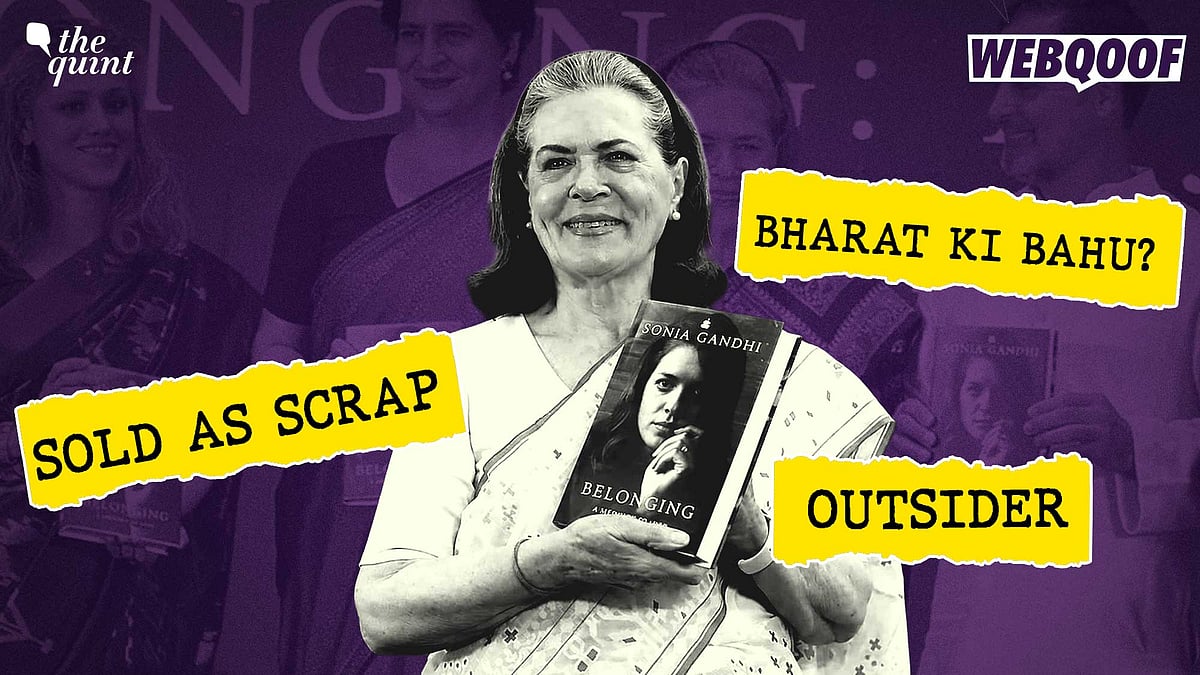
We have seen this familiar playbook used against former Congress president Sonia Gandhi time and again, including in a more recent coordinated attack after Sonia released her memoir, Belonging: A Journey of Love, on 16 November. Both Sonia and her family members spoke candidly about her decades in India, which led to false and misleading narratives targeted at her family.
Before most people had even turned the first page, the internet had already written its own script.
Within 48 hours of the release, timelines were flooded with an AI-generated video claiming her books were being sold as scrap by the kilo, along with a fresh storm of gendered harassment triggered by a personal family anecdote shared at the launch.
Let us dive into how this latest wave of misinformation and misogyny took shape, how it connects to nearly a decade of hoaxes targeting Sonia and how we debunked it.
The 'Lap' Remark and the Moral Policing Storm
At the 16 November 2026 launch, Congress leader Rahul Gandhi shared a personal childhood memory about how affectionate his parents were. He recalled that during family meals, Sonia Gandhi would often sit on Rajiv Gandhi's lap, adding that he assumed this was normal in every household until he visited his friends' homes.
It was a brief, domestic anecdote about a married couple. Online and on television, however, it quickly became a referendum on a woman's propriety.
Political opponents and television panels rushed to police the remark, with BJP spokespersons calling it "buffoonery" and arguing that public displays of affection were not in India's "DNA" or parampara. Some even feigned sympathy for Sonia’s supposed "embarrassment" in front of a nationwide audience.
On social media and YouTube, the backlash turned far uglier. Trolls and partisan roast channels weaponised the anecdote with lewd wordplay, sexualised mockery and gendered slurs, questioning her dignity as a wife and a public figure.
The remark also breathed new life into an old visual hoax. Between 13 and 19 November 2026, users on X and Facebook circulated a misleading photograph claiming to show Sonia seated on an elderly man's lap.
(Source: X/Screenshot)
A fact-check we did in 2020 (yes, she’s been targeted for a long time now) traced the image to an authentic 2005 AFP photograph taken during the visit of then-Maldivian President Maumoon Abdul Gayoom. Sonia was seated on a separate chair, not on anyone's lap.
(Source: The Quint)
The 'Scrap Book' Video and the AI Upgrade
While gendered harassment dominated the commentary, generative AI was deployed to manufacture proof of commercial failure.
Between 12 and 15 November, a viral video circulated across X, Facebook and Instagram purporting to show a second-hand bookseller in Mumbai's Fort area. In the clip, the vendor claimed Congress workers had dumped copies of Belonging at his stall by the kilo because nobody was buying them.
It was crafted to look like candid, street-level evidence of public rejection. There was just one problem.
On 18 November, Team WebQoof debunked the video as completely AI-generated. A closer look exposed the telltale giveaways: distorted text on the book covers, unnatural hand movements and an audio glitch where two different men spoke in the exact same voice. The clip had originally been uploaded on 12 November with an AI-generated tag, which was conveniently stripped away as it went viral.
In reality, HarperCollins India CEO Ananth Padmanabhan stated at the 16 November launch that more than 15,000 copies of the memoir were delivered within 10 minutes of its release.
This is not the first time generative AI has been weaponised against Sonia this year. On 25 October, WebQoof debunked an AI-altered image purporting to show her sitting across a table from Jeffrey Epstein, noting that the framing had been lifted from a photograph of Epstein with Union Minister Hardeep Singh Puri.
(Source: The Quint)
Recycled Misogyny and the 'Outsider' Playbook
Meanwhile, online book forums documented coordinated review bombing as early as 12 November, with commenters deploying baseless slurs like "bar dancer" and "KGB agent" instead of engaging with the book.
If you’ve been a longtime reader, you know this pattern is nothing new. While the tools have upgraded from crude Photoshop to generative AI, the underlying narratives remain strikingly familiar. We’ve compiled much of the misinformation against Sonia in our ‘Hall of Fake’ project. Here is just a glimpse of what our team has debunked over the years:
The 'Bar Dancer' Trope: On 16 June 2018, WebQoof debunked viral Facebook posts claiming to show Sonia in beachwear; the photos actually showed Swiss actor Ursula Andress on the sets of the James Bond film Dr No. On 9 December 2020, her 74th birthday, old photos of Andress and Marilyn Monroe were again circulated with sexist hashtags. As recently as 24 February 2026, a 1967 photograph of go-go dancers at a Sydney hotel was shared on Facebook with captions calling her an "Italian Rajmata" and a "Bar Dancer".
Fabricated Religious Plots: On 4 June 2021, WebQoof exposed a digitally altered screengrab from Sonia 27 October 2020 Bihar election address. Bad actors had edited a book titled "How to convert India into a Christian nation", a Bible and a statue of Jesus Christ onto her bookshelf. Earlier hoaxes also falsely claimed that Rajiv and Sonia Gandhi married according to Islamic rituals.
Political Manipulations: Past fact-checks have also countered edited posters placing her at Shiv Sena Bhavan and misleading claims that she chaired an official bilateral meeting ahead of then Prime Minister Manmohan Singh in Bangladesh.
The Bottom Line
What we are seeing around Belonging is a textbook case of how gendered disinformation evolves in India.
First, a woman in public life is targeted through moral policing, sexualised imagery and character assassination designed to question her respectability. Even an affectionate memory shared by her son is reframed as a breach of Indian tradition. Second, xenophobic tropes and fabricated religious plots are used to cast her as a permanent outsider. Finally, when real-world evidence does not support the narrative of public rejection, synthetic AI videos and coordinated review bombing step in to manufacture it.
That distinction matters.
You do not have to agree with Sonia Gandhi's politics or admire her memoir to recognise that an AI-generated street video is not journalism, and a cropped 2005 photograph is not a scandal. When manufactured outrage and sexist tropes dominate the timeline, they drown out genuine political debate and normalise online harassment against women in public life.
Before You Share the Next Viral Claim, Pause and Ask Three Questions
Does it look too convenient to be true? AI-generated videos often mimic real-world situations and behaviours. Look closely at text on objects, hand movements and whether voices sound unnaturally uniform.
Have I seen this before? Gendered disinformation relies heavily on recycling old, out-of-context photographs whenever a woman in public life makes headlines. A quick reverse image search can expose a 20-year-old photo in seconds.
What is the primary source? Check whether credible news organisations or official publishers are reporting the same claim. If it only exists as a viral clip with an outraged caption, treat it with scepticism.
Remember, repetition is not verification, and virality is not evidence.
- Access to all paywalled content on site
- Ad-free experience across The Quint
- Early previews of our Special Projects
Published: undefined