
Change at the Cost of Secularism? Bengal Voters on BJP Wave, Anti-TMC Mood
Voters punished TMC over corruption, but the results also reveal a sharp rise in polarisation, writes Rakhi Bose.
advertisement
As lakhs tuned in to news channels to watch the West Bengal Assembly results, many felt an uncanny sense of déjà vu. It reminded them of the moment 15 years ago when they had watched the Mamata Banerjee-led Trinamool Congress (TMC) decimate 34 years of Left rule.
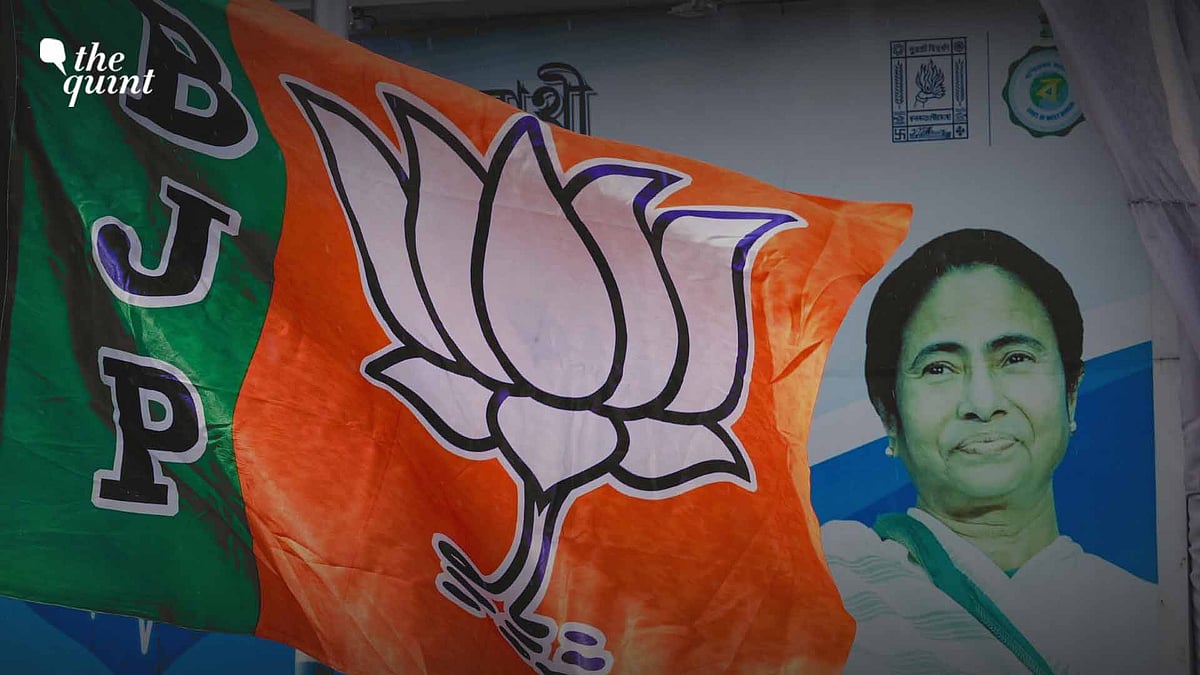
This year, it was Mamata who wore the loser's cap. And the Bharatiya Janata Party (BJP), demolishing 15 years of TMC rule and reducing the party to double digits, emerged as the victor.
For Tarit Sarkar, a 63-year-old Left voter, this historic upset brought a sense of poetic justice.
Recalling the day the TMC won its first state election, he tells The Quint, "Mamata had won on the back of her 'paribartan' wave. Now, the BJP has won on the same plank of 'change'. Back then, critics had lamented the loss of Bengal's identity as we knew it then. They said the masses had voted for populism, and not ideology. This time too, the voters seem to have chosen opportunity over ideology or identity."
Howrah resident Sarkar, however, adds, "Many will once again blame the inadequacy of the Left for the BJP win. But, on ground, people had really been frustrated with the TMC after three terms. The leadership had become unaccountable to its voters. The Left could not have pulled off regime change."
Mamata vs the System
That a "regime change" had succeeded in Bengal became clear before the sun set on 4 May. As if on cue, outside the Shekhawat Memorial School on Kolkata's Shakespeare Sarani street, the BJP supporters played the party's anthems to the accompaniment of DJ beats.
"[TMC MP] Abhishek Banerjee had promised DJ music on 4 May while declaring a TMC victory in this very spot. Now we are the ones playing the DJ," Shantanu Som, a BJP supporter clad in saffron scarf and cap, tells The Quint.
Soon after, the elections in the Bhabanipur Assembly seat are called in favour of TMC turncoat Suvendu Adhikari, who won with over 15,000 votes, against Mamata. Adhikari, who ran a highly communally polarised campaign till the very last day of polling, thanked "consolidation of Hindu votes" for his victory even as the TMC alleged that the results had been "manipulated". Responding to a clutch of reporters in Bhabanipur, Mamata called the results an "immoral victory"—and the elections "rigged", alleging the BJP "looted" 100 seats.
"The BJP was focused on Bengal from the very start, with a strong campaign driven by large sums of money. It also had the aid of institutions like the Election Commision and the Enforcement Directorate helping with the SIR [special intensive revision] of electoral rolls and timely arrests and intimidation of Opposition leaders and their associates," academic Maidul Islam claims.
Former TMC Rajya Sabha MP Jawhar Sircar agrees with Islam. "The SIR was devised by atrociously expensive legal sharks, and corporate-financed and executed by a biased chief of the Election Commission ever. It was a ruthless gameplan that excluded lakhs of genuine voters..."
In a TV news interview, former Aam Aadmi Party leader Ashutosh remarked that the election was not 'Didi vs Modi' but 'Mamata vs the System'.
But, even as doubts linger over the Supreme Court blocking 27 lakh voters, political analyst Zaad Mahmood notes that the results also reflect deep anti-incumbency, even in rural areas, and polarisation particularly on the basis of Hindu consolidation of votes.
Sircar opines that the BJP landslide was basically a vote against the TMC's "incorrigible corruption and dadagiri", adding, "Tragically, the Bengali middle class has voted for the BJP despite many not believing in its saffron politics to teach the TMC a lesson."
However, insiders with an ear to the ground claim that while Mamata was crying foul over election manipulation, the realities were more complex.
"There wasn't just support for the BJP outside but also within the TMC... What the BJP did was sort of purchase the lower and middle rung of TMC cadres," a journalist, who's also a CPI(M) booth-level worker, alleges to The Quint.
'SIR Deletions Have Definitely Had Impact'
Anindya (name withheld upon request), an artist and entrepreneur from Kolkata, is happy about the "regime change".
"West Bengal's economy has reached its nadir," he tells The Quint, as he accuses the TMC of running a parallel economy with 'Syndicate Raj'.
"No non-performing government should be given a free run for 34 or 15 years. The metro projects have not been completed for ages, just to prevent the Central government from taking credit on the eve of the election. And there are bribes and a 'cut money' culture everywhere. That's why the BJP should be given a chance," Anindya adds.
However, analysts repeatedly remind of the SIR and its impact on the poll results.
"In rural seats, for instance, the SIR shifted things—and urban areas were already deeply anti-TMC. The Muslim vote was not consolidated, which benefited the BJP since the Hindu vote seemingly was in favour of the BJP," Mahmood notes.
Sabir Ahmed, who led the team of researchers analysing SIR data at Kolkata's SABAR Institute, further explains this.
(Source: SABAR)
"Combined with deletions, Muslim voters represent 49.45 percent of all disputed entries—nearly half, from a one-fifth population base. Let's assume that all the Muslims vote for Mamata. Removing all Muslim 'under adjudication' and deleted voters from the rolls dramatically shrinks the TMC's lead, and a small CPI(M)-to-BJP shift is then enough to hand the seat to the BJP," he explains.
(Photo: SABAR)
While the exact numbers are yet to be known, analysts also believe that a split in Muslim votes dented the TMC's performance as well in some seats. While it performed well (though less than 2021) in the Muslim-dominated Murshidabad belt, for instance, a split in Muslim votes in favour of the ISF, the CPI(M), and the Congress left a negative imprint on the TMC.
'Naya' Bengal
A BJP watcher credits three persons for the party's landslide win: "Suvendu Adhikari, who was the architect of the polarisation plank; Shamik Bhattacharya, who appealed to the more 'moderate', urban 'bhadralok' Bengali; and Dilip Ghosh, who was brought back by the party as its Kharagpur Sadar candidate after being visibly sidelined following 2019."
While Bhattacharya appealed to logic, Adhikari's polarisation plank helped solidify the growing imprint of Hindutva and Islamophobic rhetoric in Bengal. Journalist Arka Deb explains,
Voters are aware, of course, of the BJP's promises which go beyond employment and development. The BJP, in its manifesto, has promised to implement the Uniform Civil Code (UCC) in West Bengal within six months. It has also promised a strict "Detect, Delete, and Deport" strategy to counter illegal immigrants, including sealing the Bengal-Bangladesh border.
So, for many, the impact of "regime change" goes beyond mere political optics—and may even become a matter of survival. Murshidabad resident and activist Asif Farooq tells The Quint that among Muslims in the migrant belts, many of whom felt as much anti-incumbency against the TMC as others but were perhaps left with little choice, the results have come as a shocker.
"The border demography discourse was central to the BJP's campaign. Now with the SIR targeting Muslims in these parts and the BJP's landslide, many of the minority population here in Murshidabad are concerned, especially those whose names were deleted," Farooq says over the phone from Murshidabad.
While many on social media and in drawing-room conversations mourned the loss of a "secular" Bengal, questioning the "communal" shift toward the BJP among the masses in wake of the poll results, academic and caste researcher Sumit Samos notes that the result in Bengal as well as the DMK-upset in Tamil Nadu are proof that regional exceptionalism and political legacies are never static nor are they immune to erosion and external challenges.
Mediating on how the BJP managed to break through to the 'secular bhadrolok' identity of Bengal, Samos, who has lived in both Tamil Nadu and Medinipur of Bengal, tells The Quint:
Writings on the Wall
In Kolkata's Rashbehari Avenue, where the BJP won, TMC supporters like Shantanu (full name withheld) have been in a bit of a pickle with the "unexpected results". The neighbourhood Shantanu lives in has been ringing loud with shrieks of 'Jai Shri Ram'.
"Till yesterday, they wouldn't have dared. Now, they're running free," the TMC supporter grumbles, pointing at a group of "rowdies" with saffron flags whizzing away in the distance on motorbikes.
With Bengal's (as well as the TMC's) history of post-poll violence, Shantanu is anticipating a tense few days ahead. When asked what the TMC cadres' instructions were for further action, Shantanu shrugs, "We have not got any word yet."
The worker looked at a nearby poster of Mamata and the "joda phool" (twin flowes) that had defined much of his life in the past decade. He may not be sure what his future held now, but he was certain that poster would be gone by the morning.
"Mamata took away governance from Writers' Building to Nabanna, calling it decolonisation. Now, the BJP will abandon Nabanna and move back to Writers' Building. If it does, I am sure they will first paint it saffron," he jokes, adding, "It is a rather twisted turn of fate."
- Access to all paywalled content on site
- Ad-free experience across The Quint
- Early previews of our Special Projects
Published: undefined