
In Suvendu Adhikari's Nandigram, 95.5% Deleted Voters Are Muslims, Says Report
Sabar Institute's study reveals most voter deletions are Muslims despite them being only 25% of the electorate.
advertisement
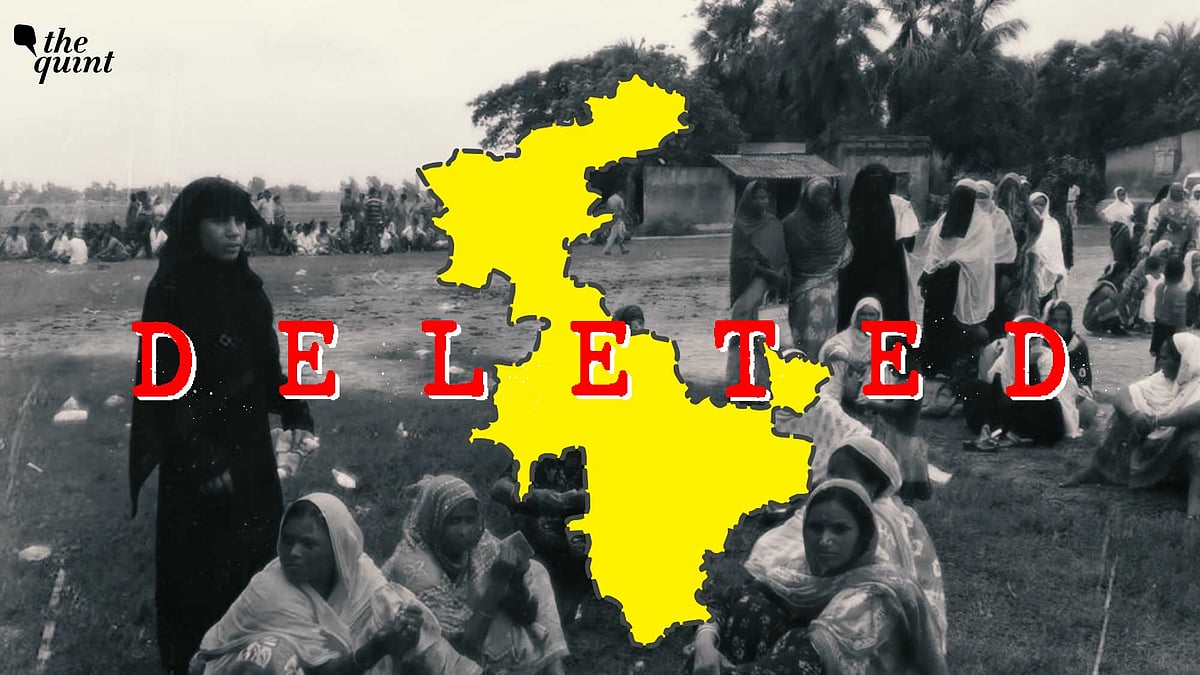
Muslims accounted for around 95% of the deletions in West Bengal's Nandigram in seven supplementary lists released by the Election Commission as part of the special intensive revision of electoral rolls in the state, as per an analysis done by a Kolkata-based research organisation, Sabar Institute.
Lakhs of voters are left in a limbo ahead of West Bengal elections to be held from 23 to 29 April 2026. On 5 April, Sabar released this study which highlighted a significant imbalance in voter deletions in a seat won by BJP's Suvendu Adhikari in 2021.
The electoral rolls for constituencies voting in the first phase of the 2026 West Bengal Legislative Assembly election were frozen at midnight on April 6. This has left many of those deleted in a confusion state as at present, stripping them off their right to vote in the upcoming election without any recourse or time for the same.
“Around 45% of the six million voters placed under a controversial logical discrepancy category are likely to be deleted after adjudication,” West Bengal chief electoral officer Manoj Kumar Agarwal told Hindustan Times on Monday. This amounts to roughly 2.7 million names being deleted after adjudication.
The Election Commission officially released the first post-SIR supplementary list on 23 March. However, accessing the data proved to be difficult due to CAPTCHA’s, download limits, poorly structured files, and watermarked PDFs.
Sabar Institute published data accompanied with illustrations to expose the gravity of the situation in Nandigram.
Disproportionate deletion of Muslim population
Information provided publicly by Sabar Institute
'Political Agenda To Purge Muslim Names'
The figures are based on the ECV voter roll data from the following supplementary lists: 1,2,3,4a, 7, 8 and 9. In six of these lists, the overall share of Muslim deletions ranges from 60.9% to a staggering 98.7%. The only exception is list 4a, where only 1 woman was removed who identified as a non-Muslim; hence, no Muslim deletions were recorded in 4a. The deletions in these lists include a total of 1,443 men and 1,383 women.
“This analysis suggests the SIR process was conducted with a political agenda — to purge Muslim names to secure electoral advantage for one party. The deleted voters are unlikely to be able to vote this time, as the appeals process will take time,” Sabir Ahamed of the Sabar Institute told The Telegraph.
This concern is aggravated by the fact that the special tribunals mandated by the Supreme Court to hear these appeals have yet to become fully functional, even though the first phase of polling on 23 April is less than a month away.
Till now, the Appellate Tribunal set up in Kolkata, to hear applications of those deleted from the voter lists, has restored only one name: Motab Shaikh, the Congress candidate for the upcoming Assembly elections, as reported by The Indian Express.
Systemic Bias and the Appellate Deadlock
The Quint has also recently reported Murshidabad and Malda — home to some of the highest Muslim populations in the state — account for the largest number of deletions, with Murshidabad alone contributing 4.55 lakh, the highest in West Bengal, and Malda following closely with 2.39 lakh.
Sabar also showed how data from a separate December 2025 dataset based on the Election Commission’s ASDD (Absent, Shifted, Deceased and Duplicate) criteria shows Muslims accounting for 33.3% of voter deletions and non-Muslims 66.7%. While it is true that non-Muslims constitute the majority of removals overall, the figures still represent a disproportionate share for Muslims, who make up about 25–26% of the electorate.
Differing religious composition across the ASDD list
Information provided publicly by Sabar Institute
Nandigram was the most high-profile contest in the last election round, which took place in 2021, between Mamata Banerjee and Suvendu Adhikari.
The BJP leader led a campaign which heavily relied on religious polarisation. Suvendu won by a tight margin of 1,900 votes. Adhikari is now seeking to retain his seat, while the Trinamool Congress has fielded Pabitra Kar, a former BJP leader, in a bid to reclaim the CM’s position.
Given the narrow margin of Adhikari’s victory in the last elections, any irregularities in the voter list could carry significant political implications.
The Sabar Institute’s study further identifies three categories where patterns of exclusion appear: “unmapped” voters, “logical discrepancy” cases, and micro-minority groups.
Unmapped voters are defined as those whose records were not linked with the 2002 electoral roll, which was used as a reference point; this category appears to largely affect marginalised Hindu communities such as the Scheduled Caste and Matua groups.
The “logical discrepancy” cases were flagged for issues such as spelling mismatches or unusual permanent address entries. In several constituencies, the report finds that Muslim-identifiable names appear repetitively, as compared to the rest of the population.
For instance, in Ballygunge, where Muslims account for almost half the population, about 77.5 % of them have been labelled under “logical discrepancies.” In Bhawanipur, Muslims, who form around 20% of residents, also comprise 51.8% of the discrepancy list.
There is only uncertainty for now. Voters are left in a predicament due to the unclear schedule for appeals, and more importantly, it is these voters will be unable to cast their votes this time, it will also remain to be seen whether they will be incorporated into the voter rolls in the future.
- Access to all paywalled content on site
- Ad-free experience across The Quint
- Early previews of our Special Projects
Published: undefined