'The Secular Consensus is a Trap for Indian Muslims': Sharjeel Imam Interview
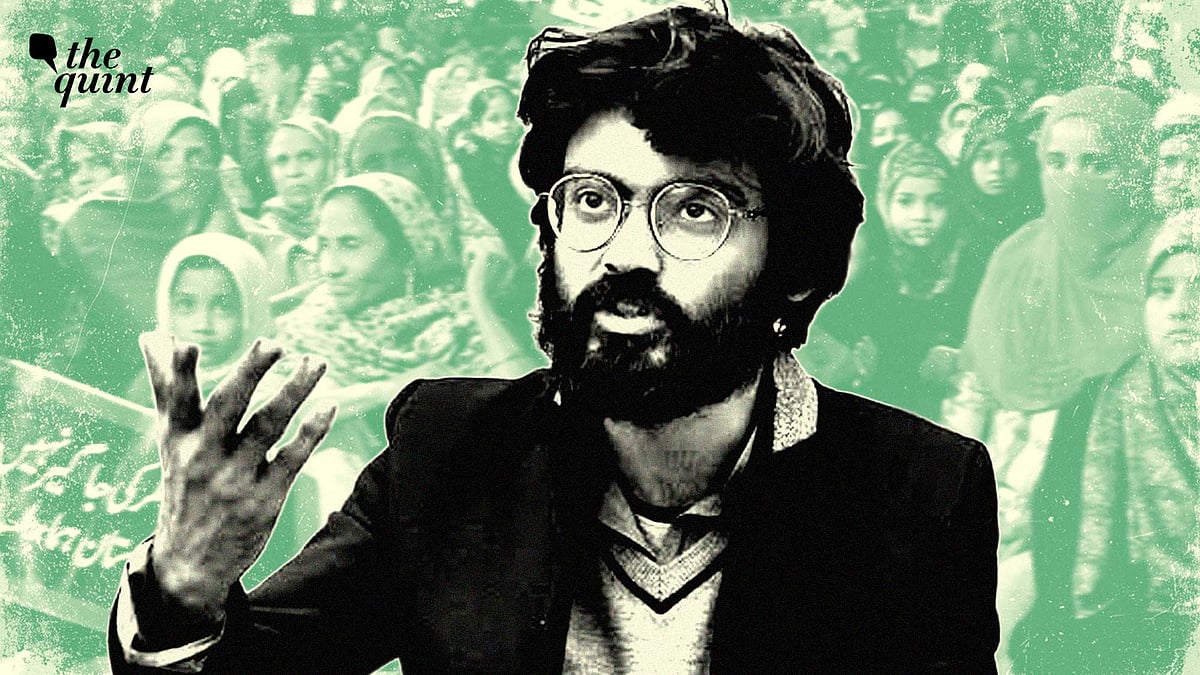
In a detailed interview, Sharjeel Imam discusses jail, faith, politics, Shaheen Bagh and future of Indian Muslims.
advertisement
(We are able to provide a platform to political prisoners like Sharjeel Imam and Umar Khalid because of our editorial independence. Become a member and support our work).
This is Sharjeel Imam's interview with journalist Athique Haneef. As per Sharjeel's request, the interview has not been edited except for para breaks for the sake of readability.
In your prison writings, you mentioned modifying Gramsci’s famous quote to say “I am a pessimist because of my intelligence and an optimist because of my faith”. You argue that for a political prisoner (Muslim) “will” is meaningless without faith in God’s grand plan. How does faith practically sustain you against the psychological toll of spending over 5 years in jail without trial?
“For, without doubt, in the remembrance of God do hearts find satisfaction.” Qur’an (13:28)
The only way to find true solace is by having faith in God, and his plan for me — while we strive for righteousness, speak truth and be patient.
“By Time, verily Man is in loss, Except such as have faith, And do righteous deeds, and (join together) in mutual teaching of Truth and of Patience and Constancy.” Qur’an (103).
Our plans, our timeframe is too insignificant in the context of human history and God’s plans.
"nahi begaanagi achhi rafeeq-e-raah-e-manzil se,
theher jaa ai Sharar, hum bhi to aakhir milne waale hain" (Iqbal)
Our stay here is temporary; dunya is a temporary abode for us, it is a site of resistance and enlightenment, of patience and steadfastness; peace comes through this belief and acting on this belief. — Sa’adat of both dunya and aakhirat are dependent on it.
Besides, although I am more of a sinner than most of my oppressed brothers and sisters, I know that I am not in prison for doing something wrong — and hence I have no regrets regarding the fact; in fact I take pride in the fact that I am among those chosen by the fascists to be incarcerated.
Further, I am able to read and write, and I have read a lot in prison in the last 7 years — that keeps me productive and gives me the opportunity to develop my skill set and widen my horizons, and contribute to the ongoing struggle.
In practical terms, its the small community of Muslim political prisoners, which is present in every jail, who play a crucial role in sustaining each others sanity. The mosque plays a central role in giving solace as well as company. We learn from each other, read the Qur’an, discuss tafsir, history, politics; joke with each other, and in the process refine our ideas.
I’ll end with a quote from Rabindranath Tagore, a man of faith, a monotheist and a great thinker:
“One who plants trees knowing that he will never sit in their shade has started to understand the meaning of life.”
In an interview after his release from prison, Professor Hany Babu has spoken about how he found God in prison and how the thought of incarceration shouldn’t intimidate an activist and stop them from questioning power. How do you think someone, especially a Muslim, a Dalit or an Adivasi overcomes the fear of prison when fear itself is used by the State as a tool of oppression?
I will start by referring to a recent letter by a fellow traveller, which mentions Mick Napier (a socialist leader of Palestine Solidarity Campaign; an anti-Zionist who has endured repeated imprisonment for his work). When asked what it would take for people to move beyond fear, “he responded that it differs from one individual to another, but that people must, in some way, “be blown out of fear by something larger than themselves.”
There are many levels of “something larger than themselves” — from your family, to community to humanity, but ultimately its faith in God and also the realisation of the incomprehensible and terrifying reality of existence — which blows us out of all kinds of fear.
In my understanding, there are three broad categories of fear:
1) Fear of pain — especially physical — like violence, incarceration, deprivation — one can overcome this fear by getting used to it; as I wrote in last answer, fear of incarceration is overrated, especially if we are fighting for our rights.
2) Fear of loss — of family, community, status, wealth, time etc. Here, one might overcome the fear by associating oneself with the larger cause, with the benefit that it might bring to the victims, the oppressed — fear is often overcome by seeing it as a bargain.
3) Fear of the unknown (and that includes death) — here neither getting used to can work, neither can it be seen as a bargain because the end product is not known. And what if the whole of humankind is oppressing me; what if maintaining my integrity seems pointless? What if there is nothing else, nothing but my individual and concepts of justice, truth and integrity at stake? What if remaining steadfast will not lead to a visible material or even moral victory in my lifetime, what if there is no community to celebrate my patience and defiance because no one is aware of it? Or because they don’t understand it as such? Recall the predicament of Prophet Yusuf (a.s.) in the Qur’anic story, when he tells the wife of his master:
“Truly to no good come those who do wrong” (Qur’an, 12:23)
It is only through faith in God and righteous deeds, and patience that fear of the unknown can be overcome. With belief in the sacred order of universe, in a state of being awed by the incomprehensible, together with moral clarity, and the realisation that we are mere drops in an unknowable, unmeasurable ocean and our material fears in the context of God’s plans are childish.
“Verily, those who say, ‘Our Lord is God,’ and remain firm (on that path) — On them shall be no fear, nor shall they grieve.” (Qur’an, 46:13)
Iqbal, while discussing fear wrote:
“It is fear to which man is a victim owing to his ignorance of the nature of his environment, and want of absolute faith in God. The highest stage of man’s ethical progress is reached when he becomes absolutely free from fear and grief. The central proposition which regulates the structure of Islam then is that there is fear in nature, and the object of Islam is to free man from fear. This view of universe indicates also the Islamic view of the metaphysical nature of man. If fear is the force which dominates man, and counteracts his ethical progress, man must be regarded as a unit of force, an energy, a germ of infinite power, the gradual unfoldment of which must be the object of all human activity.” (Islam as a moral and political ideal, 1909)
In short, it is only through faith in God and a belief that death is merely a passage to a different plane, and acting on that faith, that truly liberates us from fear; and also makes, many a times, the current tribulations easy on us — recall God’s command to fire when Prophet Abraham (a.s.) is thrown in it:
“We said: ‘O Fire! Be thou cool, and safety for Abraham.’“ (Qur’an 21:69)
Also recall Iqbal’s beautiful sher about the attitude of Prophet Abraham when he jumped into the fire:
"be-khatar kood pada aatish-e-namrood mein ishq,
aql hai mahv-e-tamaasha-e-lab-e-baam abhi."
The letter by the fellow traveller also reminded me of another Qur’anic verse relevant to our discussion:
“God’s object also is to purge those that are true in faith and to deprive of blessing those that resist Faith” (Qur’an 3:141)
and the letter added: “for while the purification of believers and the forsaking of heart’s frivolous attachments are themselves part of the Divine order of justice, liberation comes from Him and Him alone.”
In conclusion; overcoming fear, especially of state oppression which might take all the forms mentioned above, is only possible through faith, faith in the fact that truth, justice, equality are transcendental values; that life is sacred and not merely a local comprehensible phenomenon, and that each of our sacrifices, however hidden, and obscured by state power, do have a bearing not only on human history but also beyond that. I draw your attention, all Muslims, Dalits and Adivasis and other oppressed individuals, to sincerely look at the steadfastness and incomprehensible faith of the people of Gaza, and Palestine in general — in the face of a genocide by a racist settler colonial state of unmatched might. The Zionists have not been able to subdue the Palestinians, even with a genocide — and faith is the most important weapon in the hands of those resisting. That should be enough to “blow us out” of fear.
You have credited thinkers like Muhammad Iqbal, Jamaluddin Afghani and Ali Shariati rather than Marx or Darwin for shaping your understanding of capitalism, evolution and politics. You noted that Iqbal helped you synthesise post-Newtonian science with questions of faith. How has this specific intellectual lineage of Islamic modernism equipped you to critique the Indian State in a way that traditional Marxist or secular framework fall short?
There are two aspects of this intellectual lineage which are relevant:
(a) First the general ideas that define Islamic modernism — a return to the Qur’an and tawatur reports of the Prophet; a rejection of superstition and false traditions which have crept in over centuries; a rejection of blind imitation (taqlid) of traditional religious authorities; critique of traditional division of knowledge between religious and secular; viewing science and history as “religious” knowledge; history as a struggle for liberation and emancipation from ‘shirk’; science as a spiritual exercise of knowing God through his creation; seeing ‘shirk’ as the primary source of oppression in human history — superstition, despotism, nationalism, materialism, casteism etc as branches of shirk; and “tawhid” as source of liberty, justice, equality and a just political order; allying with ‘people of the book’ and monotheistic communities, and monotheistic reformers as mandated by the Qur’an; the central significance of religion in individual’s and community’s life; radical decentralisation of religious and political authority; ensuring economic justice and welfare.
(b) Secondly, there was the more specific problem of South Asian Muslims who, although a minority here, comprised almost one-third of the Muslims of the world, and as such were the largest Muslim nation, and hence required specific constitutional arrangements to ensure their autonomy so that they could freely develop cultural, educational, religious and political institutions without interference. It is my understanding that debates on this issue for over two generations of South Asian Muslims also constitute an integral part of the Islamic Modernist discourse.
While Jamaluddin Afghani, Sheikh Abduh, Rashid Rida, Allama Iqbal, Akbar Illahabadi, Ali Shariati, Abdullah Yusuf Ali among others are the major intellectual figures in the evolution of Islamic modernist thought, the second problem specific to South Asian Muslims was handled by Allama Iqbal, especially in the last two decades of his life — in his extensive writings as well as a prominent Muslim League politician.
Hence, the ideas presented by Allama are of central importance to my understanding, besides my own research on Muslim history especially violence against Muslims in the colonial and post colonial era (M.Phil as well as PhD). (I have, in the end, added more than 50 quotes from Iqbal to substantiate my observations.)
Let’s start with the limitation of the existing frameworks:
(1) The Secular framework — it is actually a branch of the overarching nationalist framework, which the Hindutva framework is also a part of. The difference between the Secular and Hindutva framework from the perspective of Muslims, Christians, Dravidians, Tribals, and even Dalits and other marginalised sections is merely of details, the core is the same — the myth of the existence of an ancient Indian nation, which had an ancient overarching unity, even as foreign elements and invaders came and were absorbed in this “uniquely tolerant” civilisation. Nehru’s ‘Discovery of India’ is a very good example of an exercise in this falsehood and mythmaking (See Perry Anderson’s ‘Indian Ideology’ ). Contrast it with Maulana Azad’s thesis that the idea and unity of India were results of just last few centuries; or Iqbal and Jinnah who outrightly rejected this myth of Indian nation — according to them the subcontinent had not yet become a nation, and Muslims of India were the only group which could be called “a nation in the modern sense” and India could become a nation if the various communities came to a respectable and just agreement.
The Secular framework: considers us all ‘Indians’ by default, the end product of all education and political development is to feel that we are only ‘Indian’ and everything else is secondary. Here, invoking any other identity for rights is regressive, or at least unnecessary, we are all already one, all brothers. Needless to say, it is a completely ahistoric vision, devoid of reality and designed specifically to oppress minorities and other marginalised groups. If religious minorities or tribals ask for autonomy or land-rights for their communities, they are being ‘communal’ and ‘divisive’.
The real history of the communities — religious, social and political — are incidental to the imagined history of this ancient Indian nation. From this starting point, the Secular ideologues, like the Hindutva ideologues, argued for a unitary state, a centralising state — so that the rights of minorities and oppressed communities could be denied; and the handful of upper caste elites could rule South Asia in the name of the majority community through what Iqbal called a “Communal Oligarchy”. The next cardinal truth for this framework is that partition was the result of Muslim League’s divisive agenda — while the actual truth is that the Brahminical forces in Congress, along with capitalist cliques wanted a centralised India to exploit the resources with impunity, and hence rejected Muslim League’s demand for decentralisation and partitioned the country, so that they could rule over tribals, dalits and other minorities in the remaining landmass; while at the same time putting the blame on Muslims.
Another cardinal truth for them is that the Constitution is noble, so noble that no one should complain, while the truth is that it has enshrined centralisation, denied Muslim representation (by mandating only territorial constituencies with joint electorates), and prohibited Muslim and Christian reservation in branches of states (even purely Muslim backward caste categories are often deemed unconstitutional). The Secular framework is devoid of any real understanding of history and is particularly Islamophobic and parochial.
In short, both Secular and Hindutva frameworks share the same core ideas — myth of uniformity, centralisation and denial of sharing of power.
On the other hand, the Marxists are not parochial in general and some of them did support and still support the Muslim League’s demands for constitutional guarantees and a say in governance. But the larger issue with them is their disavowal of religion as a positive force among Muslims, their reduction of religion as a part of an oppressive superstructure, their rejection of every invocation of religion as petty-bourgeois illusion, or elite manipulation, or grand imperial plans, or identity politics — all of them amounting to denial of agency to Muslims as Muslims. It leads to a skewed understanding of the history of partition as well as the post-partition Indian state.
I have already written on some of the ideas discussed below in articles such as 1) On Tawhid, (Milestone, 23-6-2024); 2) ‘On Islamic Modernism’ (Polis Project, 30-6-2025); 3) ‘Prison Notes’ (Maktoob media, 03-12-2024).
Also see where my writings on these issues have been extensively quoted:
I will add a few new observations here:
First of all it has to be noted that the seismic event which shaped post-colonial states in South Asia is not decolonisation but Partition — all the more for South Asian Muslims who were divided into three almost equal parts. Any analysis of the post-colonial state has to excavate the history of pre-partition political assertion of Muslims and the reaction of Brahminical and majoritarian Congress to it. To understand the predicament of Muslim masses and emerging middle class, a lot more research is needed but the broad outlines are clear from the existing research: a minority with no stake in governance, subjected to increasing violence by revivalist and racist forces in the majority community since before partition. However, it should also be noted that during the same period, post-1857, especially with Aligarh movement under Syed Ahmad Khan, the Muslims took to Western education and even though they lagged behind the Hindus, by the turn of the century there developed an educated middle class, attempting to reform religion and inculcate scientific temperament — to the extent that Rashid Rida (of Syria) (the chief disciple of Sheikh Abduh), himself commented in 1898 that unlike the Arab lands, “Indian Muslims adjusted to the new scientific conditions of the day by utilizing British India’s booming public sphere for promoting educational reform that emphasized the combination of Islamic and Modern Science… Indian Subcontinent had become a centre of Islamic reform.” In 1900 he said, “the [Muslims in Egypt and Ottoman Empire] are much less scientifically and religiously developed than Indian Muslims and Sayyid Ahmad was the source of Indian Muslim’s religious revival.” [Ref: “The Revival of Muslims of India”, 1898, Al-Manar, by Rashid Rida, as quoted in ‘Islamic Modernism between Colonialism and Orientalism’ by Ray Bor Salden]
I quoted this at length because it is a significant comment by an intellectual giant of Islamic modernism; and also because Indian Muslims comprised around one-third of the Muslim world. Hence, the development of the reformist and modernist Islamic discourse here was not merely an “Indian” phenomenon, as nationalists would have us believe, but was actually central to the global development in the Islamic discourses. Whatever the exact nature and scale of the contributions of MAO (i.e. Aligarh College) and later AMU to these discourses, it can not be denied that by the turn of the century, a host of Muslim thinkers of this type (reformist and rationalist) had emerged, best exemplified by Lisan-ul-Asr (i.e. Voice of the Age) Akbar Illahabadi. But the real representative of this trend, its culmination in many ways was Shaer-e-Mashriq (Poet of East) Allama Iqbal. This emerging educated Muslim middle class in British India became the backbone of the political movement, which challenged the hegemony of the majoritarian Congress; and also inspired and allied with other such movements — Periyar and Dravidian movement, Jaipal Munda of Tribal movement and often with Dr. Ambedkar himself.
The political dimension of this movement was personified by Jinnah — a professional lawyer from a Shia trading community, and the religious and ideological dimension by Allama Iqbal — a poet-philosopher-academic from a middle class Sunni family. The outline of the religious and political ideas involved have already been mentioned above — but the immediate political issue facing them was how to ensure a constitutional arrangement in which Muslims will have full autonomy to administer their affairs, carry out those reform programs etc without fear of violence and interference from the majority community? It is in this context that the invocation of word ‘nation’ for Muslims by Iqbal and then Jinnah can be understood. Two nations never meant two geographical nations in these discussions, but two religious nations dispersed across South Asia for which a delicate constitutional arrangement was needed. These might even be mere proto-nations, not nations yet, but the Muslims ought to receive guarantees of autonomy which will allow them to freely develop without interference from the majority and develop India in partnership with them, not under their domination. Iqbal talks of the ‘peculiar concept of nationality’ in Islam based on faith; and also that the Muslims of India are “far more homogeneous than any other people in India… and are the only people who can be described as a nation in the modern sense of the word.” But more importantly, as a religious minority, it was the fear of being dominated by the Congress and the majority in the name of “nation” that forced the Indian Muslims to come up with a coherent plan and a discourse to expose the fallacy of Congress’ argument. Jinnah’s use of the word ‘nation’ is a part of this larger development.
It is this political program — decentralisation, full provincial autonomy and a statutory Muslim share in Centre — which under the leadership of Jinnah received 80% of votes in 1946 — i.e. almost all of middle classes (check my Polis project article for detailed data of 1946 elections), even though a section of ulema aligned with Congress. The anti-Muslim violence, especially the attacks related to cow protection, also played a vital role in Muslim consolidation. The final result was Cabinet Mission Plan — a completely decentralised India divided in 3 zones, with Muslims having a say in the Centre — this was an anathema to the centralising Brahminical forces in Congress, Hindu Mahasabha and RSS — after all if Muslims became autonomous, what would stop the tribals from claiming that they had the first right to the minerals in their provinces under the principle of decentralisation? This was the red line — the capitalist class had already chalked out the Bombay Plan (1945) asking for a centralised state. In short, they rejected it outright — even Maulana Azad writes that it was Nehru who sabotaged it, and that Congress was responsible for partition. (See: India Wins Freedom.) Partition was forced on Muslims, as a unitary government was unacceptable to Muslims of Punjab and Bengal, and we, the masses on both sides, have been paying for it ever since, and are also being falsely blamed for it.
My point is that the genesis of the post-colonial Republic itself lies in the denial of legitimate democratic aspirations of Muslims and other marginalised communities. Hence it was evident that the state will have nothing to do with the Muslims left here, they might be given token representation, but they will not be made part of the system; there will be no statutory guarantees and they will be subjected to violence with impunity. The fact that Congress, RSS and Hindu Mahasabha — all of them opposed and still oppose decentralisation tells us a lot about the nature of Indian State. It’s not just anti-Muslim, but anti-Tribal, anti-Dalit — in fact it is just a small clique of elites extracted out of a handful of upper caste Hindus who have been running the nation, exploiting its resources and keeping the masses in poverty and superstition.
They are so much afraid of Islam and Christianity that according to a Presidential Order 1950, if Dalits convert to Islam or Christianity they lose their reserved status — a rule intended to discourage Dalits from converting to Islam and Christianity and also conveniently allowing the state to ignore the plight of Dalit Muslim and Christian communities. Beautiful words about “scientific temper” in the Constitution are accompanied by recommendation of cow protection! The character of higher judiciary as an upper caste Hindu elitist enclave with as few noble exceptions is well known. Their silence in the face of abuse of UAPA by BJP against Muslim and Dalit political groups and activists betrays their true character. A significant section of Marxist and Dalit historiography discuss these phenomena, but they often underestimate the uniquely Islamophobic nature of the Indian state and misunderstand the genesis of partition; and post-partition status of Muslims.
The collapse of Congress in 1990s gave some hope, as it led to rise of regional and decentralising forces across India (RJD, SP, DMK, JDU etc) which gave political agency to a larger number of communities including Muslims, but before permanent changes could be made to the system, the elites hit back, this time investing in a far more rabid and virulent organisation RSS and BJP which now acts as their vehicle of centralisation and crony capitalism, while misleading the masses with even more crass discourse of hatred and superstition.
Here the self-professed liberals and the Marxists are to be blamed as well — by vacating the sphere of religious discourse completely, or by playing along, they left this area for the quacks who have been wrecking havoc. Instead they should have, like Raja Ram Mohan Roy and Tagore played a role in promoting rational faith, clearing it out of superstitions. A parallel development can be found among Muslims as well — the leadership of the traditional ulema resisted reform, ignored scientific temper and inadvertently aided centralisation. Take Waqf for example: even after Partition they could have asked for a decentralised Waqf body elected by Muslims — from mosques to district to province to the nation — a robust system which would have survived this crisis. But why take the risk of elections when you could directly nominate yourself through the PMO? And now, you can’t stop the RSS from taking control.
Coming back to Iqbal, who foresaw all of this a hundred years ago — he died in 1937 — but reading his lectures, articles and letters, including his scathing critique of Gandhi, Nehru and the Congress makes one wonder — why has our historiography silenced Iqbal? Why have Muslims of India not discussed their most prodigal thinker in order to understand the nature of the Congress party and later the Indian State? His ideas and expressions are not merely musings of an armchair intellectual but the organic expression of a class of educated Muslims — a fact proved empirically by the tremendous support to Muslim League in 1946 — almost the whole of middle class in British India — it represents, if I may be bold enough to say — a near consensus, an ijma of the educated classes of Muslims in British India — and unlike the manufactured ijma of a handful of ulema of this or that sect, this ijma carried real weight — and still carries weight. It was the product of at least two generations of deliberations and negotiations — Lucknow Pact (1916), Nehru Report (1928), Cabinet Mission Plan (1946) are just some milestones (Jinnah was involved in all three) — and hence its all the more important for Muslims of India to analyse and learn from the political and religious debates which led to the negotiated settlement of 1946 (the Cabinet Mission). As the famous saying goes, “we don’t need to reinvent the wheel”. We have to start from where the reformist and democratic project was paused in 1947, learn from their reading of Congress, Hindu Mahasabha etc, and the attempt to form anti-Congress (now anti-RSS) alliance with Dalits, Tribals, Dravidians and other marginalised groups.
The leadership of the ulema, or at least overwhelming majority of them simply lack the skill set and motivation to take this discourse forward — busy as they are with sterile discussions on fiqh, and their obsolete theories, and projecting their passivity as “sabr”. It is once again the responsibility of the youth of the community — both from colleges and madrasas, professionals, aalims, lawyers, doctors, engineers, teachers, traders etc — the middle classes — to shake the community out of the post partition shock and trauma, which has induced an intellectual paralysis; to explain to the masses the real nature of the problem, to develop an emancipatory Islamic discourse for the improvement of the conditions of both Muslim and non Muslim masses, and to sacrifice themselves so that a better future can emerge.
(Attached are 56 quotes from Iqbal, selected by Sharjeel Imam)
Q4) You have fiercely critiqued the “Secular consensus” led by parties like Congress, calling it a “lie and a trap” that ignores the need for structural changes to prevent majoritarian tyranny. In today’s political scenario, where the idea of “Secularism” adopted by liberal elements, including the Congress is being projected by the Sangh parivar as “Muslim appeasement”, thereby projecting the idea as sympathetic to Muslims and pushing them to embrace it for survival in an increasingly hostile atmosphere, how do you think the community can free itself from shrinking into the space and critique the idea?
This is precisely why I called it a trap — it is projected as a solution; but in reality it traps us in the vicious cycle, reinforces the structural status quo, keeps us intellectually imprisoned and prevents us from exploring more meaningful strategies.
The first step is moral and intellectual clarity — let’s recap what has happened here — Congress rejected legitimate democratic and constitutional demands of Muslims in favor of centralisation, and forced partition and designed a structure which gave no statutory guarantees to Muslims. The history of the republic ever since has been of violence and political marginalisation of Muslims — with only some limited respite in some regions where Congress collapsed — Tamil Nadu, later in 90s in U.P. and Bihar — but the structure made by the Congress was so robust that this attempt by the backward castes and Muslims turned out to be temporary and no permanent changes vis-a-vis decentralisation or community rights could be made in the structure (except Mandal commission).
Within two decades, the successor of Congress i.e. BJP had become the dominant force — a force more centralising, more dangerous and anti-Muslim — it has laid bare the real nature of this structure and revealed to every Muslim, what had always been a fact that, this structure is designed to exclude the Muslims. Now, instead of exploring and developing new democratic discourse, having learned from this experience, having taken note of the fact that the collapse of Congress gave some political agency to Muslims in some parts of the nation, we are being asked to blindly go back to the violent oppressive era of pre-1990s — trying to find solace in the same oppressive structure.
A Congress-led government might bring temporary relief but it will not solve our problem, it will not change the anti-Muslim nature of the structure, and we will be trapped in this vicious BJP-Congress cycle — that cycle is our present status-quo. Our only solution is to develop our discourse on positive politics. Decentralisation, proportional representation, autonomous institutes, recognising Dalit Muslim and Christian, Muslim reservation (with share for backward castes), are the main demands of this positive politics. But how to get out of this trap?
There are around 250 million Muslims in India — almost the biggest Muslim group in world, with practically zero say in this democracy. There is a vacuum of political and intellectual leadership. A vacuum is disheartening, but it is also an invitation, an opportunity. But before embarking on any organised effort to fill this vacuum, we should understand that both Congress (and “seculars”) on the one hand, and RSS on the other want to fill this vacuum to their own satisfaction.
Let’s discuss Congress first. There are some problems that Congress shares with other secular parties vis-a-vis Muslims, and some unique to Congress. I will discuss some of them briefly.
First is the general problem of all these parties barring one or two parties at best (like DMK) is that they will always prefer a slavish Muslim vote bank, and discourage and oppose Muslim political assertion, and prefer that we vote uncritically for them out of fear of BJP. Second is regarding the discourse on structural change, here also these parties will be wary of Muslim specific changes but here Dravidian and Lohiaite forces will be more amenable than Congress — unlike Congress they at least support and bring about decentralisation to provincial level if they get powerful. Hence regional parties are more beneficial to Muslims in this respect. Third is the economic aspect, Congress ushered in neo-liberalisation — it doesn’t have a cogent discourse against it and only differs with BJP’s rampant crony-capitalism in details and intensity. It was the Communists and to a lesser extent Lohiaites who tempered the UPA govt.
Then we have two issues specific to Congress — first that it will prefer a two-party system and wish to finish off regional parties — a dangerous scenario for Muslims of India. It is a proven historical fact that regional parties have led to greater Muslim political agency — however short lived. Observe what Congress has been doing for the last few years in elections and with INDIA alliance, and you will understand what I am saying. These two parties (Congress and BJP) will not make strict laws against horse-trading, so that smaller parties can be wiped off. Then finally the most important issue — Congress is the original casteist, communal and oppressive force of this land — it has tremendous amount of baggage of all the problematic things — from causing partition, to opposing OBC reservation, to imposing emergency, to keeping masses uneducated, to massacres of Muslims and Dalits, to imposing President’s rule — the list is long. Supporting Congress uncritically automatically hands a weapon to BJP which can then mislead the Hindu masses by listing the real oppressions against them in the past — and the Muslims are projected as having been appeased, although we were the worst sufferers.
What is worse, we are then forced to defend our own oppressors, forced to defend the indefensible. Instead of forging a new progressive democratic discourse, we waste our time falsely defending Congress. In short, even if the Congress adopts our discourse on positive politics completely, it is still a problematic party till it disowns its dark past. Till then, its better for us Muslims to ally with Dravidian parties, Lohiaites and Communist among other regional and democratic forces while developing our discourse.
Now for Congress, an ideal Muslim will never question Congress’ past, will never doubt that Gandhi and Nehru had anything but noble intentions, will never question their official historiography and continue to be their intellectual slave. For many of these so-called “leaders”, there is no systemic issue vis-a-vis Muslims, no structural changes required, all that is needed is to bring Congress to power which will enforce our constitution. This is how Congress wants to fill this vacuum of 250 million Muslims.
Now let’s turn to RSS-BJP — they will not cultivate their own Muslim leaders for obvious reasons, but they also don’t want Congress to come to power, so they would pick someone from Muslims and allow them to operate to the benefit of RSS-BJP. This is how they will fill the vacuum. Who will they pick? The person or party they will pick will have certain core characteristics:
(1) They will say RSS, Congress, DMK, SP, RJD, CPI — all are equally harmful to Muslims (a claim which is blatantly false);
(2) They will have no discourse for structural change;
(3) They will use religious and emotional speeches to capture the imagination of the masses
(4) They will have no organisational capability;
(5) They will appear before elections and recklessly contest elections even where there is no chance of winning and there is every chance of helping the BJP.
(6) They will rarely take lead in street agitations.
RSS-BJP will want such parties to fill the vacuum. This category is even more dangerous because they pose as our liberators from this secular trap, but in reality they take us into a deeper hole. One of such so-called “leaders” can be heard saying that “it is not the responsibility of Muslims to defeat the BJP” — I condemn this statement, it is a highly irresponsible and dangerous statement. Defeating BJP and fascists is an essential part of our positive politics but not without forcing a conversation on our discourse on structural change — something which we can achieve by contesting from Muslim-majority seats for example — but more on this in next question. In short, it’s a delicate situation, we are stuck in a vicious cycle where our options seem to be either vote out of fear, or out of an emotional and irrational rejection of fear.
It is clear that BJP-RSS is far more dangerous than the Congress, but also that Congress is dangerous when compared to Dravidian parties (DMK etc), Communists (CPI(ML), CPI, CPM), Lohiaites (RJD, SP, JDU), Ambedkarites (BSP etc), other regional parties (eg. TMC) — wherever possible we have to ally with these parties over Congress — despite the greater chance of horse-trading in smaller parties — we need stricter laws against it. So, there are two dimensions — one is decentralisation which is beneficial not just for us but also for all marginalised sections and linguistic minorities; here we get support from and back these parties. Then the other aspect is of community rights — Muslim reservation, proportional representation, autonomous waqf bodies etc — here too issues such as election by proportional representation will help marginalised groups, and parties like BSP, RJD etc — in exchange we can seek their support on minority and Muslim specific issues.
In short, it is only through building a real emancipatory and democratic discourse — with decentralisation and community-based statutory safeguards at its core — and agitating and enriching that discourse to the benefit of all marginalised sections — a discourse based on moral and intellectual clarity that we can prevent our community from shrinking into this “secular” space.
Reflecting on your father’s political career in Bihar and the Constituent Assembly debates, you have argued that the FPTP system inherently marginalises Muslims and other minorities, advocating instead for proportional representation. Given that amending the Constitution to change the electoral system is a monumental task, what are the immediate practical steps you believe marginalised communities must take to build political power within current system?
First, let me address a few arguments given by the supporters of FPTP against PR. At the time of Constituent assembly debates, some people who preferred FPTP felt that PR system will lead to creation of parties dedicated to specific communities, which might entrench divisions and lead to what some called “communal majority”. This argument has not aged well. As Iqbal and Jinnah rightly foresaw, FPTP with no safeguards will lead to permanent marginalisation of Muslims who were, even before partition, the hated minority, the hated “other” of the emerging nationalist discourse. History has proved them right.
If, as some believed, FPTP forces coalition making, then it does so, however imperfectly, only for a large section of the majority community, but it is an unqualified curse for the Muslims, leading to what, from our perspective, is wholesale exclusion. We are already living under a permanent “communal majority”, or what Iqbal predicted would be a “Communal Oligarchy” — manufactured by consolidation of large parties under FPTP. A representative parliament under PR is much more preferable, which would encourage deal-making and negotiations. “No govt will be stable” — retorted another member of the assembly opposing PR — but stability doesn’t mean democracy and vice versa — the gulf monarchies are stable! Look at robust democracies — mixed system in Germany or federal arrangement in US — democracy is complicated, requires lengthy negotiations — that keeps the system robust. Mark my words — in the long run FPTP will lead to far more instability and chaos because it excludes the Muslims, prevents them from electing their leaders, and also snatches their democratic right by forcing them to vote for one side out of fear of the other, more anti-Muslim group — all developments foreseen by Iqbal and Jinnah. Another argument is presented to mislead the people that it might lead to decrease in representation of states with lower population growth — but that’s similar to the debate on delimitation today — solution is simple, keep the state share constant as they are today (eg. TN: 40/543), and divide those seats internally through vote share in the state, i.e. proportional representation.
Another argument is that members will not be tethered to any constituency, if chosen from a list — the solution has already been found — mixed system in Germany. Finally, there was an argument regarding the timing; as India was, in the words of Ambedkar, “just starting on its democratic career, stability of govt is of far more importance than a mathematically correct representation of various parties.” This argument had some merit in the context of partition, decolonisation, issue of princely states. In the short term, the Muslim issue could have been solved by giving reservation to Muslims and minorities (including then backward castes), but this was never the intention of Congress. Now 75 years later, this argument of stability doesn’t hold the same strength — stability is guaranteed — infact now the opposite seems true — “mathematically correct representation” will not lead to instability but has become a condition for long term stability and robustness of the system. Lack of “mathematically correct representation” will alienate more and more Muslims and other marginalised sections from this grand democratic experiment and that cannot end well for this Republic. The same is true for Ambedkarite forces as well — look at Kanshi Ram’s and BSP’s career — why was he forced to mobilise Dalits? So that they could make use of FPTP and force the others to align with an independent Dalit voice — what has been the end result? BSP stands isolated despite 3-4% national vote (2014, 3rd largest party, zero MPs); and 10-15% U.P. vote share (with 1-2 MLAs), there you have the coalition making in work — there’s an inbuilt limit in the FPTP system for these emancipatory voices before they are isolated — they are marginalised and Dalit votes appropriated, either by Brahminical forces or the neo-liberal status-quoists. This is FPTP in action for you — the results are unimaginably worse for Muslims.
Let’s recap — FPTP silences even a 20 percent vote share to zero seats, (these voters have been “defeated”, as if it was a war); exaggerates the seat share of large parties; rewards gerrymandering and electoral and voter list manipulation because a small fluctuation might lead to huge gains; and stigmatises genuine political experiments as “vote-cutters”, forcing the masses to reconcile to a two party system — this is FPTP. And that’s why Perry Anderson writes: “… what remains to this day the most damaging legacy of colonial rule: not the stoking of communal furies, but the introduction of first-past-the-post voting systems, converting plurality into monopoly representation at constituency level.” [Indian Ideology, chapter 2]
Now let us turn to the issue of immediate practical steps. As mentioned in the answer to Q4, the core of our new politics has to be our new discourse — a discourse which reveals the casteist, communal and centralising nature of the elites, a discourse which reveals the true nature of partition and constitution-making, a discourse which prioritizes decentralisation and power sharing among marginalised communities and seeks statutory guarantee for the same. The predatory neo-liberal order and its perverted crony capitalist iteration can only be challenged through development of such a discourse.
The modus operandi for the Muslims and other marginalised communities in the near future should be to form political outfits which will guard and enrich this discourse, seek alliances with marginalised and regional forces based on this discourse and build electoral and organisational strength; and always be ready to agitate peacefully for our legitimate demands of structural change. Discourse, Elections, Mobilisation — these are the three immediate tasks of a political organisation. (We have to create digital content in an organised manner in all major languages of our community – explaining our discourse in simplest and relatable terms – this has to be one of the pillars of our strategy, the core of our organised activity.)
One important roadblock has to be mentioned here — while asserting and organising themselves the Muslims, Dalits, Sikhs, Christians and Tribals will face the threat of UAPA. UPA-I in 2008-9 amended it to include terrorist activities; previously it dealt only with unlawful activity — a category of political offence. Now after this amendment by Congress, it became an uncontrollable beast and BJP has shown how it can be abused: Bhima Koregaon agitation; Delhi riots (anti CAA/NRC protests) and recently the banning of PFI under UAPA — clearly show that assertion by the marginalised face the wrath of the executive and complicit silence of the judiciary. By merging political offences with terrorist offences, the
The state has made sure that the minorities and marginalised people can be crushed at will. My point is that any discourse for emancipation has to take into account and agitate against this draconian law criminalising political activity, which allows prosecution without bail — something that should be acceptable only for dreaded terrorists who have been captured with a large amount of explosives for instance. Political offence (unlawful activity) and terrorist activity should be dealt with by separate laws.
Regarding elections, it is obvious that the Muslims should not become an accessory to BJP in FPTP model, hence we should start by contesting only from those seats where we can win (i.e. Muslim population is above 40-50 percent), or from those seats where BJP is not contesting even if one of its allies are contesting. Where BJP has a dominant vote share, and is facing off with any “secular” or regional force and Muslim vote share is not self-sufficient, we will start by supporting the anti-BJP force. But where Muslims have enough votes and BJP can’t win, or where BJP (or its proxies) is not contesting, there we have to contest, and challenge the secular forces, to force a conversation about our discourse, to force the secular parties to address the issue of structural change. Where BJP and its proxies are not contesting, but large regional allies are (like JD(U), TDP etc), we can be more experimental.
But as mentioned in Q4, we have to be wary of those “Muslim” parties and leaders who say BJP and RJD are same, who give emotional speeches, have no structural discourse, appear on the eve of elections, rarely take part in agitations and are also reckless enough to help BJP by contesting on random seats. Recent Bihar elections (2025) provide us with an illuminating example. Since after the Bhagalpur massacre of Muslims in 1989 and the collapse of Congress the next year, Bihar had been dominated by regional forces for next 35 years (1990-2025). Even when JD(U) allied with BJP, it kept it in control and BJP could never dominate or dictate governance. Even when they had dominated the nation in 2014 and 2019, in Bihar JD(U) and RJD — sometimes together, or sometimes fighting against each other — kept BJP in check. In the 2020 elections, BJP used its proxy LJP to bring down JD(U) and brought it down to 43 seats, but even then the fact that JD(U) could form a majority with RJD (the largest party) and Communists, kept BJP on a short leash; let JD(U) rule, and gave some room to Muslims. What the Muslims had in Bihar, was not available to Muslims in any other Hindi speaking state — as one side in those states had become dominated solely by BJP, reducing our bargaining strength to zero.
In Bihar this didn’t happen; we had at least 120-130 MLA seats, where we could experiment without fear of helping BJP, and force the secular parties to take note of our issues. It is no secret that despite being a poor state, since the time of Karpoori Thakur, Ghulam Sarwar, Lalu Prasad and then Nitish Kumar, Urdu public sphere and state infrastructure has been expanding in Bihar to the extent that it is the largest centre of Urdu research, teaching and publication in India right now; average consumption expenditure is almost same for Hindus and Muslims on average —the only Hindi speaking state with this characteristic. (BC and EBC reservations also aided Muslims as 1/3rd of EBC’s are Muslims).
While we did not have proportional share in power, we were not at the receiving end like in other Hindi speaking states because of the unique history of Bihar and struggle of backward castes for justice. It was a perfect ground for political assertion of Muslims, and still is, with over a dozen of Muslim majority seats, and a weak BJP. What would a serious Muslim organisation do:` Work on our political discourse of social justice and proportional representation; and link it up with emerging discourses in EBC, BC and Dalit communities, with Socialist, Communists and Ambedkarites; and tactically contest elections from those seats where we are in a majority; or in those seats where JD(U) is contesting — this way we can force RJD, CPI(ML), Congress and JD(U) to engage with our discourse on positive politics, while strengthening regional parties and keeping BJP at bay — all while getting to contest more than 100 seats.
But pay attention to what this “Muslim” party did — it contested on those seats as well where we can’t win alone, and where BJP or its proxy LJP were contesting — the result: this “Muslim” party ensured victory of BJP-LJP on at least 8 seats; which made BJP the largest party; gave 117 seats to NDA without JD(U) — close enough to majority of 122. On the other hand, JD(U) plus opposition amounted to 126 — just 4 more than majority — small enough for BJP to indulge in horse-trading. Imagine if these 8 seats were won by opposition — the NDA without JD(U) would be 109 seats — far enough to make horse trading extremely difficult and JD(U) + opposition would have been 134 — a comfortable majority with JD(U) as the largest party, enough to keep BJP in check. Instead, the reckless behaviour by this “Muslim” party has made sure that after 35 years, a national party has become the largest party in Bihar; BJP has taken the reins, JD(U) was made almost irrelevant and the bargaining power of Muslims was reduced significantly. 2025 was a disaster for Muslims of Bihar and this “Muslim” party had a role to play in reversing decades of gains accumulated incrementally. I clarify, contesting from Muslim majority seats is alright; infact necessary; but only a reckless or a dishonest person will contest from those seats where a 5000 vote difference could make BJP win. In a state where a Muslim party could contest over 100 seats, where every single seat mattered for BJP, the reckless strategy of this Muslim party has to raise doubts about their real character and intentions. I wonder if it is for this reason that the party is allowed to operate and not bombarded with UAPA and ED!
Hence, we have to be assertive but cautious; and make the masses aware of the real nature of these parties and their emotional strategies. States like Bihar, Uttar Pradesh, West Bengal provide us enough space for cautious but assertive politics based on our discourse.
Another point that I wished to highlight is that as the neo-liberal order dismantles the welfare state and privatises the state institutions, Dalits and Tribals, who despite having statutory stake in the state, are hardly present in the top capitalists groups, they will lose their bargaining power with the weakening of the state and its institutions in face of the rising strength of neo-liberal capital. Muslims are already excluded from the state as well as the capitalist order, so we will suffer relatively less because we already have zero bargaining power. Hence, as alienation grows, and agitations by the disempowered and marginalised Dalits, Tribals and backwards and urban poor etc begin, agitations for a reset; we the Muslims should not be left off guard when the negotiations happen.
I will give one example: I read an opinion piece in an Urdu newspaper (Rashtriya Sahara) by a Muslim intellectual, where he mentioned that after Emergency, when a Muslim delegation went to meet PM Morarji Desai regarding Proportional Representation, the PM rejected their proposal saying it will lead to “communal enmity”! The delegation could do nothing but return empty handed, because the masses were not ready. There was no middle class, no discourse, and even though Muslims had suffered immensely during Emergency, and had contributed to the downfall of the Congress; and even though the general mood in the nation was revolutionary, we could extract no concessions — because we did not have any discussion among ourselves, or with the Muslim masses on what changes we really wanted. Hence it is crucial to understand that history is unpredictable, the next time such a moment arrives, our masses should be ready to extract some concessions, and not be content with making this or that person Prime Minister.
During the CAA protests the mainstream media and the state fixated on your speech in Aligarh, specifically the phrase about “cutting off” the North East. You recently mentioned that substituting the word “cut” with “block” — referring to a temporary chakka jaam — might have changed the pretext, but not state’s intent to arrest you. How do you respond to the liberals and intellectuals who used that decontextualised 10 second clip to distance themselves from you?
It is clear to whoever watched that segment of the speech that I was talking about chakka jaam as an effective means of protest, and was discussing a temporary chakka jaam. Additionally, it is common knowledge for Urdu and Hindi speakers that the word ‘kaat’ (cut) is used for blocking of ways or disruption of roads, for example by natural events such as flood etc as well.
More importantly, I should remind everyone what Justice Saumitra Dayal Singh of Allahabad High Court said in his order granting bail to me in Aligarh speech of Jan’16 2020:
“… it may be noted that on an undisputed basis, neither the applicant called anyone to bear arms nor any violence was incited as a result… The exact imputations made and the effect prompted by the applicant’s words etc may remain to be examined at the trial which is yet to commence… as the applicant has remained confined for one year and two months against a maximum punishment on conviction being 3 years, for that reason alone the applicant has become entitled to bail.”
This covers the legal aspect — my call was indisputably non-violent; and even if is found seditious, the maximum sentence would be three years.
Besides, there was already an FIR in Delhi, before I even delivered the Aligarh Speech — this FIR was on my Jamia Speech calling for Chakka Jaam on 13th Dec, two days before we started the Shaheen Bagh road blockade on 15th Dec afternoon. So even if I had used the word “block” instead of “cut”, they would have arrested me for some other speech or pretext — 8 FIRs have been filed against me — the pretext might change, the reason is same — I was arrested for leading the Shaheen Bagh protests and speaking out against the fascist regime and for exhorting our youth for a peaceful but effective means of protest.
Now if a liberal or an intellectual ignores the background of these arrests, the context of these arrests, makes his opinions based on a 10 sec clip propagated by the right wing trolls; does not even bother to hear the whole speech or my other speeches — then that person is either immature or dishonest. If you allow yourselves to be led by the propaganda of the enemy camp, then you are not fit for this struggle yet. If you cannot stay resolute in the face of jingoistic witchhunt of a scholar for saying something — you should not call yourself a liberal. Even if you find the clip distasteful — if it is a non-violent call and is not spreading hate — it is your responsibility as a liberal to defend my right to say it and condemn my criminal prosecution. What are we struggling for if not for making the public sphere freer and more open — open to all ideas which are non-violent and not spreading hate!
As for the second category of many intellectuals/liberals who did condemn prosecution, but in a way as if there were doing me some great favour, because in their view I was reckless, crazy or even a BJP agent — because of the discourse I was trying to build and convey, because of my criticism of Nehru, Gandhi, Congress etc, because of my rejection of nationalism in favour of a Constitutional republicanism emphasizing decentralisation and community rights; because of my belief that partition was forced by Congress, because of my appreciation of Jinnah as a great democratic leader of Indian Muslims in British India, because of my criticism of Constitution for its centralising features, for denial of safeguards to Muslims etc; and so on. To those people I wish to say that the things I am trying to say, to convey to Muslim masses are complicated things — they might seem new to you, might even seem incomprehensible, but look at my life, my career; I have spent my life studying the Muslim problem in India; as a son of a rural politician in Bihar, then as a rare Muslim IITian, then as a part of the corporate world, then as a researcher and historian of organised violence against Muslims and the genesis of partition — for over a decade before coming to jail I had just read and researched and discussed and written, and my speeches are the result, the condensed summary of the conclusions I have reached — they are not mere ravings, they are the fruits of my incessant labour, the product of my life. If you haven’t read about my life, if you haven’t read what I have written, if you haven’t listened to me carefully — you will not understand my words — it is foolish and irresponsible for you to react. It may not be dishonest, but it is irresponsible.
Let me make it clear, it is my belief that the Constitution, for reasons discussed above and also in my speeches, is a roadblock to dignified existence of Muslim community and other religious minorities in India — and hence I do not belong to “Save the Constitution club”. In my speeches and articles, I am addressing primarily the educated Muslim youth, my disenfranchised community, the Muslim masses, in an attempt to reveal to them the real history of their deprivation in the Republic since 1947. I am trying to say something new, something complicated to the masses in a simple language; something that is validated by their experience but has been erased from the collective memory of the nation by the powerful and “intellectual” classes which include servile Muslim “intellectuals”, “leaders” and “politicians” — invested as they are in the status quo.
It is my primary goal to raise awareness regarding structural issues, regarding denial of Muslim political rights in Constitution, denial of reservation to Muslims, regarding centralisation which is detrimental for all marginalised communities etc — and raise the Muslims from their intellectual slumber and through them the other disenfranchised communities of India. Thankfully, hundreds of thousands have listened and responded. The status-quoist intellectuals, the “Save the Constitution” liberals, the “seculars” nationalists, they can help us only if they are ready to unlearn and then listen to us, but it would be a waste of our time and energies to attempt to convince them.
You were instrumental in initiating the Shaheen Bagh protests. However, you have noted that mainstream narratives and books about Shaheen Bagh deliberately erase your contributions and those of the other Muslim organisers. With CAA notified today, how do you evaluate the true legacy of that movement and what their erasure tells us about broader Indian progressive space?
First of all, regarding the true origin story of Shaheen Bagh roadblock. I can say it without any hint of exaggeration that there would have been no Shaheen Bagh roadblock if not for a handful of us scholars from JNU, Jamia and IIT and later AMU (10-15 in number on day zero, but it increased later), and our resolve to block that crucial highway. On 15th Dec, there was palpable anger against CAA/NRC, as well as against the brutal police assault on students on 13 December, in which my glasses also broke after being hit by a lathi — but the protest that day would have been just an afternoon juloos (15th was Sunday) if not for us scholars led by Asif Mujtaba and me.
The night before, on 14th, we had already decided to go to Shaheen Bagh and urge the residents to help us block the highway (Asif was also a resident of Shaheen Bagh). On 15th morning, we first went to Jamia, then went to Jamaat-e-Islami mosque to meet Naib-Ameer saab and offer Zuhr prayers. He was not there so we offered prayers and decided to come back for Asr. Asif had some work at IIT-Delhi, so he decided to return, and I along with rest of the team exited the mosque from the other gate in order to go to Shaheen Bagh as planned. Now, what happened next was what is called help from “ghaib” — a crowd of youth, professionals and workers was marching from Batla house — hundreds of them — they were shouting slogans against CAA-NRC as well as police atrocities. On seeing us, we had just exited the mosque, when they reached there, they stopped — they recognised us, we had been distributing pamphlets and speaking on roadside for over a week now. Two of them raised me on their shoulders, and thrust a mic towards me, and asked me: “What should we do?”. I replied immediately: “We should block that highway over there.” — they put me down and we started marching towards the highway.
As soon as we reached the meeting point of the road and the highway, we put barricades and blocked it. But a few minutes later, someone came from the other side and said that there is a juloos happening a 100 meters down the highway, and the MLA of AAP (Amanatullah Khan) is addressing the crowd. “It would be better if we join them while keeping the highway blocked” — someone suggested. So we joined that crowd, it was at that place where the future Shaheen Bagh stage would form by the nightfall. MLA saab spoke, then I spoke, then MLA saab again, then I again, by this time Asif had returned, he also addressed the crowd.
Our team was spread across and talking to people in groups. After a while, the MLA saab asked the people to return to their homes; I protested, took the mic and asked them to stay put, at least for the night — “we will see what happens tomorrow”. A few supporters of the MLA saab assaulted me, snatched the mic but I kept speaking. The people reacted sharply, formed a circle around me and took me to the other side of the divider. The crowd split into two — the one which came with me and the one which was already there with the MLA. I kept addressing my group and kept calling for Chakka Jaam — and people listened carefully. Asif and other scholars also contributed as speakers. Eventually the MLA saab sent a message asking us to come back and rejoin their group — we accepted — we addressed the crowd one final time each before a voice vote — MLA saab wanted people to leave; I wished for people to stay — the voice vote confirmed that people wanted to stay. MLA saab respected the wishes of the people and left. However, unfortunately, I was left without a mic. I kept speaking as loudly as I could, people were paying attention, we kept taking turns — but it was getting dark, maghrib was approaching — a mic was essential to be heard and to maintain order — there were hundreds of youth — I called my friends in Jamia — right at the time of maghrib we received a mic from a group of students who brought it from Jamia and our gathering was given a new lease — and then we kept taking turns to speak. The next big challenge came an hour later. By this time we had installed a chowki, to stand and speak on — but as I have mentioned before — a man with long beard and maulana like get-up came with a few boys and a tricolor and sat behind the crowd — I could see it from my vantage point. A few minutes later, the police came and asked us to vacate at least one side of the road so that traffic could resume on the other side, while we could sit on the other side. I was skeptical at first, but some elders convinced me — by then many elders and women had also joined and were listening to our speeches. But as soon as we opened the other side and traffic resumed, that bearded and turbaned man and his group started throwing stones at the cars and broke a few glasses. I was standing on the chowki (a wooden bed) with the mic and hence could see everything — and hence immediately told the crowd to descend to the adjoining streets, and leave the rioters alone — and by the time the crowd — well over 500 ppl — dispersed into the narrow streets — the police had already started charging from the far end of the road. I looked around one final time — saw that at least two or three young men and boys were still there who were not a part of that shady turbaned man’s group. But in confusion they were also shouting angrily and challenging the police as it charged. One of those boys used to sell jackets on a thela (cart) by the roadside — I had interacted with him throughout the day. I ran towards him as he was looking towards the police — and caught hold of his hand — coincidentally the words that came out of his mouth as I was approaching him from behind were these: “kahaan gaye wo leader saab jo bhaashan de rahe the?” (Where all the so-called leaders ran away to who were giving speeches just now?) — I grabbed his hand and yelled “main yahin hoon, aur ye log police ke agent hain” (I am right here — and those rioters are police’s agent) — he looked at me, shocked and speechless — I yelled again — “let’s go, we will come later” — we, along with a couple more, dispersed into the streets, and then waited. A few hours later, when everything was silent again, I received a call from one of the volunteers who had been working with us the whole day — “Bhaijaan, the police is gone, we have put the barricades again, please come.” — this was just before dawn — we (Asif, me and dozens of others) went there, a few youth and women were sitting there, and together we started bringing things in order. After Fajr prayer, people started trickling in, namaazis from mosques, , shopkeepers and youth of the locality — while I was giving speeches along with my team on the same stage. My recurrent theme that morning was asking the people to reflect on what happened in the night, and how retreat at the right time was crucial to sustain the movement and keep it non-violent. This was after the Fajr of 16th Dec — the 2nd day of Shaheen Bagh roadblock — “Shaheen Bagh” had arrived. Slowly the numbers increased, everyday more people came, by 3rd or 4th day women started coming in large numbers. (Afreen Fatima, along with other women scholars were already taking the lead in organising women by then). So, by day 7 we had to make a separate space for them right in front of the stage — otherwise they had to sit on the stairs by the roadside. We started offering namaaz (Salaat) on the road in the first week itself — both men and women in jamaat. This is how Shaheen Bagh started and I have written parts of this story before; and almost all of it is on video as well, a lot of videos from the earliest days of SB can be found on my FB page.
Now let’s turn to the legacy of Shaheen Bagh and anti CAA/NRC protests:
First of all, although CAA was notified and rules framed by 2024, NRC has still not been implemented. Because of our protest more than a dozen state assemblies passed resolutions against NRC, even the union govt had to clarify that there was no plan to implement NRC — a climbdown from the “chronology” expounded by the Home minister. Sure, SIR in 2025-2026 can be called NRC in disguise, but it is not exactly NRC, the questions raised about citizenship are not decided by SIR, but are passed on to relevant dept — and it is being done in a phased manner to avoid a national blowback as in 2019-2020. Additionally, it has given us time to prepare, handle the issue state by state with the limited resources and volunteers that our community has. Just imagine if there was no resistance in Delhi, no Shaheen Bagh, no sit-ins in more than 50 cities and towns of India, and hundreds of smaller settlements — NRC may very well had been implemented before 2024, detention camps would have been already built and BJP would not have been reduced to 240 seats, it would have easily gotten a majority — so to the opposition today we say — “you are welcome!” Secondly, the movement did not “fizzle out” as some columnists are writing in the newspaper these days, nor did it end in riots or was ended by riots — it continued for 4 months straight at hundreds of sites across the nation, before COVID-19 induced lockdown forced the qaum to return to their homes. It didn’t run out of steam — we were just getting started. Even the Delhi riots engineered by the right wing could not stop protests in Delhi — out of 26 sites, 13 still continued after the riots — even Shaheen Bagh continued till the lockdown. Further, successive protest movements like the successful farmer’s movement have been significantly inspired by our protests and the courage of common men and women during the winter of 2019-2020.
So, our movement blocked NRC, continued till a global pandemic disrupted society itself and inspired and motivated later protest movements. What else constitutes a successful movement? The real crackdown started only after the lockdown, after the public places had been emptied. In short, we are in jail because the movement was extremely successful.
Now let’s turn to the long term effect and legacy: In my opinion, this was the first post-partition resistance led by the youth of Muslim middle class — men and women — a middle class which was shattered by partition (migrated to Pakistan or made internal refugees by riots etc) and was able to find its feet again by the turn of this century. So in the leadership of young and educated men and women of Muslim community — workers, professionals, traders, housewives — claimed their democratic right of occupying public places and highways as a form of dissent — without (and sometimes inspite of) a self-serving clerical and political leadership which is interested more in preserving their own sphere of influence. I clarify that I am not talking here of the majority of aalims and maulanas — most of them young — who supported us wholeheartedly — I am referring here to the clerical leadership. This movement has led to starting of many processes which will have far reaching consequences. Firstly, the role played by women — both young and old — and their coming out to resist shows that the sections considered apolitical have become politically aware of the predicament of the community at large and are taking matters in their own hands. The fact that even housewives thronged public places, offered Salaat (namaaz) on the highways is enough to demonstrate the revolutionary nature of this movement. Then there is the proliferation of the new discourse, the new conversations — take my own example — the discourse which I had been refining in articles, speeches, discussions before and during the movement — we in JNU had been working on that for many years through research and reading groups (e.g. Eqbal Ahmad Study Circle) — the movement, Shaheen Bagh etc, picked our discourse and gave it a national, even international audience. People watched my speeches, read my articles, even in the remotest of districts — hundreds of thousands of Muslims as well as non-Muslims have watched or read me, written to me, engaged with the ideas I tried to present. The very fact that you, and many such scholars are asking me about my critique of secularism is a proof of the fact that our ideas are blowing in the wind — even if the liberals misunderstand us and pretend to ignore us.
Our discourse critiquing secularism and the Constitution, and our questioning of Congress, Gandhi and Nehru etc — this discourse has emerged as the real voice of anti-CAA-NRC protests, because apart from this discourse there were only boring, sterile and futile repetitions of self-congratulating nationalist discourse pretending to be the solution for Muslim issues — the time for that lie is up. Over the last few years, friends from all over India have written to me, talked to me and their understanding of the movement convinced me of the fact that our discourse has reached all corners of the nation. I will give you a few examples: A group of school students, from Gaya conveyed to me their understanding of Constituent Assembly debates, Hasrat Mohani, arguments for proportional representation etc; telling me things even I didn’t know. I asked them: “Where did you learn all of this?” They responded: “We heard your speeches and researched on internet!” Imagine my surprise and happiness — they are not even 18, they would have been 10 years old when I was arrested! Another example: a friend conveyed a message from his sister who is a professional in M.P. which said: “We thank you for bringing Jinnah to the mainstream again.” Third example: I received the second edition of my collected works published in Tamil in Chennai a few months ago. This was an updated version which included my speeches as well as most of my recent writings from prisons. Fourth example: a historian friend who teaches in United States told me that not only are my work and ideas being read there, but that she also found Bangla translations of my articles being sold by street side vendors in Kolkata. It means that I am being read in places I never imagined.
One final example: A person from rural Jaunpur told me that in his area, for the youth, I am the face and my speeches the voice of the anti CAA and Shaheen Bagh protests. There are hundreds of such examples — but these 5 pieces of anecdotal evidence are enough to substantiate my point — a new seed has been firmly planted in the minds of thousands, if not more, of youth and our new discourse is the real legacy of the movement — the conversations it started among the Muslim youth, slowly it will become the dominant discourse insha Allah, and bring our community out of intellectual slavery and the results will be visible in the fulness of time: I agree with Intzar Saifi when he writes: “its (Shaheen Bagh’s) true origin is yet to come” [ref: “A politics yet to come”, by Intzar Saifi, 28-1-2026, The India Forum.] I end this segment with a sher by Faiz:
“In mein lahu jalaa ho hamaara ki jaan-o-dil
mehfil mein kuchh charaagh farozaan huye to hain”
(translation — K.C.Kanda) [Be they fed on our blood, or on heart and soul,
Some lamps are now ablaze on the assembly floor.]
Now a few comments on the erasure: There are multiple issues to be unpacked vis-a-vis this attempt to erase my name from Shaheen Bagh protest by the majority of liberal and secular intellectuals and activists. First is lack of understanding of our discourse — that led many to hastily conclude that I am harmful for the movement and hence should be silenced and erased. But many of these people did course correction once they read me or listened to me or read about me through serious scholars like Evita Das (Feb’2020, Newslaundry), or more recently through the SC order rejecting our bails (Jan 5, 2026) which brought into focus my role in organising the Shaheen Bagh road blockade, and also in mobilisation and dissemination of material and speeches “articulating a strategy of disruption.” (By the way, the Supreme irony is that I am thankful to the Delhi police for presenting a version of the beginning of Shaheen Bagh which has atleast something to do with the actual story, unlike the completely fabricated and false story presented by the so-called liberals and intellectuals.) Anyways, the number of genuine observers has increased with time, what prevented them from appreciating the real story was the fog created by the others — not just the right wing — but the great majority of so-called progressives. There are two broad reasons: (1) lack of intellectual depth especially regarding partition and Muslim issue — they easily equate critique of the Constitution and Gandhi as support for or proxy of BJP and unless they come to terms with the dark chapter of Congress’ role in partition and Gandhi’s role in making Congress an essentially Hindu party, and the fact that BJP is only a more dangerous successor of Congress, they can’t be of any use to us — even if they are seniormost intellectuals.
Then, in addition to this, there are those intellectual who see every invocation of religion, religion-based rights and communal rights as “identity politics” — this term is an affront to all minorities across the world, and also to all religious people like me whose politics is derived from, and deeply enmeshed with their faith — be it justice, democracy, equality, resistance or scientific temperament and rationality. A “progressive space” not ready to unlearn their archaic anti-democratic theories, not ready to do away with their belief in the lies of “secular” genesis of the Indian republic, not ready to confront the violent history of the Republic, they will always look at genuine and organic Muslim intellectual voices with suspicion.
Then the other big factor is opportunism — by the third and week the Shaheen Bagh had become international and everyone wanted a slice of it — it had become a “pro-fest” — and I had spoken sharply about it back then. In that context, when we called for a tactical break at the end of third week, because of the impending Delhi elections, and the fear of communal violence — regarding which I had input from various quarters (and my MPhil as well as PhD are about riots) — and we argued for a shift of attention from Delhi to other cities — I was attacked as an agent of BJP by many so-called progressives and activists, while some said that I was afraid. Most of these people had refused to come to Shaheen Bagh in the first week, only in the second and third week they started to come for photo shoots and a captive audience — they had no role, or marginal at best — in the Shaheen Bagh protest till then — and they ganged up with those locals for whom I had made it difficult to earn money from the protest site — As planned, I retreated with my group voluntarily and started touring the provinces and thankfully their propaganda had limited effect even in Delhi itself — but it showed their opportunistic face.
20 days later when I was arrested, they got their second chance, to disown me, to mislead the masses about my intentions etc. So a combination of these two factors: lack of intellectual depth and courage, and opportunism are what led the “progressive circle” to disown me, and led them to erase me from Shaheen Bagh’s origin story — a most dishonest act and a betrayal of the Muslim masses — and this is also what inspired them to make the origin story a “dadi-nani” (grandmother) story, so that they could manipulate the narrative as they wished.
I will quote Intzar Saifi here again: “Over the past decade and a half, elite liberal arts institutions like JNU and DU have increasingly become sites not of rigorous scholarship, but of activist-brand manufacturing.”
But, they have not been able to erase our names — they live in their echo chambers and like the Bhakts, critical thinking is hardly their hallmark — beyond their echo chambers, beyond their well-oiled propaganda machines — our discourse has prospered and found a life of its own among a significant section of Muslim youth (men and women), across the nation and beyond; as Iqbal said in Jawaab-e-Shikwa:
“dil se jo baat nikalti hai asar rakhti hai
par nahi taaqat-e-parwaaz magar rakhti hai”
You have drawn a sharp distinction between the unwavering support you received from the masses and your IIT peers, and the betrayal of the so-called “intellectual class” who threw you under the bus. Why do you believe mainstream progressive circles were so quick to selectively abandon your case? Has this altered who you consider to be your allies?
I have talked about the problematic approach of judging me through decontextualised clips, or misunderstanding my speeches and my articles; or lack of engagement with them in Q6. I have also dealt in Q7 with the erasure of my name and my role as the founding member of the Shaheen Bagh movement by the mainstream circles and progressive groups. These answers help explain the quick abandonment of my case by many mainstream progressive circles. They also explain why I was not surprised, and hence it has not altered my understanding of who our allies are. But I would add some general observations about the intellectual climate of these circles to clarify what I mean. The problem is related to what I have termed as the “secular consensus” in my previous writings. I will start by referring to Perry Anderson’s ‘Indian Ideology’ — I read the book first in 2015 — I suggest all my readers to read it — the latest edition of 2021. It is a damning critique of the consensus among Indian liberals. When I first read it — not only was it enlightening, but also made immense amount of sense. I found in the book what I had been moving towards as a researcher, what I had always felt as a Muslim being raised in India. In short, Anderson, a well-respected Marxist historian, deconstructs the “Indian Ideology”, exposes the myths behind it: antiquity, unity, secularity etc. Further he quotes extensively and directly from Gandhi and Nehru to bring out their fanciful ideas of ‘ancient unity’, their defence of ‘ancient caste system’, their transformation of Congress into essentially a Hindu body, Gandhi’s promotion of cow-protection despite organised massacre of thousands of Muslims in the name of cow (My PhD topic) their casual dismissal of minority concerns regarding safeguards, and in the process forcing partition, their blackmail of Dr Ambedkar (Poona Pact), and their insistence that they represented the whole of India, which they clearly did not. The list is long, it will fill up a book. Hence I advise you to read “Indian Ideology” itself — all of the above can be found in first two chapters. I would like to add an incident from my own research — During the Round Table Conference, Gandhi put a condition to the Muslim delegation for the mere possibility of acceptance of their demands that “the Muslims should not support the special claims of the Untouchables.”, to which Iqbal replied in negative. (See Iqbal quote 28-32 and Q3.) During my research, I came across many instances of hypocrisy, deception and coercion practiced by Congress leadership vis-a-vis Muslim and Dalit demands. Although some Indian intellectuals did try to refute Anderson, but their weak attempts cannot invalidate such a powerful work and Anderson himself has taken care of them in later editions. As I have mentioned repeatedly, Maulana Azad, himself, no lover of Jinnah, blames Nehru for partition and till the end argued in favour of Cabinet Mission Plan (CMP). (His words: “It (CMP) has all the strengths and none of the weaknesses of the Pakistan scheme.”) Further, Anderson writes that “the first scrupulous account” of Gandhi and his beliefs is the book by Kathryn Tidrick — “Gandhi — A Political and Spiritual Life” (she went through over a 100 vols of his writings). And this work was received by a “deafening silence” in India, which is to be expected because “in a climate where all shades of political opinion in India…are united in formal reverence to a national icon, serious critical study of Gandhi is at a discount.” Same is true of Nehru — Today even the most liberal of thinkers don’t question his propaganda of Indian nationalism and its ancient origins, his rejection of Muslim demands for constitutional guarantees, his wholesale denial of the communal issue, his anti-democratic handling of Kashmir, or his orchestrating of disturbance in Kerala to bring down the elected Communist govt. and so on. To drive home my point, I give here three quotes from Nehru (taken from Anderson’s work), of the period 1938-1941, and three quotes from Iqbal (died 1937) from 1931-1933. The reader shall judge for himself who is being more realistic, more democratic and appealing for a negotiated settlement. These quotes are not exceptional, they represent long held beliefs by these individuals:
(1) “There is no religious or cultural conflict in India” — Nehru, 1938, in U.S.
“I must put a straight question to Pandit Jawaharlal, how is India’s problem to be solved if majority Community [does not] concede the minimum Safeguards necessary for the protection of a minority of 80 million, but continue to talk of a kind of nationalism which works out only to its own benefit” — Iqbal, 1933
(2) “the tremendous and fundamental fact of India is her essential unity through the ages” — Nehru, 1938, in U.S.
“India’s internal strife and disunion have been a great disturbing factor in the peace of the world, .. I have not lost faith in the possibility of achieving Communal agreement in India” — Iqbal, 1931
(3) “the forces working for Indian unity are formidable and overwhelming and it is difficult to conceive of any separatist tendency which can break up this unity.” — Nehru, Unity of India, 1941
“I am not hopeless of an inter communal understanding, but I cannot conceal from you the feeling that in near future our community may be called upon to adopt an independent line of action to cope with the present crisis.” — Iqbal, 1930
(4) “Politically, the idea (Muslim nation in India) is absurd, economically it is fantastic; it is hardly worth considering.” — Nehru, 1935, Autobiography
“The Muslim demand for the creation of a Muslim India within India is .. perfectly justified.” — Iqbal, 1930
I will quote a personal anecdote as well: talking to one of the respected intellectuals, one of my friends told him about me that my MPhil was on 1946 attacks on Muslims of Bihar — he asked him (my friend) if it was before or after Noakhali riots of Bengal. I was shocked to hear of this exchange — 182 persons — mostly Hindus — were killed in Noakhali and Tippera districts in Oct ‘1946 according to official data. In retaliation, a fortnight later, in Bihar, Muslims were massacred; 5000 officially killed, Lakhs made refugees in a fortnight of Nov ‘1946 — precisely when Gandhi was on his world famous tour of Bengal to bring peace. Here people remember Noakhali, they write ecstatic hymns about Gandhi’s trip to Bengal but they have forgotten Bihar. To be fair, Nehru did arrive a week after the massacres began and tried to quell it, but it was too little and too late. As I found in my research, the Times of India, by then owned by Dalmia group, had greatly exaggerated the Noakhali figures, published a letter after Bihar massacres, saying that if “the truth (about Noakhali) had been known at that time .. it is most unlikely that the trouble in Bihar would have occured.” — an implicit apology by TOI.
My point is that the collective amnesia regarding the suffering of Muslims, the communal issue and the constitutional debates surrounding it; the selective retention of events in collective memory, the uncritical adulation of Gandhi and Nehru — all of them are hallmarks of a great majority of liberals and progressives; and are the foundational ingredients of the “secular consensus”. In such a climate, a thinking and a critical Muslim can hardly expect a sympathetic audience, what I say is blasphemy to most of them. Even the most well-meaning of them (including Muslim activists etc) are unfortunately blinded by these myths — repetition has turned them into incontrovertible truths.
But, for the Muslim masses, these are non-issues, in fact many of them increase our knowledge regarding our discourse — only if you listen to them. Their experience as second class citizens in India is not new, even our fathers felt the same way and so did our grandfathers. The masses are not invested in upholding the “secular consensus” — they will chuckle and nod in affirmative when you tell them Akbar Illahabadi’s sher:
“bhai Gandhi ka nihaayat hi muqaddas kaam hai
raampuri ((a kind of knife) haath mein hai aur raam hi kaa naam hai”
Besides the Muslim masses, and the Muslim scholars from JNU, AMU, IITs etc, the first organised force to turn up in our support was BAPSA, the Ambedkarite forces of JNU; and after some time of my arrest, the other leftist organisations of JNU especially AISA (CPIML). From the very start, my friends from IIT-Bombay and other IITs supported me; not only because they knew me personally, but also because they know me as a thinking and critical man — someone who would speak only if he has evidence. Many others wrote to me offering support when I was arrested — a non-Muslim from Bengal wrote a few years ago saying that there were people in Bengal standing up for me even when there was hardly anyone in Delhi among the “progressives”; a similar message came from Tamil Nadu.
So we did find allies organically; across nation, across communities, but the core which emerged was the youth and masses of Muslims — and hundreds of young scholars — Muslim, Dalit, Hindu, Christians etc — now the next step should be to connect with the masses of other oppressed communities — as they are not invested in these myths regarding Gandhi, Nehru, Congress etc; and build a common front; and also with scholars who are critical, ready to explore this new line of thought, from all communities; and as previously mentioned, also with the well-meaning liberals and seculars who are ready to unlearn and work with us.
What do you envision as your role in the future of Muslim political assertion in India?
If and when I am released, I intend to work with like-minded individuals across the nation to form an outfit or organisation to pursue the tasks and goals mentioned above; and seek alliance with other democratic and decentralising forces.
The immediate tasks that I wish to dedicate myself to are researching, writing and speaking — on various aspects of our discourse — to make it accessible and comprehensible for the masses. Both the religious and the political aspect of the discourse are essential. We have to, in partnership with the young aalims of this country, develop this rationalist, empathetic and emancipatory discourse of our religion; focus our gaze back to the Qur’an and the tawatur sunnat of the Prophet, and work out the meaning of Tawhid for our age and generation as we fight against both ancient and modern idols of oppression.
Intrinsically linked to this, as mentioned above is our political discourse and our reaching out to other oppressed groups.
So, refining our religious and political ideas, explaining them to our masses, building organisation; electoral strength and agitational capacity — I wish to be able to play a part in all or any of these; to the best of my capacity. Ultimately, its God’s decision and his plan for me which only He knows:
“Those before them did (also) devise plots; but in all things the master-planning is God’s” (Qur’an 13:42)
(Athique Haneef is a journalist based in Kozhikode, Kerala. He has five years of experience and has written on a wide range of issues covering geopolitics, national politics, and football.)