
Exclusive | 'I Was Told he's Untouchable': IAS Officer Molested by KPS Gill
In an exclusive interview, Rupan Deol Bajaj discusses her legal battle against KPS Gill that led to his conviction.
advertisement
The taking down of the film 'Satluj' has brought focus on the controversial tenure of KPS Gill, Punjab's top cop at the time of the disappearance of Jaswant Singh Khalra, on whom the film is based.
The film alleges large-scale killings and disappearances under Gill's watch, including the abduction and murder of Khalra himself. 'Supercop' for some, 'Butcher of Punjab' for others, Gill evokes polarised reactions.
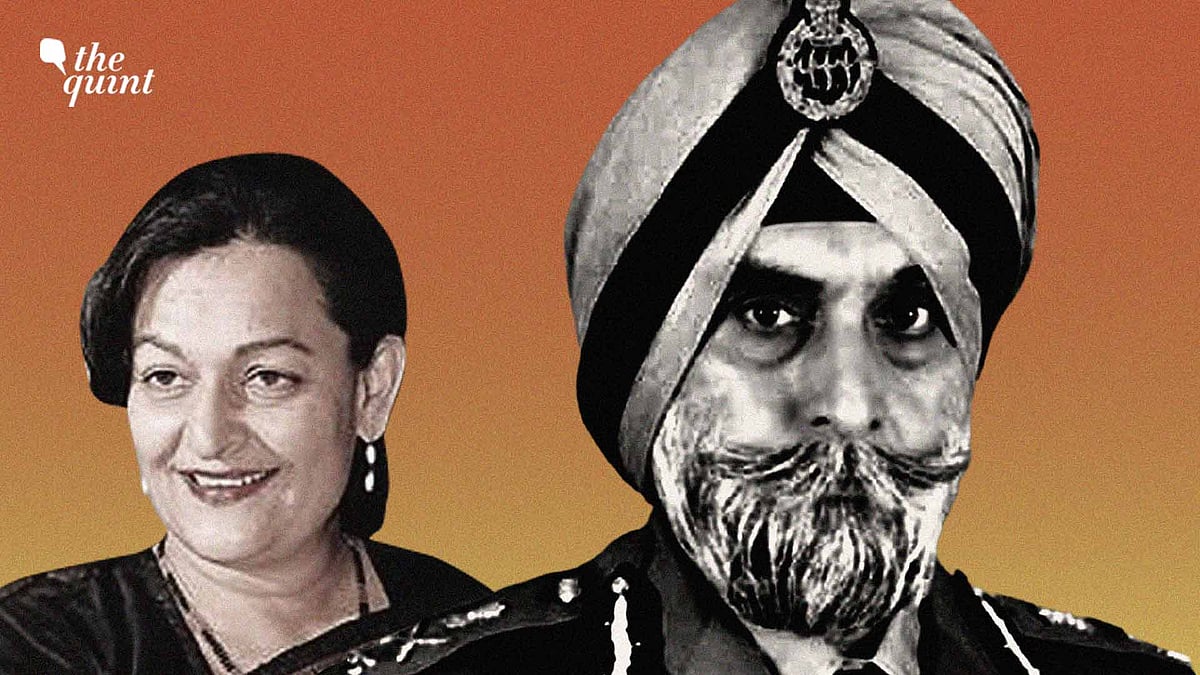
One case that was seen as proof of Gill's impunity was the molestation charge levelled by IAS officer Rupan Deol Bajaj. After a protracted legal battle, Gill was convicted by the Supreme Court in the case in 2005, 17 years after the offence.
The survivor, Rupan Deol Bajaj, recalls how she kept fighting despite facing pressure and intimidation. In an exclusive conversation with The Quint, the former IAS officer narrates how officials at the highest level protected Gill and warned her against taking him on.
Your trial with KPS Gill was a very long and public one. What made you pursue this case and what challenges did you face?
I approached people from the administration first. Their response was not just inexplicable, it was offensive. They all knew what had happened. It had occurred at an official party attended by senior officers, Intelligence Bureau officials, and members of the press, yet everyone pretended they knew nothing until I spoke.
When I explained what had happened, I was told that 'He is wrapped in the national flag. I should take it in my stride, and I was lucky that nothing more happened.' I wanted action under the Conduct Rules. I then went to DGP Julio Ribeiro. He apologised on behalf of KPS Gill and the Punjab Police. He explained that when he brought Gill from Assam, he made him promise to not drink and to not misbehave with women, but he was 'in the habit' of doing so. I told him it was time to break that habit. Ribeiro told me to put everything in writing and that he'll be send a note to the governor.
When I met him again, he had verified that my allegations were true. He reprimanded Gill and warned him to not repeat such behaviour. Be he also decided to 'forgive' him. Who was he to decide? I had not delegated my authority to him to forgive. I was told that no further action could be taken as Gill was fighting a 'national battle' and that acting against him would demoralise the police force. I responded that, on this issue, they need to be demoralised and then remoralised.
I was told by higher-ups that they would close the CBI case against my husband. I was asked what postings we wanted,. But I told them that I wasn't looking for a posting. I never sought anything like that my entire life.
When the High Court quashed the case, you approached the Supreme Court. What did you go through in that period?
I was already angry with the reactions of people around me. I was being told that when I joined the service, I should have been prepared for this. They said if I was going to be so sensitive about these things, I should have stayed at home and focused on cooking. I felt even the High Court did not understand what I went through. The High Court dismissed my FIR, calling it a trivial offence under Section 95. Some even tried portraying me as a terrorist, or that I was sympathetic towards terrorists.
(Vice-President) Krishan Kant later offered his support, and (PM) Atal Bihari Vajpayee even offered to take up my case. I refused to let it become a political issue. For me, this was about the dignity of a working woman.
Were you satisfied with the ruling?
He was sentenced to two months simple imprisonment, and three months rigorous imprisonment, with a fine of, Rs 50,000. I was satisfied with it. He went to appeal to the High Court against that. The court completely agreed with the findings, but diluted the judgment. It became 2 years of probation and two months of imprisonment. The fine was made from Rs. 50,000 to Rs. 1 lakh. I appealed against that to the High Court. They diluted it further and made the probation six months, and they increased the fine to Rs. 2 lakh. When I was asked for my account number I told them that there is no provision of compensation. I find it very degrading. I feel so insulted, to think that my dignity can be compromised with compensation"
You wrote a letter to the government to revoke KPS Gill's Padma Shri award...
Once there were a lot of officers who were with me in support, when we went to the president of the IAS Association. Once they all got to know how the Governor felt, they all backed out. Then, when my case got quashed in the High Court, after that, they gave him the Padma Shri. 19 women officers, I think 20. Maybe 50 people, 55 people from the IAS, from all over the country signed the letter to the President of India. Are we going to let a convict have it? Is that the value of the Padma Shri?
- Access to all paywalled content on site
- Ad-free experience across The Quint
- Early previews of our Special Projects
Published: undefined