Why We Need a 'Satluj' for Kashmir and the Northeast
In Kashmir, human rights activist Jalil Andrabi was abducted and killed in a manner similar to Jaswant Singh Khalra.
advertisement
(We are able to publish such articles because of our editorial independence. Become a member of The Quint and support our journalism.)
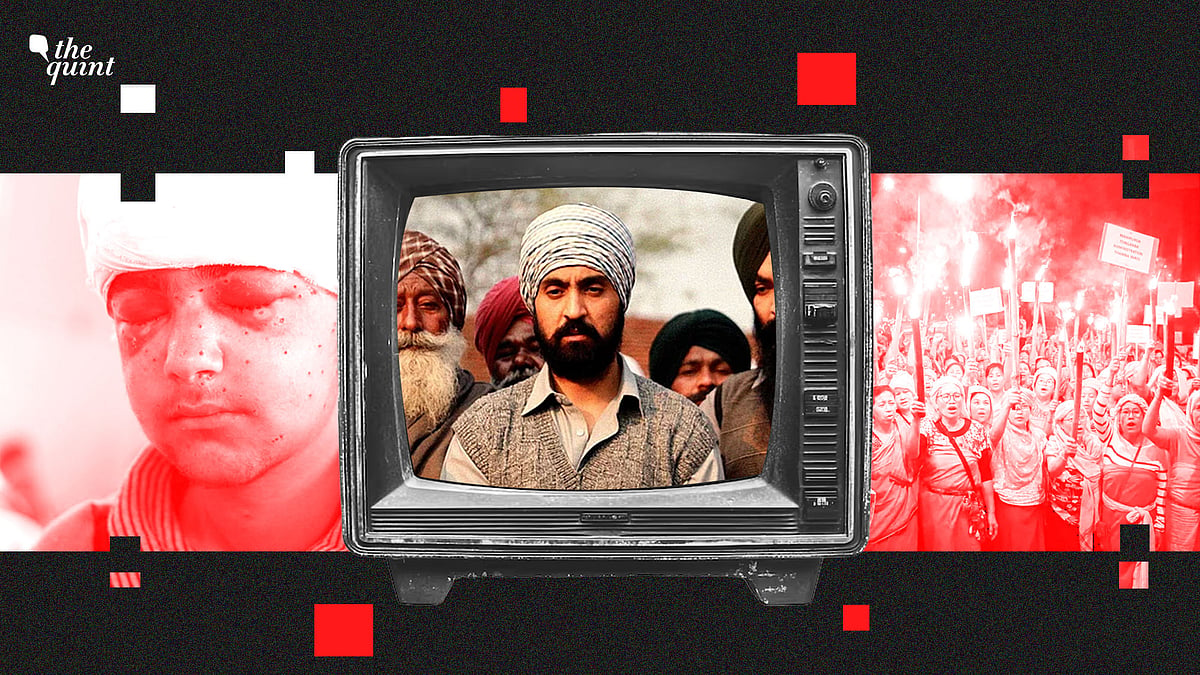
After being pulled from the streaming platform Zee5, Honey Trehan’s film Satluj has broken records for leaks and is being screened on projectors in different villages of Punjab. While Zee has not clarified the reason behind the withdrawal, one constituency that has been vocal against censorship by the Modi government has come out against the film itself. A section of Indian liberals, who are otherwise known for criticising the Modi government’s censorship, have criticised the film, with some calling it full of falsehoods and a threat to the nation, while questioning its portrayal of their hero, the infamous Punjab Police DGP KPS Gill.
Satluj, originally named Punjab 95, is a film based on the life of human rights activist Jaswant Singh Khalra, who was tracking Punjabis who had disappeared during the militancy era. Khalra himself was later picked up by Punjab Police, killed in custody and thrown into the Satluj river. In a dark era of propaganda films such as Dhurandhar, Kashmir Files and Kerala Story, which incite hatred, or celebrate majoritarianism and state-sponsored violence, Satluj is a light in itself. It should have been celebrated for showing stories of state violence. Instead, it was met with more condemnation from liberals than from Indian right-wingers.
Satluj tells the story of enforced disappearances in the north-western Indian state of Punjab, and it is a great and bold experiment by filmmakers. From Kashmir in the north to Assam and Manipur in the Northeast, India has many Jaswant Singh Khalras and thousands of disappearances. Their stories are waiting to be told and shown across India. They need producers like Ronnie Screwvala, filmmakers like Honey Trehan and actors like Diljit Dosanjh in Satluj. Yet the condemnation of Satluj is more likely to demotivate filmmakers than inspire them to make films that challenge the state narrative. Here are some stories that should be told, just like Satluj.
Jhelum, Kashmir
Six months after Jaswant Singh Khalra’s disappearance, another human rights activist disappeared in Punjab’s neighbouring state of Jammu and Kashmir.
The 36-year-old lawyer Jalil Andrabi was chairman of the Kashmir commission of jurists, a human rights organisation in Jammu and Kashmir. He was fighting against custodial killings, disappearances, arbitrary arrests and detentions. On 8 March 1996, Andrabi was kidnapped by paramilitary Rashtriya Rifles personnel, with the help of former militants, while he was driving home with his family.
After his abduction, Jalil’s body was found in the Jhelum river on 27 March 1996, with his hands tied and his body mutilated. The report further describes how former militants who had become armed supporters of the state tried to lure him out of his house.
On the instructions of the Jammu and Kashmir High Court, the state police and security forces formed a SIT, which held army major Avtar Singh accountable for Jalil Andrabi’s death. Singh was later reported missing after his services were terminated by the Indian army. He was held accountable in at least six extrajudicial killings.
In 2009, Avtar Singh was traced to California, where he was arrested in 2011 after his wife accused him of choking her. He was later released, and the Indian government sought his extradition. The following year, Avtar Singh killed his wife and two children. With Avtar’s death, the hope of delivering and securing justice for Jalil Andrabi also died.
Brahmaputra, Assam
The mighty Brahmputra is a lifeline in China, India’s northeast and Bangladesh. It has also carried the dead bodies of the sons of the soil of Assam who disappeared during the militancy. Just as the body of human rights activist Jaswant Singh Khalra was thrown into the Satluj river on 24 October 1995, a severed leg belonging to an unknown person was found in the Brahmputra river in Assam, a north-eastern part of India, by two journalists investigating secret killings backed by the state.
On 22 June 1999, after receiving a secret tip-off, The Telegraph photographer Anupam Nath and correspondent Sankhdeep Chaudhary found a severed leg on the banks of the Brahmputra river at Hudumpura, nearly 30 km from Guwahati. After initial reluctance from local people, a resident told the journalists that masked men used to arrive in a maruti gypsy, drag people from the vehicle, shoot them dead and then drive away. Out of fear, local people remained silent. A photograph of the severed leg was published in the newspaper the next day, leading to an uproar in the state. These incidents were initially described as secret killings, and there had already been many reports of severed legs and heads being found in different parts of the state.
Since the formation of the United Liberation front of Assam (ULFA) in 1979, which demanded a separate and sovereign Assam, the Indian military, paramilitary forces, Assam police and ULFA militants had been at loggerheads. During this period, alongside militant violence, violations of human rights were also quite common.
During investigations, it was found that SULFA, or Surrendered ULFA, a state-backed outfit, was behind the killings of militants, their family members and linkmen. According to Secret Killings in Assam, a book by India today magazine editor Kaushik Deka, all the secret killings were related to ULFA, with the disappearances somehow connected to ULFA.
In all the cases, SULFA was behind the secret midnight kidnappings of UFLA members, family members of militant organisations and linkmen. Those kidnapped later disappeared, and sometimes their bodies were found.
According to the book, in the murder case of Dimba Rajkonwar, the elder brother of ULFA Chairman Arabinda Rajkhowa, the victim’s family, members of the public and initial police records named three SULFA leaders—Nayan Das, Raju Phukan and Krishna Hazarika—as the culprits. Even before the inquiry began, Nayan Das was killed under mysterious circumstances. Raju Phukan was also shot dead by the army a few days later. The final accused, Krishna Hazarika, was also mysteriously killed.
In connection with the killings of ULFA leader Mithinga Daimary’s family, SULFA leader Abinash Bardoloi was questioned by police. He, too, was later killed by unidentified gunmen. Similarly, another SULFA leader, Rinku Choudhury, who was involved in several killings in Goalpara district, was also killed under mysterious circumstances.
These SULFA leaders, who were killed in mysterious circumstances, could have been used by the state police to carry out the secret killings. There are reasons to suspect that, because of fears that they would make uncomfortable disclosures before the commission, they were eliminated one by one by the same machinery that had earlier used them against ULFAs. To substantiate this speculation, SULFA leader J. K. Mahanta, during his submission before the commission, expressed suspicion that ULFA might not have been involved in the murder of SULFA leader Tapan Dutta.
On 17 May 1996, Parag Das, a prominent Assamese economist, human rights activist and editor of the Assamese daily Asomiya Pratidin, was shot dead in broad daylight. Das was considered an ideologue by ULFA. There was no progress in his murder case, and his alleged killers were assassinated by ULFA.
The secret killings between 1998 and 2001 later led to the defeat of the AGP government and the return of Congress to power in 2001 on the issue of secret killings. To investigate the killings, the Justice Meera Sarma commission was formed, but the justice resigned, citing non-cooperation from the government.
According to the book, the secret killings in Assam were a state-sponsored weapon intended to tame the militants. The strategy was initially successful but soon went out of control, taking the AGP government with it. According to reports, there were between 300 and 400 secret killings in Assam from 1998 to 2001.
Just as Punjab has the Satluj river and the Satluj film exposing the reality of disappearances, a film about the secret killings in Assam is needed to expose disappearances in the north-eastern state of India. It could be called Brahmputra, as the secret killings of Assam were exposed in the river.
Manipur
India’s conflict-torn state of Manipur deserves a film about extrajudicial killings, human rights violations and disappearances.
In 2012, the Manipur-based Extra Judicial Execution Victims' Families Association (EEVFAM), along with Human Rights Alert, filed public-interest litigation in the Supreme Court alleging the extrajudicial execution of 1,528 civilians, including 98 children, by security forces in Manipur between 1979 and 2012.
In July 2004, Thangjam Manorama was kidnapped from her home in Imphal. The next day, her bullet-ridden body was found, leading to the historic naked protest by Manipuri women outside the Assam Rifles headquarter, where they held a banner reading, “Indian army rape us”.
In 2017, the Supreme Court ordered the CBI to investigate some of the killings in these cases. Apart from these claims and court reports, mass graves have also been found in Manipur. In one instance in 2014, eight human skulls and several skeletal remains were found in the compound of a highschool named Tombisana. Interestingly, the compound had been occupied by Indian paramilitary forces for 20 years.
Just as the state makes war-propaganda films and right-wingers make chauvinist cinema, Manipur also deserves a film highlighting human rights violations, disappearances and fake encounters.
While Satluj falls short of holding the state accountable for killings and disappearances, it exposes fake encounters and killings carried out in the name of ensuring the nation’s safety. Despite state and police denials, these encounter killings and mysterious disappearances in different disturbed regions of India tell a different story.
No matter what the state and police argue, such killings point towards a nexus between the state, intelligence agencies and the police behind these horrific murders. Films such as Satluj can inspire films such as Jhelum, exposing killings and disappearances in Kashmir, and Brahmputra, exposing the tragedy of Assam.
Ultimately, all these films can narrate the ordeal of the people and the story of state violence against its own citizens, as explained by former intelligence officials. The late Intelligence Bureau officer and prominent author of books about Indian Intelligence, Maloy Krishna Dhar, sheds light on the issue.
After Tarn Taran SSP Ajit Singh Sandhu, an accused in the Jaswant Singh murder case, committed suicide, Dhar wrote a tribute to him highlighting the state’s role in disappearances and arguing that the police were merely pawns in a larger system designed to eliminate critics and potential enemies. He wrote:
“Ajit Singh Sandhu and his colleagues, some of them missionaries in uniform, accepted their assigned jobs as frontline soldiers. They were told to shoot first, ask questions later. They were assured by their bosses in Chandigarh and Delhi that they would be taken care of. The unholy war had to be won. Our political leaders, like their imperial masters, have been using the police and the administration for coercion in the name of preserving the unity and integrity of the country. Their adventurism has generated several killing fields in the country and the neighborhood (remember the Indian Peace Keeping Force!). The Northeast, the ravaged lands of Naxalbari, the Bihar plains and Andhra Pradesh bear testimony to their misdeeds. Everywhere, they press in the services of the forces to tackle the law and order problems arising out of their bankruptcy. The law is enforced and order is restored, at the cost of innocent lives. Policemen were supposed to face terrorists as part of their professional duties. Their frontal and tactical engagements were well justified. But history bears testimony that hundreds of terrorists were not killed in frontal engagements and thousands of innocent youths were silently liquidated as part of ‘mass control measures’. Sandhu, who had carried out the orders of his superiors and political masters and secured Tarn Taran, thought he was above the law. Many brave and honest officers like him had committed themselves and made Punjab safe at a colossal human cost.
Satluj has raised questions about India’s difficult past and the conduct of its forces in dealing with religious and ethnic minorities. Instead of being hailed and celebrated, the film has not only been prevented from streaming but has also been criticised by champions of free speech.
All nations have a history and a difficult past. Mature democracies such as the US and Canada make films about human rights violations committed by their own forces and question both their institutions and the people in charge of them. Canada has, in fact, apologised for the forced schooling of indigenous children and their deaths. Such actions are taken to prevent those mistakes from being repeated.
The Indian state and its champions, on the other hand, are not ready to face the truth—the truth of Khalra. While the body of Jaswant Singh Khalra in Satluj, the body of Jalil Andrabi in Jhelum and the anonymous bodies in Brahmputra may have been washed away long ago, the stories of their deaths, and the discussions and films about them, continue to haunt the champions of the mother of democracy.
India, and Indian liberals in particular, should welcome films such as Satluj and support films about Kashmir, Assam and Manipur. Cinema is one of the best ways to sensitise the population at large so that people do not remain silent when such violations are repeated.
(The writer is an independent journalist based in Punjab. This is an opinion piece and the views expressed are the author’s own. The Quint neither endorses nor is responsible for them.)
- Access to all paywalled content on site
- Ad-free experience across The Quint
- Early previews of our Special Projects
Published: undefined