
Maharashtra Civic Polls: Congress Leads in 4 Cities, No. 2 in 5; 5 Key Takeaways
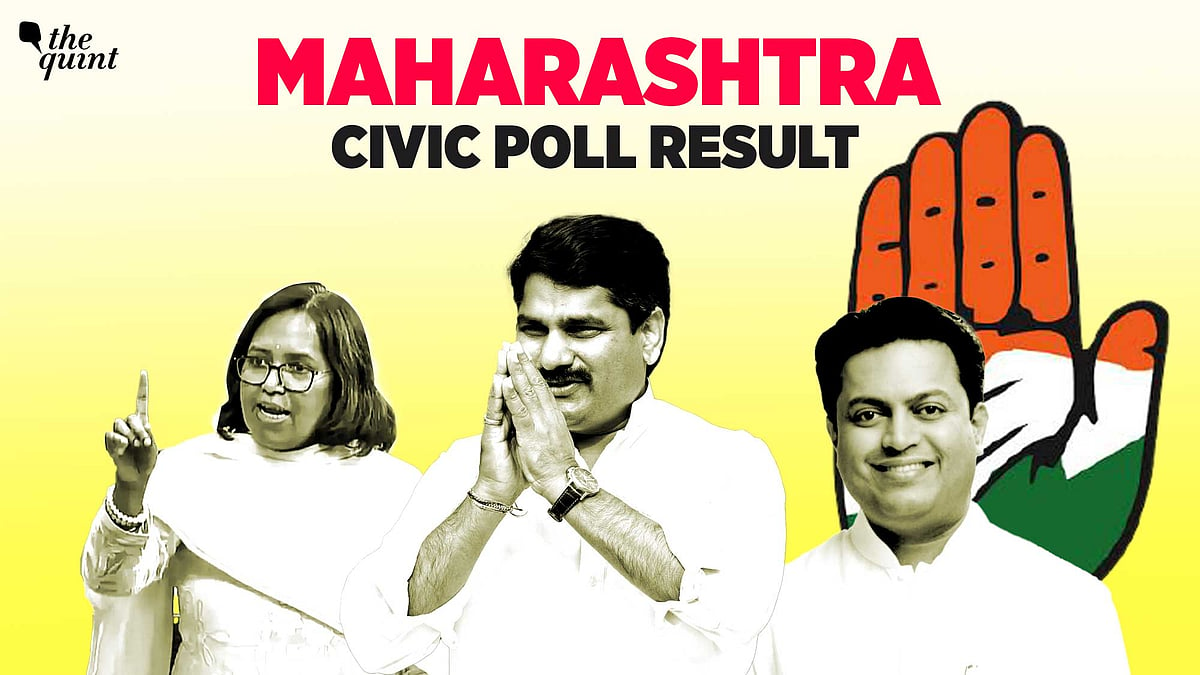
Congress has emerged as the main Opposition force in Maharashtra, outside the Mumbai region.
advertisement
Coming a little over a year after the Maharashtra Assembly poll disaster, the Municipal Corporation elections were predicted to be a washout for the Congress. However, the party has surprised many by showing its resilience in the state.
The Congress managed to emerge as the single largest party in four municipal corporations and bagged the number two position in five other corporations. This is significant as the ruling BJP-led alliance had the advantage of being in power as well as the vast resources at its disposal.
Where did the party do well in the state?
Where did it perform poorly?
What are the main takeaways for it?
We'll answer these three questions in this piece.
Where Did the Congress do Well?
The Congress has secured a majority on its own in the Latur Municipal Corporation and emerged as the single largest party in Kolhapur, Bhiwandi-Nizampur and Chandrapur Municipal Corporations.
It also emerged as the main opposition in Sangli-Miraj-Kupwad, Nagpur, Amravati, Akola and Mira-Bhayandar. It managed to get a respectable number of seats in Parbhani, Pune and Jalna as well.
It held its ground in the Brihanmumbai Municipal Corporation (BMC), winning 24 seats, contesting in alliance with the VBA. The wins were largely due to the party's traditional base among Muslim, Dalit and Catholic voters.
Where did Congress Perform Poorly?
The Congress drew a blank in Thane, Navi Mumbai, Dhule, Jalgaon, Pimpri-Chinchwad and Ichalkaranji. However in Ichalkaranji, it fought under the leadership of the VBA, which performed reasonably well.
The biggest disappointment for the party would probably be Solapur and Nanded.
In Solapur, it could only win 2 seats. Its candidate Praniti Shinde, had won the seat in the Lok Sabha elections. But the party drew a blank in Solapur in the Assembly elections, failing to win a single segment (its ally NCPSP did win the predominantly rural Mohol segment). The Congress suffered mainly due to the confusion in its local unit.
The Congress was leading the Nanded Corporation last time but it has been weakened in the area due to the exit of Ashok Chavan and rise of the AIMIM. It could manage only 10 seats out of 81, behind the AIMIM's 15.
Key Takeaways for the Congress
1. Biggest Opposition Party in Maharashtra
The Congress remains the biggest opposition party in Maharashtra. It has the highest number of Municipal Corporation seats across the state after the BJP and Shiv Sena (Shinde). It is the biggest party after the BJP outside the Mumbai Metropolitan Region. Especially significant is the party's decent performance in Pune and Nagpur, which are Maharashtra's second and third biggest cities in terms of population.
2. Credit to Local Leadership
The Congress' performance owes a great deal to its local leadership in different cities. Particularly worth mentioning is the role played by Satej 'Bunty' Patil in Kolhapur and Amit Deshmukh in Latur. In contrast, the party performed poorly where its local leadership was divided or ineffective, such as Solapur.
3. Alliance with VBA Worked
The Congress gained due to its alliance with the VBA, especially in cities like Akola, Amravati and Nagpur. It managed to consolidate neo-Buddhist and Muslim voters as well as progressive sections among dominant castes.
4. Structural Weakness in Cities Near Mumbai
The Congress continues its structural weakness in the cities adjacent to Mumbai. The party performed poorly in Thane, Navi Mumbai, Kalyan-Dombivili, Vasai-Virar, Panvel and Ulhasnagar. It managed to do well only in Bhiwandi-Nizampur, where Muslims form a majority and in Mira Bhayander where Muslims and Christians put together are over 20 percent.
The party generally performed poorly in the Hindu Middle Class areas. This is consistent with the party's larger weakness among this demographic outside of South India. For instance, in the 2024 Haryana elections, the Congress ended up losing the state partly due to its poor performance in Gurugram and Faridabad.
In India's rapidly urbanising reality, the Congress would need to address this structural weakness among urban middle class voters.
5. Support Among Key Demographic Groups
The results indicate that the Congress has retained support among key demographic groups such as Muslims and Dalits and it seems to have made some gains among younger voters.
This is reflected in CVoter's survey for the BMC elections. When asked "which party is most principled?", 46 percent Dalits, 27 percent Muslims and 32 percent voters between 18-24 years replied "Congress".
This is significant as the party hasn't been in power in Mumbai since several decades and in Maharashtra since 2014.
- Access to all paywalled content on site
- Ad-free experience across The Quint
- Early previews of our Special Projects
Published: undefined