
MP SIR: 24% Higher Deletions Among Women; Rural and Tribal Seats Most Affected
According to data, in MP, the names of about 4.5 lakh more women voters have been deleted compared to men.
advertisement
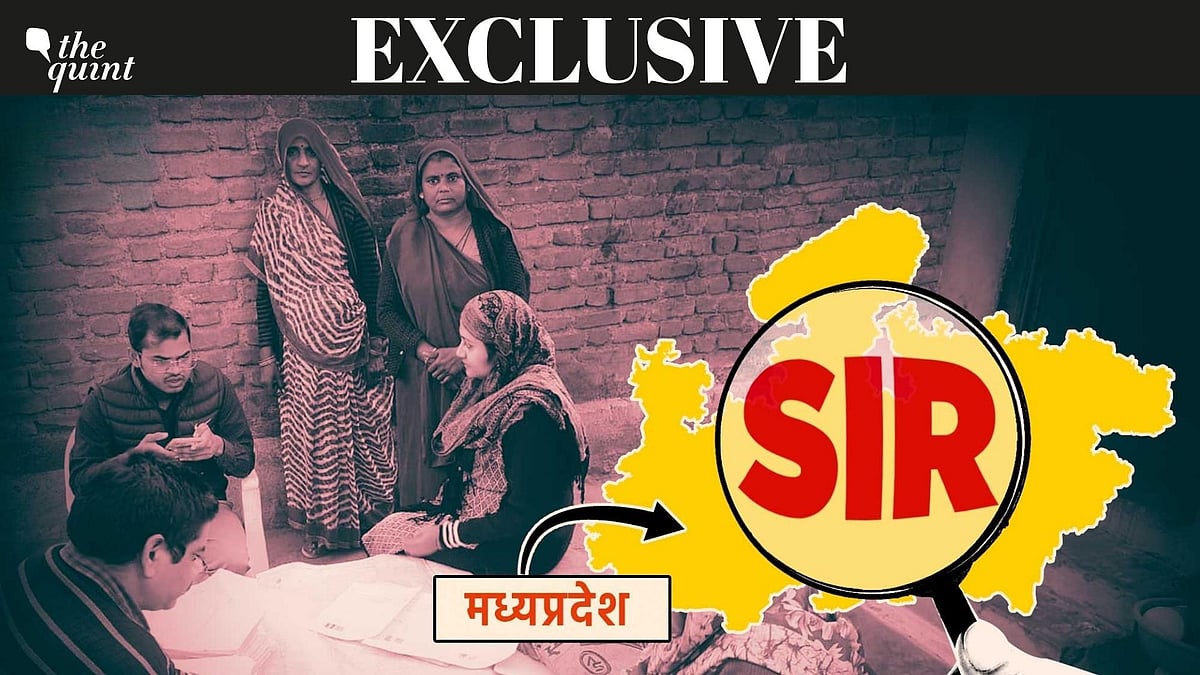
Over 42,74,160 voters have been removed from the electoral list as per the draft electoral roll, follwing the Special Intensive Revision (SIR) exercise in Madhya Pradesh.
On 23 December, Joint Chief Electoral Officer Ram Pratap Singh Jadon stated that as of 27 October 2025, Madhya Pradesh had 5,74,06,143 voters. As of today, the total number of voters stands at 5,31,31,983.
From the draft roll, the names of 23,63,850 women voters were removed, while 19,08,541 men voters were deleted.
After the first phase of the SIR, 31.51 lakh voters (5.49%) were found to have either shifted or were absent. Meanwhile, 8.46 lakh voters (1.47%) had passed away, and 2.77 lakh voters (0.48%) were found to be enrolled at more than one place.
What Happened on ST Seats
Analysis of the SIR draft roll shows that on rural and Scheduled Tribe (ST)–reserved Assembly seats, the rate of deletion of women voters’ names is 13% to 110% higher than that of men. On average, deletions among male voters range between 4,000 and 7,000, while female voter deletions average between 7,000 and 12,000.
For example:
Badwara (Katni): Against 4,351 men, the names of 9,165 women were deleted—more than double, with women’s deletions 110% higher than men’s.
Ghoradongri (Betul): The draft roll shows 6,699 women voters deleted compared to 3,599 men, a difference of 86%.
Bhainsdehi (Betul): Women’s deletions are about 84% higher than men’s, with 3,216 men and 5,901 women removed from the voters’ list.
Chitrangi (Singrauli): Compared to 7,236 men, the names of 12,545 women were deleted—1.73 times higher.
Bhikangaon (Khargone): Against 7,653 men, 12,376 women were deleted, which is around 62% higher.
More Women Voters Deleted on SC Seats
On Assembly seats reserved for the Scheduled Castes (SC), the deletion of women voters’ names is also consistently and clearly higher than that of men, though the gap is smaller than on ST seats. Among the top 10 SC seats, women’s deletions are 30% to 70% higher than men’s.
In the draft roll, an average of 3,000–5,000 male voters have been removed from SC seats, while the average deletion of women voters ranges between 5,000 and 8,000.
Examples:
Ashta (Sehore): Compared to 2,534 men, the names of 5,047 women were removed from the voters’ list—99% higher.
Sarangpur (Rajgarh): Women voters’ deletions (6,376) are 93% higher than those of men (3,296).
Chandla (Chhatarpur): Against 4,394 male voters, 7,838 women are missing from the draft roll—78% higher.
Dimani (Morena): Compared to 3,812 men, 6,678 women were deleted, around 1.75 times higher.
Ambah (Morena): Against 3,104 men, 5,351 women were removed—72% higher.
A Similar Deletion Pattern in Vindhya and Bundelkhand
The graph of women voters’ deletions is significantly higher in the Vindhya region districts—Rewa, Satna, and Sidhi—as well as in Bundelkhand districts such as Panna, Sagar, and Datia.
Deotalab (Rewa): The names of 4,037 more women were deleted compared to men.
Churhat (Sidhi): 12,624 women voters were removed compared to 7,828 men.
Amarpatan (Satna): 3,394 more women’s names were deleted than men’s on this seat.
Gunnour (Panna): Against 4,229 men, 7,415 women were deleted from the voters’ list.
Surkhi (Sagar): The names of 14,073 women voters were deleted, which is 3,317 more than men.
In Rajgarh and Sehore districts of the central region, the deletion of women voters’ names is also higher than that of men.
More Male Voters’ Names Deleted in Urban Constituencies
However, if we look at the state’s urban Assembly constituencies, the pattern of name deletions from the draft electoral rolls changes completely—or even reverses—compared to ST/SC and rural seats. In urban constituencies, up to 16% more male voters’ names have been removed from the draft rolls compared to female voters.
Examples:
Bhopal South-West (Bhopal): In this constituency, the names of 34,081 men were removed, while 29,346 women were deleted from the draft roll. Male deletions are 16% higher than female deletions.
Govindpura (Bhopal): Compared to 44,960 women voters, the names of 50,974 male voters were deleted. Here, the male deletion rate is 13.4% higher.
Gwalior East (Gwalior): In this seat, male deletions are 12.8% higher than female deletions. The names of 40,178 male voters and 35,607 female voters were removed.
Narela (Bhopal): Here, 43,051 men’s names were deleted compared to 38,179 women’s, which is 12.8% higher.
Gwalior (Gwalior): Male deletions here are 10.2% higher than those of women.
In urban constituencies such as Indore-1, Indore-2, and Ujjain as well, the number of male voter deletions is higher than that of female voters.
In 42 seats, the election margin is smaller than the male–female deletion gap
The largest gap between male and female voter deletions in the state is in Chitrangi (Singrauli), where the difference stands at 5,309. Data analysis shows that there are 42 Assembly constituencies in Madhya Pradesh where the margin of victory or defeat in the 2023 election is smaller than the gap between male and female voter deletions.
Examples:
Shajapur (Shajapur): The BJP won this seat by a margin of just 28 votes. Here, the male–female deletion gap is 1,454.
Mahidpur (Ujjain): The Congress won this seat with a margin of 290 votes, while the deletion gap now stands at 1,886.
Dharampuri (Dhar): The BJP secured victory here by 356 votes. The gap between male and female deletions is 3,603.
According to a report by The Hindu, both male and female voters showed a stronger preference for the BJP than for the Congress. Data indicates that 43% of women voted for the Congress, while 47% supported the BJP.
Interestingly, the Congress received greater support from women than from men, whereas the BJP drew more support from male voters compared to women.
- Access to all paywalled content on site
- Ad-free experience across The Quint
- Early previews of our Special Projects
Published: undefined