
Delhi Riots Took Her Husband. 6 Years On, Anxiety is Now a Constant Companion
Exactly 6 years ago, Nargis' husband left for work and never returned. "My entire world collapsed," says Nargis.
advertisement
“I never got to know who killed my husband, if it was a person or a mob. All I know is that my husband went for work as usual but never returned.”
In the narrow lanes of Shiv Vihar, Northeast Delhi, houses stand cheek by jowl, sharing common walls, where eerie silence hovers in the air and buildings still speak of the ruins of one of the most barbaric episodes of violence this city witnessed six years ago—the 2020 Delhi pogrom. And this is where Nargis lives.
Thirty-two-year-old Nargis is a mother of three children—two daughters Nashra (9) and Hifza (7), and a son, Amaan (12). She starts her day in the wee hours, juggling between packing school tiffin for her children and tying their hair to send them neatly to Sunrise Public School, a relief school that was set up by the NGO Miles2Smile for the kids who survived the riots.
After the children leave for school, Nargis' daily chores wait for her to start—brooming, dusting, and mopping occupy the most time. Alongside sits her sewing machine, with a heap of clothes waiting for Nargis to transform them into beautiful scarves, masks, and belts, helping her with a decent amount of income in some months but barely any on some other days.
Then her second source of income, segregation of copper wires from trash, helps her make ends meet.
This wasn't always how Nargis lived.
Nargis was a housewife. Her life consisted of her husband and children. But her heart died, she said, the day her husband, Mursaleen, bid farewell to this world. He was among 53 who lost their lives to the Delhi riots of 2020, and Nargis was among 25 women who were widowed in the riots.
Read our story on the widows of Delhi riots here.
Nargis has taken to tailoring to help financially support her family.
(Photo: Mohd Imamuddin)
The Day She Lost Her Husband, Mursaleen
When this reporter met Nargis, talking about her late husband triggered her anxiety. It was a memory she could never forget, a grief that lives in her body and shows up often in the form of anxiety now.
21 February 2020 was supposed to be another mundane day, it was anything but.
Mursaleen (then 32) woke up and had a nondescript conversation with Nargis (then 27), but something was different in the air and in her heart. Nargis was fraught without a reason.
“I suddenly felt something was wrong. Mursaleen brought medicine for my anxiety and told me to take it after he returns from work,” Nargis said.
He worked as a scrap dealer and had a small warehouse in Indra Vihar, in the vicinity of Shiv Vihar. Nargis said that Mursaleen shaved his beard, got a haircut and told me to do some household work that day. He wore new clothes and went off to work.
Where Nargis still lives with her family. The house also bore the brunt of Delhi riots.
(Photo: Mohd Imamuddin)
Mursaleen did not come back home until dusk. She made multiple calls, but no one answered.
Anxiously, Nargis called her in-laws, who lived near Mursaleen’s shop in Shiv Vihar—one of the epicenters of the riots—only to learn that what has been labelled as “one of the most horrific riots of Delhi” had unfolded and Mursaleen’s whereabouts were unknown to everybody.
She searched for him for weeks, from one police station to another and one hospital to another. This search stopped when Nargis' mobile rang on 12 March 2020, asking her to come to GTB hospital to recognise the dead body of her husband.
On reaching the spot, what she saw left her aghast. Mursaleen’s face was injured by a sword, lips sliced into parts. Three bullets in legs, one in the stomach, and four in the chest. To Nargis, he was his entire world and in that moment, her entire world collapsed.
The Quint also accessed the post-mortem report which states that the "whole body blackened and was foul smelling." It also laid down further injury marks on the body. The report stated that the body was found in a nala on 28 February, which means a week after Mursaleen had left his home.
Post-mortem report of Mursaleen.
(Photo: Accessed by The Quint)
"I was in a terrible condition, and my Maira was born very weak. Mursaleen's brother said, ‘Give her to me.’ I gave her away to them, thinking that at least the other children had received some love from their father, but she would be completely deprived, even of the word 'father,” Nargis told me, with pain in her eyes and voice.
Nargis said she could not afford or manage to file a case at that point. She was informed later that a family relative had filed a case but she does not have more information about this.
When Nargis was Living, not just Surviving
Nargis and Mursaleen were married for 10 years. "A life without worry, the most beautiful days of our lives," said Nargis.
"I never had any stress—he would do all the work without me even asking. And even if we ever argued, it was only about why I was doing work and not taking rest," Nargis said.
"I liked everything about him, and he liked everything about me," she added, with a smile on her face, which lasted only for a few seconds.
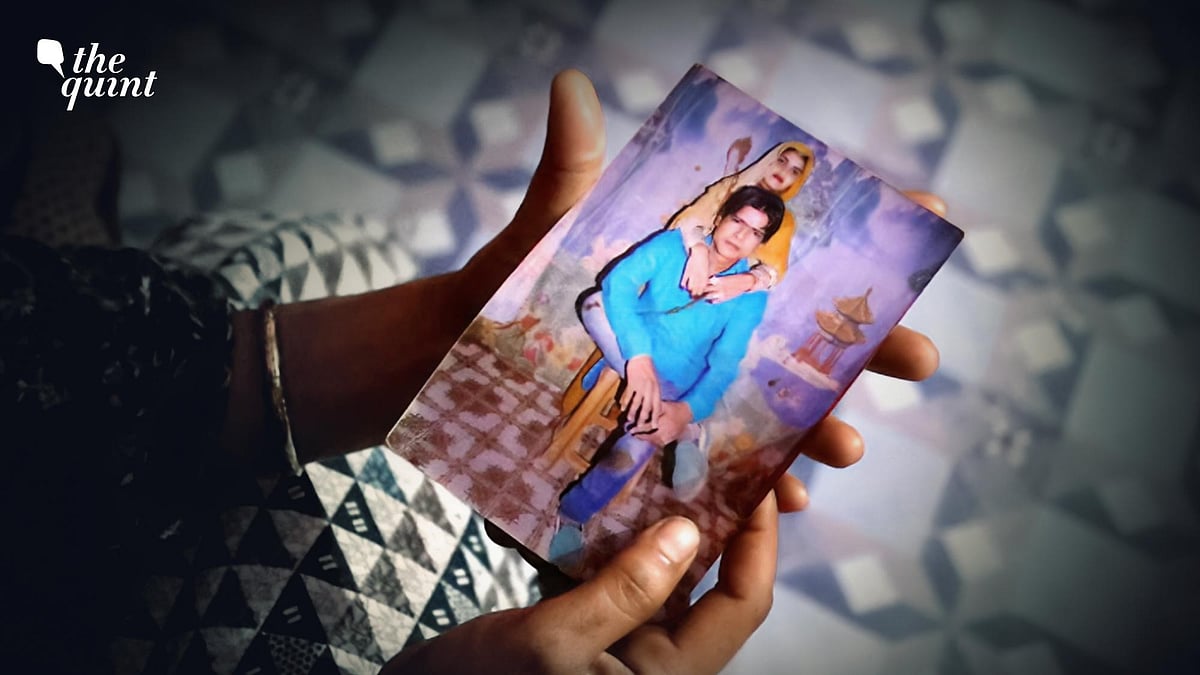
Nargis with a photo of Murasleen and her.
(Photo: Mohd Imamuddin)
The Withering Life of Nargis
Soon after the death of Mursaleen, everything seemed to betray Nargis; poverty enveloped her life, anxiety became her constant companion, and her Lord, Allah became the island in the sea of her worries.
A lot of days passed on a single meal, many nights spent in tears. The children constantly asked about Mursaleen, having kept in the dark about his death.
"I didn’t tell the children about the death—I sent my daughters to their grandmother’s house. My son had seen it, but he didn’t fully understand what had happened," she said.
Nargis with a photo of Murasleen and her.
(Photo: Mohd Imamuddin)
In her dreams, Nargis still meets Mursaleen. In those dreams, he assures her that he is with her, she said.
'My Youngest Daughter Somehow Still Remembers Him'
As she predicted, it was not easy for the children. When Nargis’s children learned about their father’s killing, they could not bear it and fell sick for days.
Having had to face trauma that was too heavy for their adolescent age.
Nargis, along with the children found some relief when they joined the school was free of cost. She also got Rs. 10 lakhs from the government which she used for buying a plot of land to have a secure future.
Six years have passed, but the wounds still linger in their tender hearts, with Hifza being the most impacted.
“I explain things to her, and I become both mother and father for her so that the absence of a father isn’t felt,” she added.
It's during the festivals when the children, especially, Hifza misses their Abba the most because “Everyone has their father with them on Eid—but I don’t,” Hifza said.
Amidst battling between the roles of a mother and a father, Nargis finds peace in “only offering namaz," she remarked.
Nargis prays to find peace.
(Photo: Mohd Imamuddin)
For hours she sits on the prayer mat she received on her wedding and recalls the life they had lived with peace and ease. This prayer now has visible holes in them.
(Sidra Fatima is a journalist and writer based in Delhi, focused on documenting the stories of survivors of mob lynchings, communal violence, and demolitions. She works with Miles2Smile foundation)
- Access to all paywalled content on site
- Ad-free experience across The Quint
- Early previews of our Special Projects
Published: undefined