
Cockroaches Are Cornered, but CJP is Redrawing the Political Map. Here's How
After Saurav Das and Ashutosh Ranka were sent to custody, CJP received support from unexpected qurarters.
advertisement
Jantar Mantar 2.0 has been very different for the Cockroach Janta Party. This time, the Modi government showed far greater willingness to use police violence and large-scale detentions to prevent a mass mobilisation. It put two top leaders of the CJP in custody for a week and even de-notified Jantar Mantar, the site of CJP's July revolution, as a protest site.
So does this mean the government has vanquished the cockroaches?
Not quite. The space for the CJP might be shrinking on the street, but it has achieved something unprecedented in the political space.
This is a story of four tweets that may have gone unnoticed by many but are politically extremely significant.
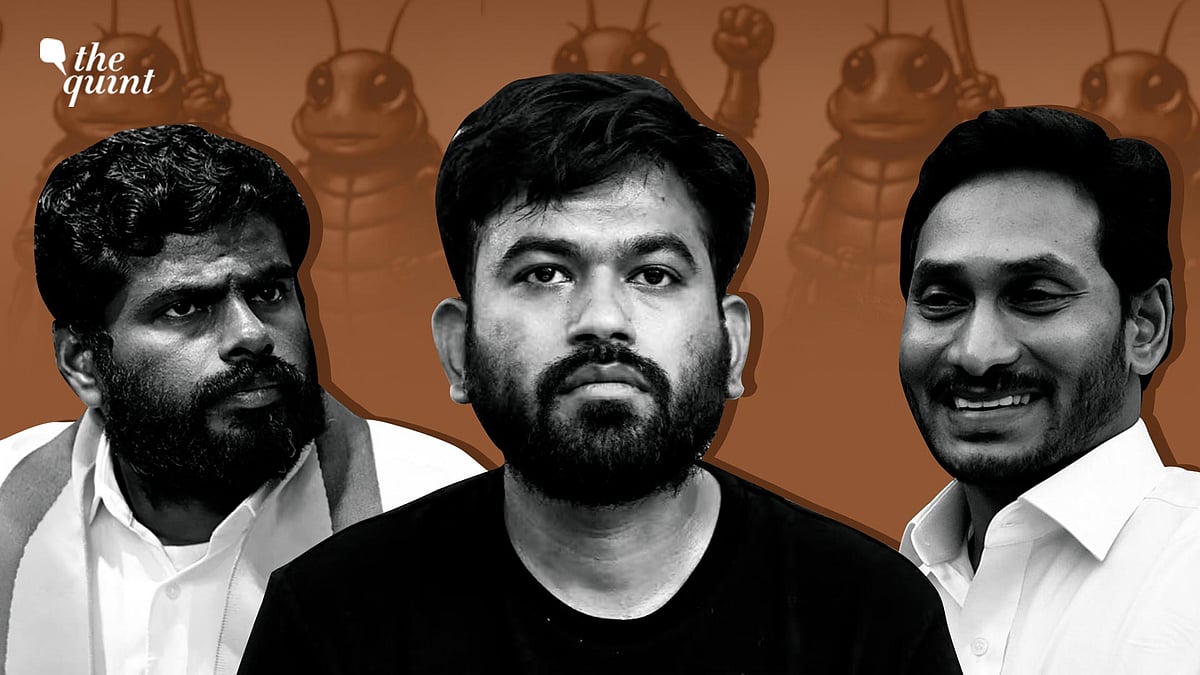
After CJP leaders Saurav Das and Ashutosh Ranka were sent to judicial custody, they received tweets of support from four unexpected leaders: former Andhra Chief Minister YS Jaganmohan Reddy, former Odisha CM Naveen Patnaik, BRS leader KT Rama Rao and former Tamil Nadu BJP chief K Annamalai.
Why is this important?
Three of the parties mentioned above - YSRCP, BJD and BRS aren't part of the INDIA Bloc. They have mostly stayed away from any Opposition-backed mobilisation against the Modi government. K Annamalai was a key part of the BJP. But the three parties aren't exactly in the same category. The BRS has been vocally anti-BJP due to its secular image in Telangana. It opposed linking the Women's Reservation Bill to delimitation and also opposed the Waqf Amendment Bill in Parliament. KT Rama Rao has been vocal about secularism and freedom of expression.
Naveen Patnaik hasn't been as critical of the BJP and even when he has, he hasn't expressed in ideological terms like the BRS. However, in September he joined the chorus demanding the resignation of CEC Gyanesh Kumar and he has also spoken out against the Centre's Mining Bill.
Patnaik's shift has been coming for some time now, since the BJP defeated him in Odisha in 2024, bringing an end to two decades of his rule. Fearing that a resurgent Congress may occupy Opposition space, Patnaik has since been forced to become much more vocal against the BJP.
The more surprising cases are that of YS Jaganmohan Reddy and K Annamalai and they deserve a separate discussion.
Jaganmohan Reddy's U-Turn
Till recently, Reddy was seen as BJP's unofficial ally. Reddy had supported the Modi government even on the delimitation issue earlier this year, breaking ranks with many other Southern parties. He has now taken a major pivot. He is even expressing regret for backing the Modi government's 2023 law on the appointment of Election Commissioners.
What explains this U-turn?
There are two elements to this.
The biggest reason is the perception in the YSRCP rank and file that the BJP used the electoral machinery to favour its ally and his main rival, N Chandrababu Naidu, in the 2024 elections. This has further strengthened after recent political violence against the party's supporters.
The second reason is a sense of hurt. Reddy feels betrayed that the BJP joined hands with Naidu even though the latter had criticised the BJP bitterly after their break-up in 2018 and became a key part of the anti-BJP alliance. Reddy's pain is that no matter how much he tried to appease the BJP, the latter's first choice in Andhra Pradesh would always be Naidu due to a better compatibility of the base of the two parties.
Supporting CJP is Reddy's way of repositioning himself in the anti-BJP space but without joining the Congress-led INDIA Bloc.
K Annamalai's Strategy
Annamalai formally left the BJP in June and launched We The Leaders, a political movement intended to become a party. He has claimed that the movement has attracted lakhs of members, mostly under 40 years of age.
His target age group is the same as the one CJP has mobilised. This explains Annamalai's criticism of the BJP regarding the arrest of CJP leaders.
Annamalai's calculation is that by 2031, the young voters who may be disgruntled with the TVK government then would look to him and not DMK as the main alternative.
What Happens Next?
The anti-BJP space is expanding, and the CJP is acting as a catalyst. This is bad news for the BJP but not necessarily good news for the Congress. After its improved performance in the 2024 Lok Sabha elections, the Congress felt that it could now dictate terms within the Opposition.
But now there seems to be a cluster of parties that want to be part of the anti-BJP space but not necessarily align with the Congress. Besides the three parties mentioned above, it includes the Aam Aadmi Party, DMK, BSP and Prashant Kishor to name a few. If the SP-Congress alliance doesn't work out for the upcoming Uttar Pradesh elections, who knows, even the SP might shift that side.
It will come down to two things: how the Congress takes forward the protest against CEC Gyanesh Kumar and how the CJP recalibrates its strategy.
The next parliement session will be important. The scanner will be on parties like BJD and YSRCP if the Modi government introduces any contentious legislation.
- Access to all paywalled content on site
- Ad-free experience across The Quint
- Early previews of our Special Projects
Published: undefined