
Bhojshala-Kamal Maula Verdict: In MP's Dhar, a Familiar Mandir-Masjid Story
Dhar is not Ayodhya, and copy-pasting the 'Ayodhya model' here is a legal impossibility, says a senior lawyer.
advertisement
The air in the historic town of Dhar, in Madhya Pradesh, is thick with a familiar, politically charged static. Following the landmark 242-page ruling by the Indore Bench of the Madhya Pradesh High Court on 15 May, declaring the disputed Bhojshala-Kamal Maula complex a Hindu temple, the state machinery wasted no time in sounding the triumphal bugle.
MP Chief Minister Mohan Yadav immediately captured the media spotlight, welcoming the court’s verdict—and declaring his administration’s intent to oversee the construction of a "grand temple" at the site.
Dhar is not Ayodhya, and copy-pasting the "Ayodhya model" here is a legal impossibility, explains a senior lawyer.
(Photo: PTI)
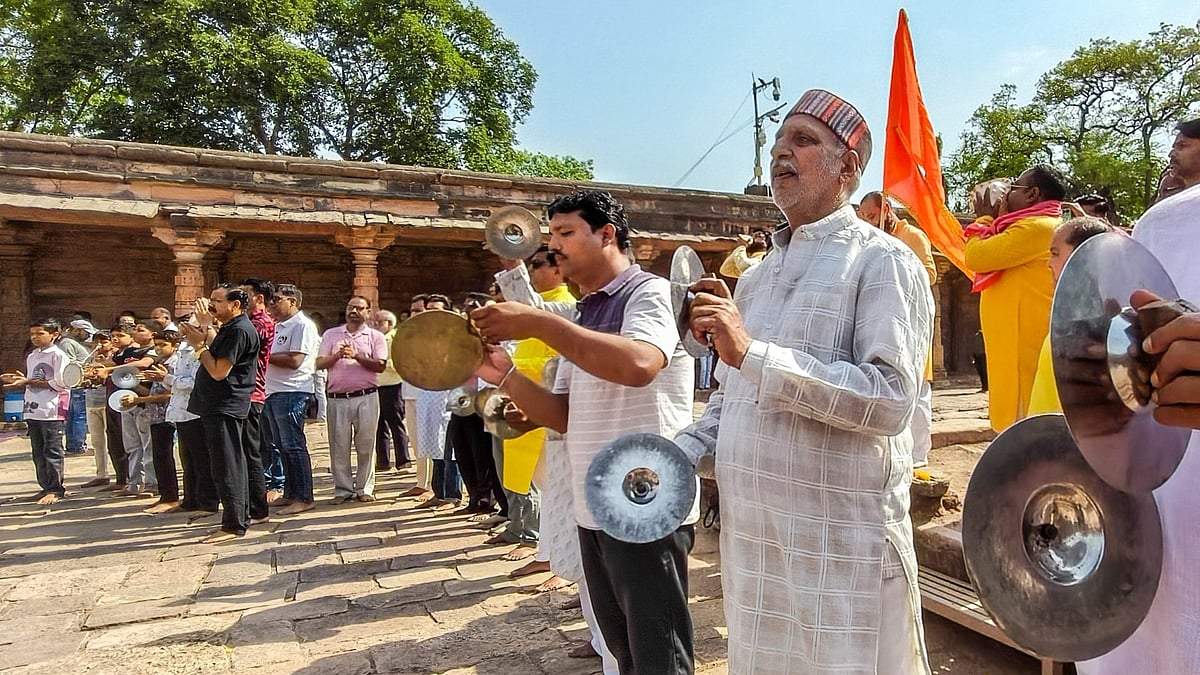
Though the ancient Bhojshala-Kamal Maula complex is still under the custody of the Archaeological Survey of India (ASI), festivities started immediately after the court order. The whole complex was decorated with banners, buntings, and marigold flowers, and since then puja has been performed there every day.
“The ASI has issued orders allowing puja," District Collector Rajeev Ranjan Meena, who participated in the rituals, alongwith other officials, told The Quint.
The truth of the Bhojshala controversy is best captured by two profound realities: a multi-layered legal battle that is only just beginning, and an empty marble pedestal in Dhar that has been waiting for its deity for well over a century.
An Old Plot and a Familiar Illusion
The Chief Minister’s immediate invocation of Ayodhya is a masterclass in political messaging, but a disaster in legal realism. It creates the dangerous illusion of a quick resolution.
The 2019 Ayodhya verdict by the Supreme Court was a singular, exhaustive adjudication that concluded a decades-long nationwide movement. The resolution was built on the foundation of judicial finality, complete with a Supreme Court-mandated allocation of an alternative five-acre plot for a mosque to ensure a semblance of civic closure and constitutional balance.
After the Madhya Pradesh High Court verdict, the whole Bhojshala complex was decorated with banners, buntings, and marigold flowers, and since then puja has been performed there every day.
(Photo: PTI)
Hours after the high court's ruling, Hindu petitioners rushed to file a caveat in the Supreme Court, fully aware of what comes next.
The All India Muslim Personal Law Board (AIMPLB) and the Kamal Maula Mosque Committee are already drafting a Special Leave Petition. Tousif Warsi, counsel of Maulana Kamaluddin Welfare Society, told The Quint:
He added that in the "order passed by the high court, all the legal, technical, and historical submissions and objections to maintainability of the petitions (unconstitutional body seeking constitutional relief from constitutional court of law) also on the survey report (of the ASI) has not been considered in true purport. Also, the historical aspect of the matter has been considered selectively. As a result, we are very hopeful from the Supreme Court.”
While arguing in the high court, the Muslim side had challenged the constitutional validity and legal standing of the Hindu Front for Justice to file a PIL.
Like in Ayodhya, he tells The Quint, we started preparation much before the apex court delivered its verdict.
The battle now moves to New Delhi, where the Supreme Court will have to microscopically examine whether the high court’s absolute reliance on archaeological data violates the strict mandates of the Places of Worship Act.
This federal law was explicitly designed to freeze the religious character of all places of worship as they stood on 15 August 1947. By promising a "grand temple" before the apex court has even admitted the appeal, the state leadership is overpromising a swift victory to a domestic audience, added the senior lawyer.
The Cost of Living in Limbo
While top-tier senior advocates prepare to debate the Constitutional nuances of the matter in the air-conditioned corridors of the Supreme Court, the town of Dhar faces the tangible, grueling consequences of "forever litigation."
For over two decades, under a sensitive 2003 ASI arrangement, the local population managed a delicate, shared co-existence as the Hindus prayed in the complex on Tuesdays, and Muslims offered namaz on Fridays. It was an imperfect, heavily policed compromise, but it allowed the town to breathe, function, and conduct business.
History shows that when a town becomes a permanent legal battleground, its economy stagnates. Local tourism, real estate, and daily commerce are put on a perpetual hold. The social fabric is stretched thin as neighbours are forced to view each other through the lens of pending litigation. The political class gains an eternal electoral talking point, but the local populace pays the daily tax of living in a hyper-police bandobast town.
Amidst the deployment of a large police force, including the presence of the Rapid Action Force, Hindus performed puja on Tuesday. Come Friday, the Muslims are determined to offer namaz.
The Empty Pedestal
Nowhere is the performative nature of this controversy more visible than in the ongoing saga of the Goddess Vagdevi (Saraswati) idol. The exquisite 11th-century white marble statue, originally consecrated by King Bhoja of the Paramara dynasty, was excavated from the Bhojshala ruins and quietly shipped off to central London by British colonial officials in the late 19th century.
The performative nature of the Bhojshala controversy is the most visible in the ongoing saga of the Goddess Vagdevi (Saraswati) idol.
(Photo: PTI)
Twenty-two years have passed since that promise. Governments have risen and fallen, political slogans have been rewritten, and yet, the statue remains under the soft museum lights of central London. The pedestal in Dhar remains entirely empty. In the wake of the May 2026 verdict, the political script has been dusted off and replayed.
Chief Minister Mohan Yadav has once again "sounded the bugle," directing officials to initiate procedures with the Central government to repatriate the idol in a textbook example of cultural antiquities being used as eternal political carrots.
However, an ASI official, wishing anonymity, explained, "International repatriation of heritage is an incredibly complex geopolitical and diplomatic process, not a state-level administrative directive."
A Saga of Unfulfilled Political Carrots
By continuously framing the statue’s absence as an emotional injury that only their political party can heal, leaders ensure they have a potent narrative to deploy during every election cycle, without ever having to deliver on the actual legal and diplomatic heavy lifting required to move the statue across continents. The empty pedestal is incredibly useful to politicians; filling it would mean losing a powerful grievance.
The Bhojshala controversy exposes a profound flaw in how modern India handles historical wounds.
(Photo: PTI)
When the Supreme Court inevitably takes up the Bhojshala appeal, it must look beyond the archaeological dirt and consider the future of the living community. Perhaps the true resolution lies not in building an exclusive monolith that erases centuries of history, but in transforming the site into a national cultural monument—a living museum that acknowledges both its glorious origins as a center of Vedic learning and its painful medieval fractures.
Until then, the people of Dhar will remain trapped in a legal loop, and the empty pedestal will continue to stand as a quiet, marble monument to unfulfilled political promises.
(Deshdeep Saxena is an independent jouranlist reporting on news and politics from Madhya Pradesh.)
- Access to all paywalled content on site
- Ad-free experience across The Quint
- Early previews of our Special Projects
Published: undefined