
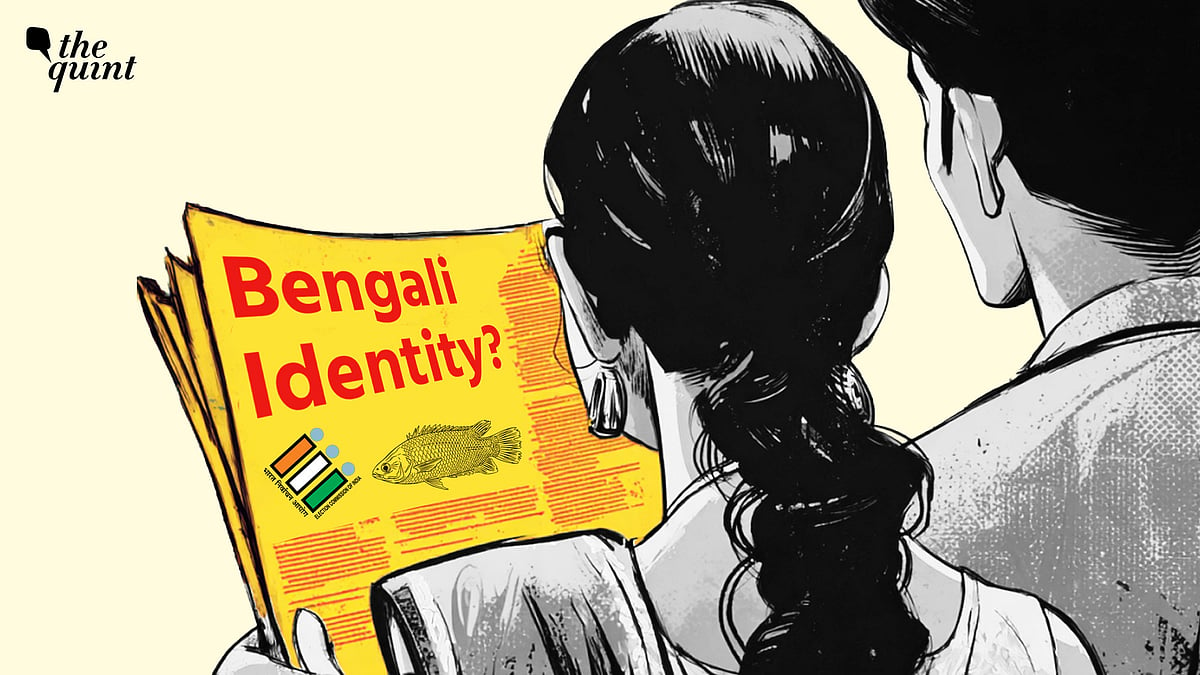
Fish to SIR, Everything About 2026 Bengal Polls is a Test for Bengali Identity
The secular, progressive Bengali will be put to test on 4 May. As will the fish-eating BJP.
advertisement
Mornings are usually a busy time at the Southern Market 'maacher bazaar' (fish market) in Rashbehari Avenue neighbourhood of South Kolkata. The shops are set up at dawn. And, by late morning, the freshest catch is already sold out, aggressively bought out by middle-aged men in starchy panjabis or women in printed chaapa sarees, carrying home the spoils of war in their trusty striped mesh and nylon "bajaarer tholi" (shopping bag), the same one they have used for years, and wearing a tell-tale smirk.
In West Bengal, shopping for fish is not just a daily chore. For many, it's a ritual.
The depth of a "real" Bengali is often measured by their ability to tell good fish apart from the bad. Now, as Bengal awaits the 2026 Assembly election results, this instinct is being put to the test, with Bengali voters looking to sift between the good and the bad fish in the state's politics.
BJP leader Anurag Thakur eating fish ahead of Bengal polls.
(Photo: X)
While critics have questioned the party's "sincerity" about such claims amid "double standards" on meat consumption across states, the campaign, on the face of it, is meant to counter the criticism, mounted by the ruling Trinamool Congress (TMC)—that the BJP is a party of outsiders and non-Bengalis, who, if they assume power in Bengal, will enforce Bengalis to eat only vegetarian food.
When seen in the larger context, though, the overtures speak to a deeper and very real anxiety that has increasingly been creeping in across the state: Will Bengal stay in the hands of Bengalis? And conversely, if it doesn't, will Bengalis be able to stay in Bengal?
Politicising the Bengali Identity
This election is unlike any other that the state has seen, with lakhs removed from the state's voter list under the Special Intensive Revision (SIR) of electoral rolls mandated by the Election Commission of India.
The Quint has spoken with scores of persons (with legally valid documents) whose names were "waitlisted" or removed entirely from the state's polls. Apart from the obvious incredulity at not being allowed to cast their vote by the ECI, the very body entrusted with ensuring enfranchisement, what stands out is the psychological impact of being "erased," as one deleted voter in Kolkata put.
But, while the SIR and the uncertainty surrounding it has left the common man and woman at their wits' end, it has set up the stage for both BJP and TMC to play out the larger politics of identity and belonging: Who is a Bengali? What defines Bengal? Who belongs to Bengal and, perhaps most importantly, who will be allowed to live here in future?
The question of identity has always been part of Bengal's political discourse. During the Congress-Left era, this identity, for the most part, was defined based on political ideology. The Congress' reign was marked with violence against the communist leaders.
A Durgapur-born professional working in Bengaluru recalls the killing of her grandmother Comrade Latika Sen, a CPI(M) leader, who was shot dead on the streets during a Congress crackdown against protesters demanding the release of political prisoners.
"The Congress ran a reign of terror in those years. I have grown up listening to stories of the bravery of my ancestors in the face of fascist powers," she said. And yet, today, she remains disillusioned with the Left, like many former supporters facing the decline of both the Left's organisation and philosophical structure that once bound the state's discourse.
Critics of the Left also point out the Marichjhapi massacre in 1979 over the forced eviction of Hindu Dalit refugees from East Pakistan from the Sunderbans during Jyoti Basu's government, and the communal polarisation that foregrounded the police shooting against anti-land acquisition protesters of 2009 also alienated caste and minority groups. The invisibalisation of caste and underrepresentation of Muslims, as well as eventual excesses by sections of the party leadership in the Left led to resentment in these sections, which was eventually leveraged by the TMC.
"After 2011, for instance, the Mamata Banerjee government started focusing on caste, making overtures toward the the Scheduled Caste/Scheduled Tribe/Other Backward Class communities like the Matuas of the border regions, the Lepchas, Bhutias in North Bengal, and other caste or tribal groups, along with efforts to establish itself as pro-poor," political analyst Maidul Islam tells The Quint. These were also the groups that the BJP eventually targeted when they first started to expand in the state.
The TMC also strengthened its base among Muslims by increasing their representation in the state's politics. The perception that the minority somewhat prospered in the state, compared to earlier, invited allegations of "appeasement" but Mamata remained unfazed. In 2013, despite grumblings, the TMC introduced the Imam bhata (monthly allowance).
The TMC saw the signs early on. In 2016, to counter the appeasement allegations, Mamata started the Durga Puja carnival on Red Road to silence questions over her visits to mosques to offer namaz. By 2017, the Purohit bhata was introduced to balance out the Imam bhata. In 2025, inaugurated a Rs 250 crore Jagannath temple in Digha.
"Such moves invited some suspicion from the Muslims as well. Rise of 'third front' politics like that of the ISF or Humayun Kabir's emotional Babri pitch have had an impact on voter psyche in some regions," analyst Zaad Mahmood tells The Quint.
A street covered with TMC flags and wall painting in Murshidabad.
(Photo: Rakhi Bose)
Perhaps aware that it could not 'out-Hindu' the BJP, the TMC shifted tack and adopted a new slogan, "Bangla Banglar Mey Ke Chay" (Bengal wants its daughter) following 2019. It was both a stern assertion of Bengali nativist nationalism and a call to action for Bengal to retain its cultural identity and Bengaliness by electing someone from Bengal.
It also became a way to bring in both Hindus and Muslims under a common Bengali identity at a time when the BJP had already started pushing the "insider-outsider" narrative, with laws like the CAA and NRC.
"Election after election, the narrative that Mamata Banerjee kept reiterating is that Bengal's culture is under threat. Which it is. This Hindi-Hindu-Hindutva ideology is entirely antithetical to Bengali cultural discourse and identity. She said that if you want to retain your culture and Bengaliness, vote for me. It worked for her too," Jawhar Sircar explained in an exclusive interview to The Quint.
'Us and Them'
"Communal divides did exist in Bengal, it's the legacy of Partition or even the violence before and after that. Be it the Great Bengal riots, the violence in 1964...the result was that Kolkata was already ghettoised, there was always an "us" and "them", perhaps as a remnant of the trauma of these events. Since the Partition, however, the Left and Congress had not stoked the communal line to drive elections in Bengal. After 2014, that changed".
The BJP and the Hindu-right has been active in establishing Muslims as the "other". By invoking (and often inventing) memories of sectarian violence and distorting history through propaganda films like "The Bengal Files", or communalising significant events like the "Football Lovers' Day" (when 16 football fans were killed in a stampede and ensuing violence during an East Bengal-Mohun Bagan match). After the TMC cleverly renamed it as "Khela Hobe Diwas", in line with its slogan, meaning 'Game On', the BJP led by Dilip Ghosh called it "Pashcimbanga Bachao Diwas".
Caught between the tug of war between TMC and BJP, the upper-caste, upper class, primarily Hindu academia that flourished under the Left has been marginalised to the sidelines, leaving room for a rising expression of populist and increasingly communal angst among the general populace, thanks to a cocktail of the right's anti-Muslim propaganda and the TMC's "de-Leftification" of Bengali heritage and education.
Incidentally, many in the Left, including the progressive bhadralok, since the coming of BJP, have quietly promoted the BJP over TMC as part of an apparent "strategy" to weaken Mamata's hold. During the 2021 elections, one of the unofficial slogans of a section of the Left was "Aage Ram, Tarpor Bam" (First Ram, then Left).
This year, a younger vanguard of leaders like Dipshita Dhar, Afreen Begum, Meenakshi Mukherjee and others contesting on a CPI(M) ticket are trying to flip the narrative in Kolkata and bring back the focus of electoral rhetoric on issues the Left had once ideologically stood for: people's empowerment, and right to dignity and bijli pani sadak. But while they have an impact among a certain section of the secular, urban, educated voters and Left-optimists, the larger narrative is still being dominated by the bigger parties.
Polarisation vs Change
During a recent rally, Home Minister Amit Shah spoke about removing "them" from Bengal, "those who have four marriages".
Meanwhile, Prime Minister Narendra Modi has been the more benign face, snacking on jhaal mudi (spicy puffed rice) and taking boat rides on the Ganga. He has also been campaigning for Ratna Debnath, the mother of the 2024 RG Kar rape victim contesting as a BJP candidate from Panihati. While the party has been spinning her reportedly voluntary candidacy into its 'nari shakti' rhetoric, the move has met with a lukewarm (to say the least) response from those who had fought for Abhaya, the victim.
The brutal rape and murder of the young doctor sparked the fuse of a protest that was, at its core, "a fight against the political ideology of both the TMC and the BJP, and their culture of impunity that only empowers the powerful", as a "Reclaim the Night" protester told The Quint, requesting anonimity. "The BJP or TMC reaping any benefit from the Abhaya tragedy would be the height of irony".
For many, therefore, this vote has come down to picking the lesser of the evils.
Ankita Ghosh, a former student of Jadavpur University who now works with a bank in Mumbai, has flown back home to vote. "I'm an executive class migrant and my privilege cushions me from the larger impact of any regime change that those in more constrained positions face. For me, question of regime change is then a matter of ideology," Ghosh states.
Meanwhile, Samserganj's Sultan Sheikh, a migrant worker from Murshidabad who spends most parts of the year in Kerala working as a carpenter, also came home because he wanted to vote. But he was not allowed to vote, as his name was under adjudication following SIR.
Sheikh and the thousands of voters in rural, Muslim-populated belts of West Bengal lining the Bangladesh border who have been struck off from this year's voter list, now feel a threat to their identity, making the question of 'Who is a Bengali' much more pertinent to the community.
Murshidabad saw the highest deletions of Muslims in West Bengal under SIR.
(Photo: Rakhi Bose)
"We know that the BJP has tried to portray Muslims, especially the poorer migrant-worker population in Bengal's border districts, as Bangladeshi. They have called our language "Bangladeshi language", even though every one knows there is no such thing. We speak in Bangla. It is definitely a way to show us as outsiders, which puts our future existence in the country under jeopardy," Sheikh states.
On the other hand, many especially among the Hindu community have been demanding development and see the BJP as the only vehicle that can roll in "unnayan" (development) and bring in Central funds essential for said development. There is also a growing anti-incumbency against the TMC government, which has been in power for 15 years.
While some amount of anti-incumbency would thus be natural, the party faces allegations of corruption and syndication from the ground up. Irrespective of communal or caste make-up, every constituency that The Quint visited was plagued with complaints against the ruling party's "high handedness" and corruption. Thus owning the Bengali identity question, as Jawhar Sircar mentions, is just as essential for Mamata as it is for Modi.
Defining the 'Real Bengali'
So what does it really mean then, to be a Bengali? Is it just about eating fish, watching Satyajit Ray-Mrinal Sen in black and white, and romanticising Karl Marx inside dimly lit South Kolkata cafes? Is it to choose TMC over the BJP?
"Well, once it used to be about being a secular, progressive people. Bengal used to have cosmopolitanism which allowed for different strands of identities to coexist under one big cultural banner. Now, it is more about nativism," Islam explains.
Bengal's favourite bard, Rabindranath Tagore, had written in Bongomata, "You have made Bengalis, you have not made people". The lines, meant to satirise the self-consciousness and passivity of the bhadralok, have perhaps taken on a new meaning today for most of the state's residents like writer and actor Soumit Deb (and also Ghosh and Sheikh) who identify first as Bengali and then by their caste and religious identity.
He further adds, "Promoting a communal identity over a cultural one has become common in every state in BJP era. And Bengalis, both Hindus and Muslims, are aware of these gimmicks. Every party may try to exploit identity politics but it is only the one party which has tried to eliminate one group entirely from the state's voter rolls. And we all know who that is."
But this conviction in secular and democratic ethos weakens as one crosses the Hoogly river heading west from Kolkata, and arrives at the district of Howrah, where just days ahead of the second phase, TMC and BJP workers assaulted each other over political differences. Amid high security deployment, the region remains tense. Here, every year during Ram Nabami, the Hindus and Muslims (including non-Bengali migrants who form a sizable chunk of the population) in the region clash. With every clash, the region becomes more and more polarised.
Snehangshu Ghoshal, a worker aligned with the CPI(M) tells The Quint:
In these parts, being Bengali is a far more adaptive idea. The language is coarse and accentuated with Hindi, the music is loud, and the adda is still on the rock. Though South Bengal is a TMC bastion, Satyaki Tat, another local from Shibpur, feels that due to the high Hindu population in the region and polarisation over the years, the BJP's footprint has grown.
And, come 4 May, the secular, progressive Bengali's Bangali asmita will be put to the test. As will the fish-eating BJP's pitch for poriborton (change).
- Access to all paywalled content on site
- Ad-free experience across The Quint
- Early previews of our Special Projects
Published: undefined