
How Babri Masjid Demolition Damaged Idea of India: A View from Punjab
The last ten years have seen a clear shift from democracy to authoritarianism—where dissent is labelled anti-Hindu.
advertisement
When Narendra Modi hoisted a saffron flag at the Ram Mandir in Ayodhya with shivering hands, the video went viral on social media, reflecting his deep emotion. The larger message being pushed was that the collective struggles of Hindus for five centuries had finally paid off, a historical wrong had been corrected, and Modi was the devoted Ram bhakt who had achieved it.
Prime Minister Narendra Modi being presented a replica of Ayodhya's Ram Mandir by Uttar Pradesh Chief Minister Yogi Adityanath after the Pran Pratishtha ceremony at the Ram Mandir.
Prime Minister Narendra Modi breaks his fast after the "Pran Pratishtha" ceremony at the Ram Mandir
Prime Minister Narendra Modi prostrates before the idol of Ram Lalla during the Pran Pratishtha rituals at the Ram Mandir, in Ayodhya.
This kind of symbolism has been used by the Prime Minister many times during events such as the Ram Mandir bhoomi pooja, the new Parliament pooja, and in numerous speeches, where he projected himself as a staunch Hindu leader who strengthened the BJP-RSS dream of a Hindu Rashtra.
The entire idea of a Hindu Rashtra today is built on the narrative of Mughal barbarism and the need for revenge. It is an emotional script where Hindu victimhood becomes the foundation of political power.
This pattern is also visible in popular cinema. Films such as The Kashmir Files, The Kerala Story, JNU: Jahangir National University, Veer Savarkar, and even Paresh Rawal’s recent film The Taj Story, which claims there was a temple underneath the Taj Mahal, all carry the same message— Muslims harmed Hindus, Hindus have suffered, and it is time for retribution.
This cultural production feeds directly into majoritarian politics that thrives on grievance, rage, and the rewriting of history to justify the politics of the present.
But what does this message say to the Muslim citizens of this nation, who have been subjugated under this regime?
The Ayodhya Verdict: Based on Law or Faith?
According to the Ayodhya verdict, the Muslim Waqf Board was allotted a different five-acre land. Though the land was allotted, no brick has yet been laid, as the initial blueprint submitted to the Ayodhya Development Authority was rejected.
The Ayodhya verdict should be considered one of the biggest judgments of the 21st century. After the illegal demolition of the Babri Masjid in 1992, Hindus finally got their site back as per their claim after five centuries.
Justice DY Chandrachud, whose Bench delivered the judgment, told senior journalist Sreenivasan Jain in an interview for Newslaundry that the verdict was based on law, not faith. Yet he described the building of a mosque there as an act of discretion.
India is a secular democratic republic according to the Constitution. If the upholder of the Constitution can make such contradictory claims, then what meaning is left in the word Constitution?
India accepted the idea of democracy in 1947. If the state is attempting to allegedly correct historical wrongs, then the whole project of equal citizenship and a secular democratic republic collapses.
Unfairly Implicating Muslims Post-Babri Masjid Demolition
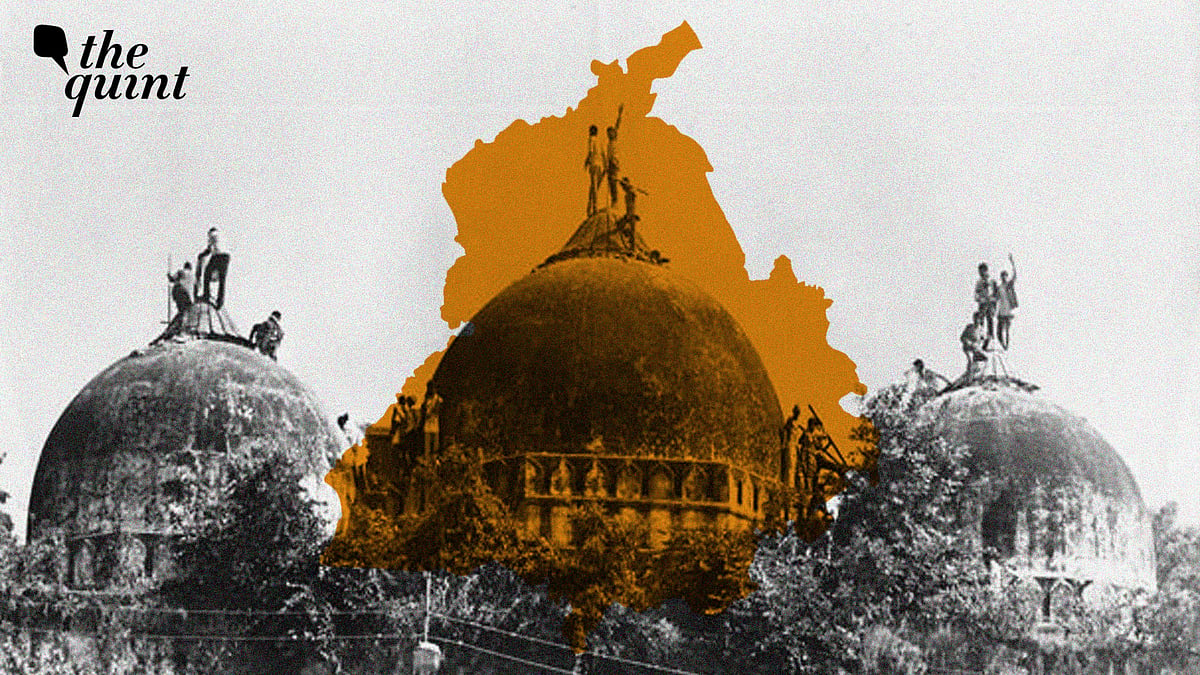
The demolition of the Babri Masjid led to immense riots in Mumbai and the vilification of an entire Muslim community.
Before Babri Masjid, the Terrorism and Disruptive Activities Prevention Act (TADA), which came into effect in May 1985, had been used exclusively to target Sikhs and the Khalistan movement in Punjab. After the demolition and subsequent riots, we began to see instances of Muslims being arrested and framed under TADA.
One of the earliest such cases involved brothers Zaheeruddin Ahmed and Nisaruddin Ahmed, accused in the 1993 serial train blasts — explosions on the night of 5–6 December 1993 that struck six long-distance trains serving cities Lucknow, Kanpur, Hyderabad, Surat, and Mumbai. The blasts occurred on the first anniversary of the demolition of Babri Masjid.
Zaheer recalled that when he was in jail, he was surrounded by Sikhs jailed on Khalistan-related charges. But gradually the demography changed, with more and more Muslims being arrested.
Another example is the acquittal of twelve Muslim men arrested after the 2006 Mumbai local train blasts, which had killed more than 187 people. They were finally acquitted by the High Court in July 2025 after 19 years in custody, though tragically, one of them, Kamaal Ansari, died in jail after contracting COVID-19.
These cases highlight the long-term criminalization and targeting of Muslims in the aftermath of major terror incidents, reflecting a continuity in the use of state power to disproportionately implicate minority communities following communal polarization after the Babri Masjid demolition.
Babri Masjid Demolition Shapes Legal, Political Structures Even Today
This pattern of targeting Muslims persists in contemporary times as well.
A striking example is the 2020 Delhi riots conspiracy case, where Umar Khalid, Gulfisha Fatima, and several others were arrested and remain in jail under the Unlawful Activities (Prevention) Act (UAPA). The riots erupted in north-east Delhi in February 2020 during protests against the Citizenship (Amendment) Act, 2019 (CAA) and the National Register of Citizens (NRC), and left 53 people dead and over 700 injured.
Courts are still refusing bail in the “larger conspiracy” cases, with the Delhi Police Special Cell arguing that the violence was planned and that the accused were among the “masterminds.”
It reflects how the communal and institutional dynamics unleashed by the Babri Masjid demolition continue to shape legal and political structures in India even today.
Like the BJP has done in the last ten years, through CAA-NRC, othering of Muslims, bulldozer justice, lynching of Muslims over beef, garlanding of the Bilkis Bano rapists, using UAPA to arrest minorities, and taking away the space for dissent and criticism—it all makes the project of the BJP-RSS successful.
We have seen the BJP-RSS undermine democratic institutions one by one. Opposition leader Rahul Gandhi claims “vote chori” also shows that the word democracy is now just symbolic and has lost all meaning.
Bageshwar Baba rallying for Hindu Rashtra and certain celebrities supporting it show that today, to survive, one is either part of Hindu Rashtra or anti-Hindu. There is no in-between.
From Soft Hindutva to Hard Hindutva
Like the BJP, we too look for answers in Nehru, India’s first Prime Minister, who has been the most discussed and often blamed figure since 2014.
As per columnist Pratap Bhanu Mehta, the idea of Hindu nationalism is not isolated. It emerges from within democracy, from democratic structures. But once in power, it uses democratic mechanisms such as elections, majoritarianism, and identity politics to soften the ground and reshape the state. Nehru wanted the Indian state to be modern but did not challenge structural inequality based on caste and religion.
Recently, the 7/11 verdict led to the release of many Muslims who had spent years in jail. This happened even before Modi came to power. The functioning of the state has been similar since 1947, evolving from soft Hindutva to hard Hindutva. The state has become increasingly radical toward minorities.
However, the 1984 anti-Sikh riots and the 1992 demolition of Babri Masjid remain permanent blots on the Indian state and Constitution. Both reflect that when the state itself wants to harm minorities, there is no justice left for them. The state rewards those who lead the charge against minorities.
The idea of Hindu Rashtra does not mean there will be a bhagwa flag or that the Constitution will be replaced with Manusmriti.
The idea of Hindu Rashtra comes from within the democratic state, with the Indian flag, the Constitution, and the judiciary still in place. Only resistance to the state is labelled as anti-Hindu, and those who criticise the state are given different labels such as Pakistani, Urban Naxal, or Khalistani, depending on their identity.
- Access to all paywalled content on site
- Ad-free experience across The Quint
- Early previews of our Special Projects
Published: undefined