
Can a People’s Candidate Win? Pranab Doley’s Fight in Assam's Bokakhat
Independent Pranab Doley's image as a people's candidate is his biggest advantage in the upcoming Assam elections.
advertisement
In November last year, India was represented at the 14th United Nations Forum on Business and Human Rights at Palais des Nations in Geneva by human rights activist Pranab Doley. Before an audience of 4,000 people, he spoke at the session—titled 'Advancing the Just Transition During Times of Crises'—about how states and businesses can support a just energy transition while respecting the human rights of indigenous people.
Doley, who has been fighting for the rights of indigenous people for more than a decade, transitioned into electoral politics in 2021 as an independent candidate from Bokakhat constituency in Assam’s Golaghat district. At that time, he posed a tough fight to Atul Bora, an important member in Chief Minister Himanta Biswa Sarma's Cabinet of ministers, currently handling the Agriculture portfolio.
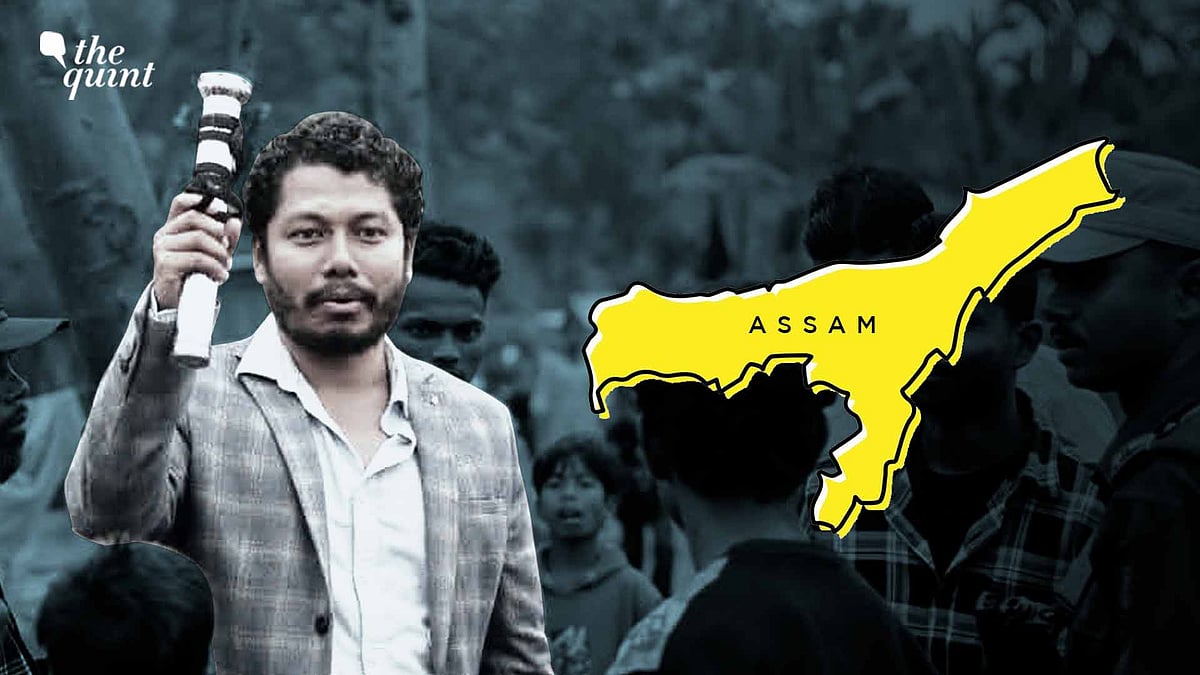
Pranab Doley explaining his election symbol torchlight to people.
(Photo: Sourced from Facebook)
While initially deciding not to contest, Doley has finally embarked on the electoral battle of 2026, purely on the strength of public support. His years of activism have earned him goodwill at the grassroots, which he hopes to encash in this election.
Bokakhat: A Constituency Defined by Contradictions
Forty-year-old Doley has a strong following among the younger generation. He leads a group called ‘Youth for Bokakhat’, which has more than 1,000 members. They are mostly campaigning for him on the ground.
However, he is aware that public support alone isn't enough to win an election. Along with his supporters, he has started an online crowdfunding campaign to generate funds for his electoral journey this time.
Bokakhat is primarily a rural constituency. As per the 2024 Lok Sabha election data, the constituency has 1,58,782 registered voters. As per Bokakhat Municipal Board data, the urban population of Bokakhat is approximately 20,182—based on updated projections as of March 2026.
What makes it strategically important is that a lion’s share of the Kaziranga National Park—a major tourist attraction and a UNESCO World Heritage Site—falls under this constituency. In fact, of the total area of 1,307 sq km of Bokakhat, almost 33 percent or 430 sq km comes under Kaziranga.
A Life Shaped by the Margins
Doley hails from Panbari Mising Gaon, a village just in the fringes of Kaziranga.
Doley says that Bokakhat’s status as a “no-development” zone has left its economy heavily reliant on tourism, agriculture, and tea gardens, without adequate state support for farmers. Blaming his opposing candidate Bora, he tells The Quint, "Our sitting MLA, despite handling the Animal Husbandry and Agriculture portfolios, has hardly done much for the farmers here. On paper, there are some schemes for pumpkin farmers but the benefits don't reach the actual farmers, who have to throw away their surplus produce for lack of a cold storage unit."
If elected, he says his priorities would include strengthening basic infrastructure linked to tourism around Kaziranga, including healthcare, housing, and public amenities, while also promoting cooperative-based village tourism to generate local income. In agriculture, he proposes building cold storage units, improving irrigation, and setting up procurement centres. He also emphasises improving living conditions for tea garden workers, who continue to lack basic amenities.
Having grown up amid frequent human-wildlife conflict, Doley highlights compensation for loss of life, crops, and property as a major concern.
"Also, as Bokakhat is a flood- and erosion-affected constituency, I will try to ensure people get proper rehabilitation and build infrastructure which can house them during such calamities," he adds.
Hats in the Ring
While six candidates have filed nominations from Bokakhat, the contest is widely seen as a three-cornered fight between NDA ally Asom Gana Parishad’s (AGP) Atul Bora — currently Assam’s Agriculture Minister — Pranab Doley, and Raijor Dol’s Saikia. Also in the fray are independent candidate Jiten Gogoi, a two-time MLA from Bokakhat; Hemanta Doloi, contesting as an independent; and Bibekananda Rajowar of the Gondwana Ganatantra Party (GGT), who represents the tea tribe community.
Among them, Bora, Doley, and Gogoi were in the fray in the last election as well. Bora, an important name in the ruling alliance, had an easy win by securing 60.56 percent of the votes, while Doley came second by getting 23.04 percent of the votes.
Gogoi received 4.61 percent of the total votes. Bora will be looking to complete his hat-trick from Bokakhat this time, but experts say that there are signs of a strong anti-incumbency against him, and that people of Bokakhat could also ideally want someone local to represent them, as Bora is originally from Golaghat.
Two-time sitting MLA Atul Bora at an event in Bokakhat.
(Photo: Sourced from Facebook)
Two-time former MLA Gogoi is a local known to the people of Bokakhat, but he doesn't seem to have much support among the younger generation. In 2009, 63-year-old Gogoi, who is a surrendered United Liberation Front of Assam (ULFA) leader, was caught while illegally angling inside Kaziranga, and when charged, he assaulted a park ranger.
'King of Kaziranga' Jiten Gogoi meeting voters.
(Photo: Sourced from Facebook)
The opposition alliance of the Congress and the Raijor Dol have fielded Saikia, a candidate mostly unknown to the people of Bokakhat. He was formerly chairman of the Assam Pradesh Kisan Congress. He resigned recently to join Raijor Dol.
Hari Prasad Saikia, the candidate backed by opposition this time.
(Photo: Sourced from Facebook)
There is also Rajowar, a candidate from the tea tribe community contesting from the GGT, a party which has some influence in states like Chhattisgarh and Madhya Pradesh but not much in Assam.
Lakshman Bowri, a tea tribe worker in Lakhijan tea garden near Bokakhat and secretary of Assam Cha Mazdoor Sangha, the largest organisation of tea garden workers in Assam, tells The Quint, “There are more than 65,000 tea tribe voters in Bokakhat, and so we are the biggest factor in deciding the fate of the election here. Rajowar is from our community and works in Numaligarh tea garden. So, he might get 20 percent of tea tribe votes. Rest of our votes will be distributed between Bora, Doley, and the opposition candidate.”
Sourav Kumar Patgiri, who has been working closely with Doley since a decade, tells The Quint,
Agrarian Economy Under Stress
Bokakhat, being a ‘no development’ zone due to its proximity to Kaziranga, restricts industrial projects in the constituency. This makes the constituency heavily dependent on agriculture. Veteran journalist Nilu Acharjee, who's been working in the Assamese daily Dainjk Janambhoomi for more than three decades, is critical of the agrarian condition in the constituency.
Uttam Saikia, conservationist and former honorary wildlife warden of Kaziranga National Park, adds, “Kohora, Agoratoli, and parts of Bagori range come under Bokakhat. Two very important animal corridors mainly used by wildlife of Kaziranga—Panbari and Haldibari—also fall under this constituency. Then, there is the sixth addition of Kaziranga, which goes up to Bhakatsapori in Bokakhat. That's why the locals here have a long-standing demand of turning Bokakhat into a tourist hub."
Apart from Kaziranga, another famous attraction of Bokakhat is peda, a traditional milk-based sweet whose taste stops many vehicles passing along the NH-37. However, Uttam Saikia says that the peda business in the region has suffered because milk production has dropped over the years.
”People don't think of pursuing higher education. Even today, just passing their higher secondary is good enough for them," he tells The Quint.
The Making of a People’s Candidate
Doley, a first-generation scholar, has been into activism since his student days. He did his graduation from the Institute of Rural Reconstruction, Sriniketan under Visva Bharati University. He then did his Masters degree in Social Work from the Mumbai campus of Tata Institute of Social Science. He has worked as an anti-mining activist in states like Chhattisgarh and Jharkhand.
An old candid picture of Pranab Doley.
(Photo: Sourced from Facebook)
He was also in the protest group under renowned anti-nuclear activist Praful Bidwai and actively protested the nuclear treaty between the US and India. He returned to his birthplace Bokakhat in 2015, and since then has been actively fighting for issues like land rights of indigenous people and compensation for affected people from wildlife conflicts. He has also been vocal against the militarised conservation model of Kaziranga and human rights violations like the case of Akash Orang, a seven-year-old-boy who was accidentally shot by a forest guard in 2016.
Tea tribe leader Bawri says Doley has actively worked on issues of tea garden workers. “In 2024, Doley actively worked on the ground to resist taking away the land of tea tribe people near Hatikhuli Tea Estate to build a five star hotel. He also helped to expose a microfinance unit scam recently which duped a large number of our women recently.”
Bosagaon resident Duarah says while Bora has worked on infrastructure like roads, people are seeking a fresh face.
That, perhaps, is the biggest advantage for Doley—his image as a people's candidate. As electoral equations grow more complex, he is hopeful that people will choose the torch—his election symbol—to remove the darkness in Bokakhat.
“Bora sees the people of Bokakhat just as his votebank. But, for me, they are my people. I am their son, brother, uncle. I am married to public service," he says with a laugh.
Come 9 April, he may have more reasons to smile, as the Bokakhat constituency has a history of throwing surprises with independent candidates here winning thrice.
(Nabarun Guha is an independent journalist based in Assam covering politics, environment, and human rights issues.)
- Access to all paywalled content on site
- Ad-free experience across The Quint
- Early previews of our Special Projects
Published: undefined