
'1,318 Hate Speeches in 2025, Anti-Christian Hate Speeches Spike by 41%': Report
1,164 hate speech cases (88%) occurred in states governed by the BJP, either directly or with coalition partners.
advertisement
(Exposing hate and communalism is a key focus area in The Quint's reportage. Such stories often come with a great deal of risk to our reporters. Become a member and support our 'Uncovering Hate Project').
In 2025, a total of 1,318 hate speech events were documented targeting religious minorities, particularly Muslims and Christians across India. On average, four hate speech events occurred per day, as per the new India Hate Lab (IHL) report.
This marks a 13% increase from 2024, and 97% increase from 2023, when 668 such incidents were recorded.
IHL, a project of Center for the Study of Organized Hate (CSOH) also highlighted The Quint's report on the attacks against Christians around Christmas 2025.
The IHL report noted that even though there has been an unprecedented surge in hate speech, there was further, deeper entrenchment of sectarian rhetoric as a routine feature of India’s political and social landscape.
The number of recorded hate speech incidents targeting religious minorities in 2025 surpassed the 1,165 instances documented in 2024.
Follow The Quint's Hate Tracker for more updates.
Last year, IHL observed that political leaders and members of Hindutva organisations drew on well-entrenched fear-mongering and scapegoating narratives that "depicted Muslims and Christians as disloyal, anti-national, dangerous, or demographically threatening."
These narratives, once confined to the margins, have now become central to public discourse, shaping electoral strategies, community organizing, and national debates on national identity and security.
"This rhetoric of conspiracy theories are almost immediately translated into policy initiatives, legitimizing aggressive measures to counter “love jihad” by Muslims and mass forced conversions of Hindus by Christians," stated IHL report.
Further, the ecosystem of hate maintained its highly organized character in 2025. The Bharatiya Janata Party (BJP) and Rashtriya Swayamsevak Sangh (RSS) affiliates such as the Vishwa Hindu Parishad (VHP) and the Bajrang Dal were central drivers of in-person hate speech events. Other far-right groups such as Antarrashtriya Hindu Parishad, Sakal Hindu Samaj also added to it.
'41% Increase in Anti-Christian Hate Speech': Key Findings
A total of 1,289 speeches, or 98%, targeted Muslims, either explicitly in 1,156 cases or alongside Christians in 133 cases. This represents an increase of nearly 12% rise from the 1,147 instances recorded in 2024.
Hate speech targeting Christians was recorded in 162 incidents, accounting for 12% of all events, either explicitly in 29 cases or alongside Muslims in 133 cases. This represents a nearly 41% increase from the 115 anti-Christian hate speech incidents documented in 2024.
Uttar Pradesh (266), Maharashtra (193), Madhya Pradesh (172), Uttarakhand (155), and Delhi (76) recorded the highest number of hate speech events.
1,164 hate speech incidents (88%) occurred in states governed by the BJP, either directly or with coalition partners, as well as in BJP-administered Union Territories, reflecting a 25% increase from the 931 incidents recorded in 2024.
Seven opposition-ruled states recorded 154 hate speech events in 2025, a 34% decrease from the 234 incidents documented in these states in 2024.
April recorded the highest monthly spike, with 158 hate speech events coinciding with Ram Navami processions and hate rallies organized in response to the Pahalgam terror attack.
(Photo: India Hate Lab report)
Uttar Pradesh Tops The List For Hate Speeches
The nature of the hate speeches also included jibes against Rohingya refugees. IHL observed that 69 hate speech events targeted Rohingya refugees, while 192 speeches invoked the “Bangladeshi infiltrator” bogey.
Among the 21 states analyzed, Uttar Pradesh recorded the highest number of hate speech events, with 266 incidents, accounting for 20% of the total. This represents an increase of nearly 10% from the 242 events recorded in 2024 and a 156% increase from the 104 events documented in 2023.
(Photo: India Hate Lab report)
Followed by Maharashtra which recorded the second-highest number of hate speech incidents in 2025, with 193 documented events, accounting for approximately 15% of the total dataset.
Among the top ten states and UTs with the highest number of hate speech events, the Prime Minister Narendra Modi-led BJP governed directly or ruled in coalition in nine for all or most of the year.
(Photo: India Hate Lab report)
This included the National Capital Territory of Delhi, where the BJP came to power in February 2025 following the Assembly elections.
Congress-ruled Karnataka was the only non-BJP–governed state to feature among the top ten, with 40 documented hate speech events.
(Photo: India Hate Lab report)
Distribution of hate speech: In 2025, the data shows that while both domestic and international events continued to trigger episodic spikes in hate speech, the more striking trend was the persistence of an elevated baseline throughout the year, the report noted.
IHL added, "Unlike previous years, where hate speech tapered off outside election cycles, 2025 exhibited sustained levels of mobilization even during non-election periods. This continuity suggests a strategic shift rather than reactive mobilization alone."
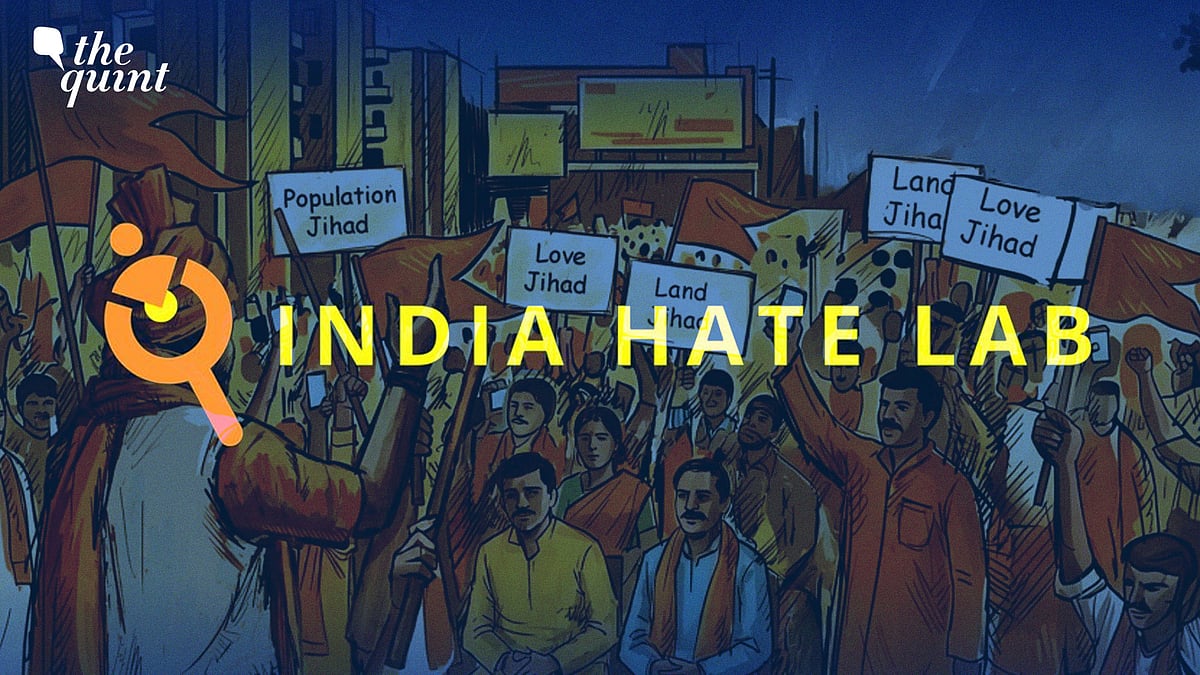
The key themes: In 2025, 656 hate speeches, accounting for nearly 50 percent of the total, referenced conspiracy theories. The most frequently invoked tropes included “love jihad,” “land jihad,” “population jihad,” “thook (spit) jihad,” “education jihad,” “drug jihad,” and “vote jihad.”
(Photo: India Hate Lab report)
Uttarakhand CM Made Most Hate Speeches
Among the organisations, the VHP and Bajrang Dal emerged as the most frequent organizers of hate speech events, directly sponsoring or facilitating 289 gatherings, accounting for 22% of all documented incidents.
However, among the key individuals responsible for delivering the highest number of hate speeches, a diverse set of actors stood out, including senior BJP leaders in 2025.
(Photo: India Hate Lab report)
CM Dhami's speeches were frequently delivered during election campaigns in states such as Delhi and Bihar. Dhami routinely propagated anti-Muslim conspiracy theories, including “love jihad,” “land jihad,” and “thook jihad,” framing Muslims as demographic, cultural, and moral threats.
On the second position was Pravin Togadia, chief of the AHP-RBD, who delivered 46 hate speeches in 2025, up from 31 in 2024 and 32 in 2023. Togadia, a former leader of the Vishwa Hindu Parishad (VHP), had previously fallen out with PM Modi and the broader Sangh Parivar.
Pertaining to elections, IHL also laid down that for the most part, rampant electoral hate speech in India has been concentrated around major state or general elections and only sporadically during local electoral contests.
In 2025, however, IHL observed a notable shift: "the systematic use of hate speech as a primary electoral tool for municipal and local body elections, which is traditionally fought on hyper-local issues of development, infrastructure, and civic amenities."
Ranging from various types of 'jihad' to the 'illegal immigrant' and 'intruder' narrative. The Quint covered this in our report on hate speeches around Bihar elections.
Regarding social media's role, the IHL stated that out of the 1,318 in-person hate speech events targeting Muslim and Christian minorities documented in 2025, IHL traced 1,278 of these events back to their original sources on social media platforms, where they were first shared or live streamed by far-right organizations, leaders, individual hate actors or participants.
(Photo: India Hate Lab report)
- Access to all paywalled content on site
- Ad-free experience across The Quint
- Early previews of our Special Projects
Published: undefined