
Exclusive: Removing Hurriyat From X Doesn't Undo What I Stand For, Says Mirwaiz
Social media is the only place I have left to connect with people, Mirwaiz Umar Farooq tells The Quint.
advertisement
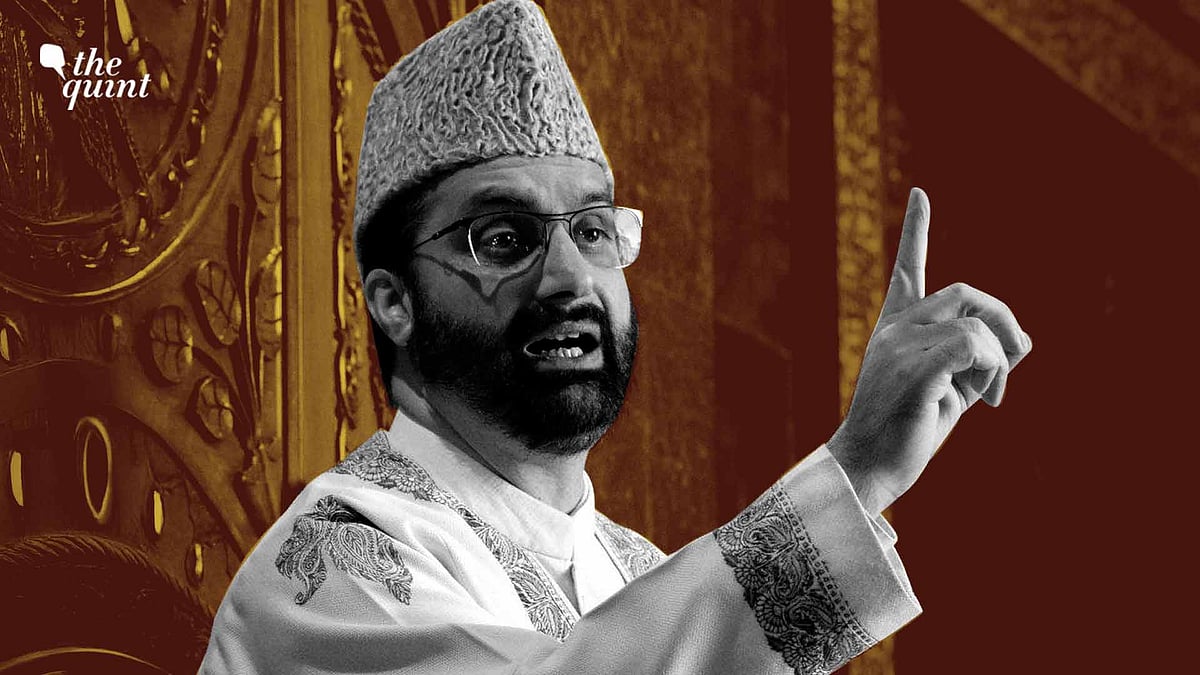
“Social media space is the only space available to me. The pulpit of Jama Masjid is also restricted (very often). Even last Friday, I was put under house arrest. That’s why, to stay connected and communicate, I made the changes to my (X) handle,” Mirwaiz Umar Farooq, Kashmir's chief cleric and separatist leader, tells The Quint, days after he dropped the ‘Hurriyat chairman’ title from his X bio.
The Mirwaiz's decision has sparked a controversy in the Valley amid debates over whether the banned group, which had once spearheaded extensive political campaigns for what it termed as the "resolution" of the Kashmir issue, has effectively been written out of the region’s history.
Hurriyat was outlawed for five years in March 2025 under the Unlawful Activities (Prevention) Act, 1967 (UAPA), on grounds that it was allegedly involved in subversive activities and was “supporting terrorism and fuelling secessionist activities”.
Under Pressure?
Last week, the Mirwaiz had tweeted that he was being “pressed” by the authorities in Kashmir to dissociate from the Hurriyat on his X handle, and delete the mention of his affiliation with the group. He had added that the authorities had warned that his handle would be taken down, should he continue to proclaim his association with Hurriyat. He described the deletion as “Hobson’s choice”, meaning there was no other way available to him.
His tweets have since triggered a political storm in the union territory, especially as his opponents have accused him of reneging on his previous promises, where he had been batting for a "political solution" for J&K. Some even see it as a prelude to the Mirwaiz, a hereditary title of a chief cleric that has remained a political fixture in the fractious politics of J&K since the 19th century, jumping the separatist camp and joining the mainstream.
‘My Beliefs Stem From My Convictions’
In an exclusive conversation with The Quint, the Mirwaiz adds that his political positions are "non-negotiable"—something he has held on to since he was 17-years-old, when he slipped in the robe of the head priest following the assassination of his father.
Moulvi Mohammad Farooq, the senior Mirwaiz, was assassinated by militants in May 1990. Farooq, like his son today, was considered as a political moderate.
Founded in 1993 through the most turbulent years of militancy, the All Parties Hurriyat Conference (APHC) came together as an amalgam of several separatist formations that wielded considerable political influence in the insurgency-wracked region. Their role was that of political mediation as they were believed to be closer to the Pakistani establishment.
Several national leaders including former Prime Minister Atal Bihari Vajpayee held several rounds of negotiations with Hurriyat leaders in their efforts to defuse the unrest in the region.
It also reopened dormant cases pertaining to militancy against various separatist leaders such as Yasin Malik, who headed the Jammu & Kashmir Liberation Front (JKLF), which it had banned along with Jamaat-e-Islami in early 2019. Two years later, the government outlawed the Muslim Conference and the Tehreek-e-Hurriyat, the two other major separatist organisations.
The Hartal Movements of Kashmir
Through various hartal (strikes), the Hurriyat often pressed its political demands as it protested the killings of civilians and the alleged role of the security forces.
The group also organised strikes to push back against controversial measures. In 2008, it protested against the state government's decision to transfer 100 acres of land to Shri Amarnath Shrine Board (SASB), which led to a civil uprising the same year. The region was also gripped by periods of unrest in 2009, 2010, 2013 and 2016.
It is this role as the organiser of strikes and shutdowns that has been at the centre of allegations that the government had made against him. But the Mirwaiz denies taking part in any wrongdoing, describing the strikes as “legitimate and democratic means to peacefully express disagreement and dissent and register protest.”
Besides heading a separatist group, the Mirwaiz is also a top priest of Kashmir who presides over the customary Friday sermons—loaded with political rhetoric and religious opinion of a range social and cultural matters—at the 600-year-old Jamia Masjid in Srinagar. The sprawling mosque of pillared halls and tiled cloisters has been at the centre of political mobilisation in Kashmir since late 19th century.
The Legacy of the Hereditary Priest
The title of Mirwaiz came to prominence during the reign of the Dogra dynasty in J&K, which established its control over the region in 1846. The then Mirwaiz Rasul Shah founded Anjuman Nusrat-ul-Islam at the turn of the 19th century, a socio-political group whose purpose was to usher in educational and cultural reforms within the Muslim community in Kashmir.
“It was Mirwaiz Rasul Shah who established the first primary school in Kashmir,” explains Noor Ahmad Baba, a former professor of political science at the University of Kashmir. “He understood the relevance of education for Muslims.”
The Anjuman also acted as a check against the visiting stream of European missionaries, who had been expanding their proselytising campaigns in the Muslim-majority region. Mirwaiz became a part of the wider political mobilisation calling for more rights for the Muslim subjects under the Hindu Dogra monarchy, whose rule had come to be resented by the Kashmiris.
These schisms continued to define the duality of political loyalties in Kashmir, at least until the early 1980s, when Farooq Abdullah, the then chief minister, inked an accord with Mirwaz Moulvi Farooq.
The coming together of the two Farooqs in what was called the ‘Double Farooq’ accord was intended to consolidate Kashmiris politically against what they saw as the imperious tendencies of the Central government headed by Indira Gandhi during her second term as the Prime Minister. In his recent book The Chief Minister and the Spy, former spymaster AS Dulat has defended this pact between the two leaders.
Before that, it was the Holy Relic movement of the 1964 that catapulted Moulvi Farooq to popular fame after he became a part of Action Committee, a broad-based political grouping that came into being in response to the sudden disappearance of a glass vial which encloses a hair strand of Prophet Muhammad.
The Mirwaiz’s Role During the ‘JP Movement’
During the 1977 Lok Sabha elections, the Mirwaiz reprised his role as a political heavyweight, this time as a (tacit) supporter of the Janata Party amid a national upsurge seeking the dislodgement of Indira Gandhi at the Centre following the proclamation of Emergency. In J&K, the Janata Party had relied on the political forces arrayed against Sheikh Abdullah, who had grown unpopular after his controversial accord with Gandhi in 1975, and that included the AAC.
In recent times, the Mirwaiz has significantly recalibrated his political rhetoric, voicing measured concerns over various political and social issues. The regional law enforcement has also sometimes denied him permission to attend Friday prayers at the mosque, citing potential risks of violent protests.
Earlier in 2025, the Mirwaiz also met Aga Ruhullah, a Parliamentarian from the National Conference, in a rare meet that saw the coming together of two diverging political voices over their shared opposition to the controversial Waqf Amendment Bill.
It is this history of “evolving” politics of the Mirwaiz that has triggered speculations whether the current bearer of the title will also alter his course into a different direction, possibly joining the mainstream. However, in the interview with The Quint, Mirwaiz denies it.
“For what purpose?” he asks. “We already have enough people there, and many well meaning (ones) among them. But has it been able to resolve the conflict and the uncertainty we live in? We had a war this year also. The role I have always seen for myself, inherited from the political legacy of my predecessors, is of a man working towards peace, brotherhood and resolution...through dialogue.”
‘A Place of Despair’
When asked if he had any roadmap in mind for a long-term peace in J&K, Mirwaiz says he had always believed in the possibility.
He tells The Quint that, far from the government’s claim of normalcy, he finds the Kashmir region grappling with a “difficult situation” amid widespread feelings of political despair, underscoring concerns over alleged demographic changes and loss of identity.
“Incarceration of political prisoners (who are being) kept in squalid jail conditions affecting their health is a major concern for families and people,” he adds.
“Even day-to-day issues of employment, reservation in education, and harassment faced by Kashmiris working and studying in various states of India fuelled by the narratives engineered through sections of social media and TV news is causing a lot of stress to people.”
(Shakir Mir is an independent journalist reporting on news and politics from Kashmir.)
- Access to all paywalled content on site
- Ad-free experience across The Quint
- Early previews of our Special Projects
Published: undefined