
'Account Not Available': Kashmiri News Portals Decry 'Censorship' Amid Iran War
Several news websites and social media accounts of journalists and clerics have been withheld for over a week.
advertisement
(Update: As of 13 March, some of the accounts mentioned below have been restored.)
When Burhan Nazir learned that Kashmir Bulletin had been withheld in India, the executive editor of the Valley-based digital outlet was stunned. For years, the platform has built a steady readership by reporting on local civic issues, governance, and social developments in Kashmir. But, as readers in India could no longer access the website, he called the act "a deadly blow to an independent media house”.
“I even deleted all posts related to pro-Iran protests in Kashmir, yet our news portal, which has primarily covered social and administrative issues, was withheld in India,” Nazir told The Quint.
Nazir claimed his newsroom received no official communication explaining why the access to the website was restricted.
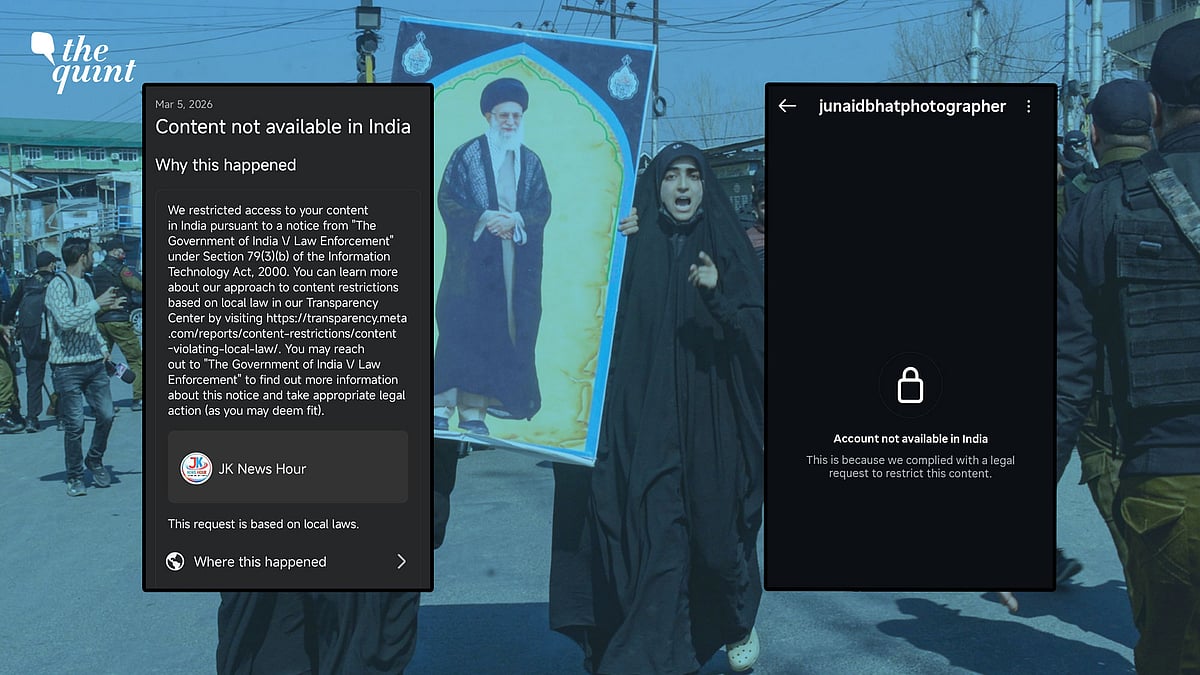
As first reported by The Hindu, the affected portals are Rising Kashmir, Greater Kashmir, Kashmir Life, Kashmir Bulletin, The Voice of Kashmir, Valley Dastaan, JK News Hour, and Asian Revolution
The developments came amid heightened security concerns. The Union Ministry of Home Affairs on 28 February issued a nationwide advisory urging state governments to stay vigilant against the risk of possible violence and unrest in the wake of Israel-US strikes against Iran. The communication reportedly asked states to identify “pro-Iran radical preachers giving inflammatory sermons.”
Although different news portals were withheld on different days, some have now been blocked for over a week, while some have now been restored.
Concerns Among Journalists
Syed Sajad Rizvi, founding editor of the news portal Valley Dastaan, raised similar concerns.
Rizvi had launched Valley Dastaan in 2022 with the aim of promoting independent reporting and discussing social, political, and global issues. But the recent restrictions, he said, raise troubling questions.
“Such actions take a psychological toll on journalists," he added.
The restrictions have raised questions among media observers in Kashmir. Kashmir-based media researcher and journalist Khalid Bashir Gaura said he found the move puzzling. “As the social media accounts of some credible news organisations, such as Kashmir Life, Rising Kashmir, and Greater Kashmir, have been taken down, I wonder why not cringe content pages?”
Religious Clerics’ Social Media Pages Restricted
Not only news portals, official pages of religious clerics who have purportedly posted against the US-Israel strike on Iran are also suspended. Social media pages belonging to prominent Shia clerics—including Molvi Masroor Abbas Ansari and Aga Syed Mohammad Hadi—were also taken down.
Speaking to The Quint, Ansari said he had recently posted about the ongoing developments in Iran as well as about the processions that took place in Kashmir.
“Only the authorities concerned can tell us why our Facebook pages was restricted. We assume that the administration may not have been able to tolerate the natural reaction of the people here,” he claimed.
According to him, Meta informed him the page had been removed following a notice from the “Government of India Law Enforcement”. Calling the move "unjustifiable", he called on authorities to restore the page immediately.
Meanwhile, Altaf Thakur, the Bharatiya Janata Party (BJP) J&K spokesperson, told The Quint that action must be taken against these digital media outlets "as no democracy allows inciteful content".
"It's great to withhold the accounts of these outlets, uploading stone-pelting videos aimed at disturbing peace and tranquility in the region," Altaf added.
Police Crackdown on ‘Misinformation’
Meanwhile, Srinagar Police on 3 March, Tuesday registered a case against some media outlets and individuals for allegedly circulating fabricated and misleading information with an intention to incite unrest and disturb public order in connection with the protests against Khamenei's killing.
The FIRs have been registered at the Cyber Police Station in Srinagar against several individuals, including politicians and social media users, accused of spreading inflammatory content online.
Among those booked are Srinagar Member of Parliament Aga Syed Ruhullah Mehdi and former Srinagar mayor Junaid Azim Mattu for allegedly circulating “false, fabricated and misleading” content on social media.
“Such deliberate attempts to disseminate misinformation pose a serious threat to peace, security and overall stability. Accordingly, FIR No 02/2026 and FIR No 03/2026 have been registered under Sections 197(1)(d) and 353(1)(b) of the Bharatiya Nyaya Sanhita at Cyber Police Station, Srinagar,” the police said in a statement.
‘I Will Continue to Speak’
Responding to the FIR against him, Junaid Azim Mattu said he would continue to speak out.
“I will continue to commit the crime of having a conscience. I understand the compulsion of the officers to do this but such measures aim to suppress my voice. It won’t stop me from speaking up for humanity, justice, and to seek answers about my country’s and its leadership’s unprecedented moral abdication when it comes to Iran,” he told The Quint.
He further alleged that media outlets in Kashmir were under mounting pressure to abstain from covering the processions over Khamenei's death.
“I demand that such restrictions on the media be lifted immediately. We live in India, not Israel, and our institutions should uphold the law and freedom of speech,” he said.
Not the First Such Action
This is not the first time social media accounts have been restricted in India during periods of heightened tension.
In May 2025, when India and Pakistan were on the brink of war, the Indian government issued executive orders mandating that X block more than 8,000 accounts in India. The directives included requests to prevent access to accounts owned by well-known X users and overseas news outlets in the country.
India’s principal law governing online content is the Information Technology Act, 2000. The law gives legal recognition to digital signatures, e-commerce, and electronic transactions, while also providing the government with powers to regulate online content. Under Section 69A and Section 79(3)(b) of the IT Act, the Central government can order intermediaries to block access to websites, social media accounts, or online information in the interest of India’s sovereignty, security, or public order.
As of 2025, India ranked 151 out of 180 countries in the World Press Freedom index compiled by Reporters Without Borders, a global organisation that monitors media freedom. In 2024, India ranked 159.
RSF has repeatedly raised concerns about press freedom in Kashmir, noting the difficulties journalists in the region face in accessing information and sources.
The Quint has reached out to Srinagar Police and Meta for further details. The article will be updated as and when they respond.
(Irshad Hussain is an independent journalist based in Kashmir. He tweets at @Irshad55hussain. Mubashir Naik is a practicing advocate and legal researcher based in Kashmir. He reports on political instability, conflict, refugee issues, human rights, culture, health, and sports. He tweets @sule_khaak.)
- Access to all paywalled content on site
- Ad-free experience across The Quint
- Early previews of our Special Projects
Published: undefined