Reforms or Targeting? The Debate Over Madrasas in India
Targeting madrasas risks eroding Muslim identity and undermining their educational and cultural significance.
advertisement
This article has been authored by a member of The Quint. Our membership programme allows those who are not full-time journalists or our regular contributors to get published on The Quint under our exclusive 'Member's Opinion' section, along with many other benefits. Our membership is open and available to any reader of The Quint. Become a member today and send us your articles at TQmembersonly@thequint.com
Madrasas in India are witnessing continued action. In one Bharatiya Janata Party (BJP)-ruled state after another, efforts are being made to impose stricter regulations on madrasas. In some cases, they are described as illegal; in others, action is being taken in the name of reform, while questions are being raised about their curriculum, eventually leading to the sealing of institutions that impart Islamic knowledge.
Currently, a series of actions against madrasas is underway in West Bengal. Uttarakhand, too, recently abolished its Madarsa Board under the Uniform Civil Code, and Uttar Pradesh has continued to subject these religious institutions to various forms of scrutiny. A petitioner in the Rajasthan High Court also suggested that the state should prepare a syllabus for madrasas up to the primary and upper-primary levels.
Amid all these debates, however, little attention is being paid to the key questions. First, in what ways do these attacks amount to an attack on Muslim identity. Second, what will happen to the students and teachers associated with these madrasas? These important questions remain largely overlooked while the rest of the debate continues.
Modernisation of Madrasas
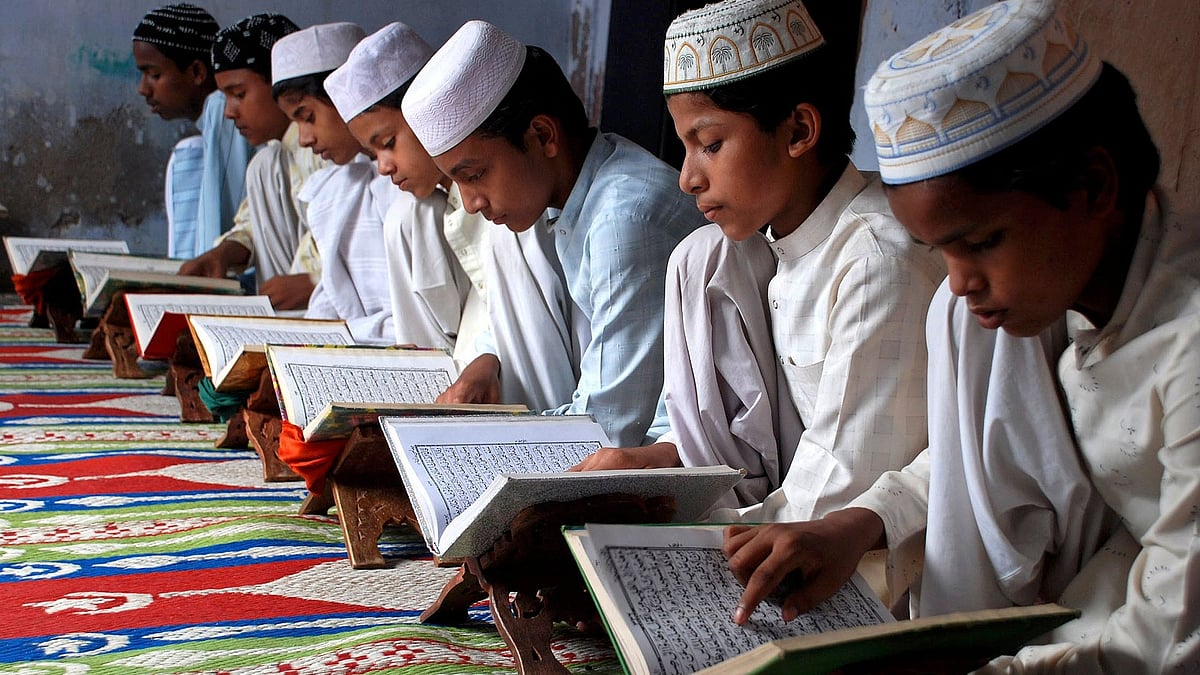
Madrasas are educational institutions established and run by the Muslim community to impart knowledge of Islam, the Holy Qur’an, Islamic law and jurisprudence, Hadith, and related subjects. Across the world, irrespective of the school of thought under which they are established, they share this fundamental purpose. Any reform that undermines this basic structure and purpose cannot be considered genuine reform; rather, it risks eroding the very identity and defining character of these spaces.
However, rather than advocating the closure of these institutions, policymakers focused on introducing modern subjects, upgrading infrastructure, and expanding educational opportunities. Furthermore, initiatives such as the National Monitoring Committee for Minority Education (NMCME) and the Scheme for Providing Quality Education in Madrasas (SPQEM) were introduced to support these institutions in incorporating modern subjects and vocational training into their curricula and developing into accredited study centres offering education at the primary, secondary, and senior secondary levels.
However, it is true that all these initiatives remained largely confined to paper, with little or no work being done on the ground, and the situation did not improve. Like the Sachar Committee Report, the recommendations of the NMCME did not receive the attention required to bring about meaningful improvements. Another scheme, the Infrastructure Development in Minority Institutions (IDMI), was also introduced, but there is hardly any evidence of its implementation.
More importantly, children studying in madrasas generally come from financially weaker backgrounds and often cannot afford private schools, while the condition of government schools is already well known. Teachers working there are also trained to function within the same educational structure. If this opportunity is also taken away from these children and teachers, what will happen to them in particular, and a community that is already educationally and economically disadvantaged?
However, the steps being taken now raise questions that go beyond the concerns of children studying and teachers working in madrasas. History offers several examples of governments taking action against madrasas in the name of reform, with consequences far more devastating than people had anticipated.
Mustafa Kemal Atatürk, in 1924, too, insisted on the Unification of Education in Turkey, which aimed to centralise the education system by abolishing institutions imparting traditional Islamic education. It eventually raised serious concerns about classical Islamic knowledge, control over institutions and their curricula, and state intervention in religious education.
There are other examples, too, which show how such coercive attempts to reform or unify Islamic education, sometimes in a secular setup, can hamper Islamic intellectual heritage, move religious knowledge into informal spaces, and restrict Islam to customs and practices.
And whenever such attempts have been made, the question has invariably been raised: Why is there a need to modernise madrasas? If the objective of modernisation is merely to introduce modern subjects and make students employable, this can be achieved within the existing structure as well. Attempts to unify or bring them under greater control, therefore, appear to be aimed at dismantling their existing structure or targeting Muslim identity.
Who Decides?
Yogendra Sikand’s work, titled Voices for Reform in the Indian Madarsas, highlights that Muslim reformers supported the introduction of subjects such as mathematics and science while maintaining the Islamic character of these institutions. They also opposed government-led reforms because of concerns over autonomy, state control, and the dilution of religious identity. The madrasa structure needs to be preserved for imparting knowledge of Islam, and any idea of reform needs to be discussed with the community running these institutions.
Looking at the action now being taken against madrasas, it seems that this is a direct attack on these institutions and, ultimately, on the identity of Indian Muslims. These institutions are sites of everyday Muslim social life, and delegitimising them simply means discrediting cultural memory, intellectual tradition and weakening the educational and cultural spaces through which the Muslim community preserves and reproduces its collective identity.
The closure of madrasas or state control over their functioning raises another significant concern: who decides what kind of knowledge is legitimate for Muslims? At a time when Muslims are subject to various forms of injustice, including social, political, and economic injustices, these actions appear more like a form of epistemic injustice, in which their traditions and institutions, such as madrasas and mosques, are denied legitimacy and pushed to the margins.
(Shafey Anwarul Haque is a Lucknow-based academic, researcher and translator. His work focuses on minority and human rights issues, media representations of Muslims, identity politics, and the role of media in shaping public discourse and so on. The views expressed above are the author’s own. The Quint neither endorses nor is responsible for the same)