
'How Many Protests Will It Take for FTII Itanagar to Function?'
'I feel mentally exhausted from pausing our lives repeatedly just to fight for our basic rights,' writes a student.
advertisement
After months of preparing for the entrance exam, followed by days filled with anxiety, my long wait was finally over. In October 2024, I got an email with the acceptance letter for India's first Documentary Cinema course at the Film and Television Institute of India (FTII) in Itanagar, Arunachal Pradesh.
As my life seemed to have shifted into the fast lane, I discontinued my freelance writing job. FTII Itanagar is only the third national film institute of India. I packed my suitcase, finished some last-minute shopping, and spent time with my friends before it was time to leave.
We decided to boycott because filmmaking cannot be taught online. For months afterward, the institute then failed to provide clarity on when the on-campus classes would actually begin.
We had put our lives on pause to join the institute.
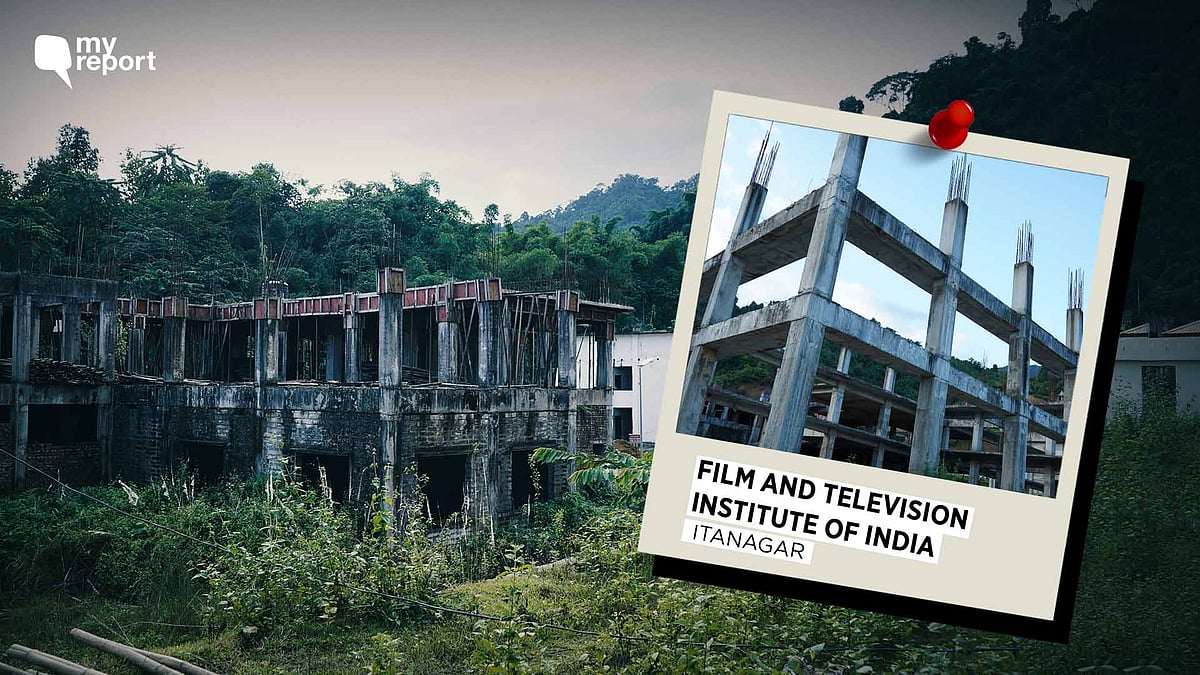
In November 2025, after the completion of the first semester, the academic block for faculty still remains incomplete.
(Image accessed by The Quint)
After losing four months, the academic year finally began in March 2025. We expected the campus to be ready—at least with the basic facilities required for living and learning. Yet, when we arrived, there were no signs of the studios typical of a film school, nor the classrooms, screening halls, or even our hostels.
It was like stepping into a construction site in the middle of the wilderness. The campus had only three residential buildings—a guest house, a transit block, and a girls’ living quarter—alongside a barely functioning canteen.
During the monsoon season, landslides become frequent. The main access road to the canteen and other academic spaces, it turns into a hazardous stretch of thick, slippery mud. Several students have reportedly slipped here, and in some cases, sustained ankle injuries.
(Image accessed by The Quint)
We faced long power cuts, even during academic hours, and prolonged network outages—there was no Wi-Fi on campus—especially on days when it rained. This left us cut off from the outside world and our families. The water supply was often interrupted, too. There were also no security guards, no main gate, boundary walls, or fencing, and not even a doctor or nurse available in case of medical emergencies.
Students walk daily on this broken, under-construction road, lined with construction machinery and unfinished buildings, to reach their classes. During the initial months, the path was covered with mud and gravel, leading to multiple slips and falls. In one instance, a serious injury was narrowly avoided when a student fell near exposed iron rods protruding from the ground.
(Image accessed by The Quint)
'Broken Promises at FTII Itanagar'
The dismal state of affairs at the institute led us to stage our very first on-campus protest in March, which continued for about a week. In response, we received a written assurance from the then campus director, stating that the entire campus would be completed by December 2025, with one classroom theatre (CRT) to be handed over by the end of April 2025.
Dissatisfied with the makeshift arrangements yet still hopeful for change, we resumed our classes. We tried our best to cope, but the reality remained unchanged as we continued to face the same issues—irregular power supply, lack of medical support, no CRT, makeshift classrooms, and the absence of boundary walls, or even proper roads.
A recent photograph of the Digital Block meant for VFX and animation.
(Image accessed by The Quint)
By May, the promised deadline for a dignified learning experience in the CRT had already passed. Around the same time, with the onset of the monsoon, landslides became frequent, turning an already unsafe terrain even more hazardous. We were left with no other option but to stage another academic halt the same month.
The library hall which served as the only classroom for the entire batch for most of the first semester.
(Image accessed by The Quint)
But what we received was systematic apathy and neglect as officials shifted blame onto one another. They made only vague promises, and in a shameless attempt to silence us, pressured us to stop media interactions and return to our classes.
The protest continued until August, coinciding with the institute's two-month-long monsoon break. When we returned, the campus had only one CRT, which remained acoustically uncalibrated. Despite that, we completed our first semester and put in our best efforts to make our debut films.
'FTII Itanagar Still Struggles With an Unfinished Campus'
Now, as we begin our second semester, two departments—Documentary Cinema and Screen Acting—find themselves in the midst of a third academic halt.
All the academic spaces essential to start our specialisation courses—including the sound studio, studio floor, preview theatre, dance and make-up studio, carpentry and props department—remain incomplete, with deadlines repeatedly missed. Proper campus boundary and fencing, as well as the 24×7 availability of a doctor, are still absent.
I feel mentally exhausted from pausing our lives again and again just to fight for our basic rights. The hypocrisies and lies we have faced have left a deep impact on our lives and education. It seems that mist can be found not only in the mountains but also within our education system—and unlike the mountains, this mist is not beautiful. It shields those who should be held accountable.
(The Quint has reached out to FTII Itanagar and the Ministry of Information and Broadcasting on the issues raised by the student. The story will be updated as and when they respond.)
(The author is a student of the first batch of the Documentary Cinema course at FTII Itanagar)
(All 'My Report' branded stories are submitted by citizen journalists to The Quint. Though The Quint inquires into the claims/allegations from all parties before publishing, the report and the views expressed above are the citizen journalist's own. The Quint neither endorses, nor is responsible for the same.)
- Access to all paywalled content on site
- Ad-free experience across The Quint
- Early previews of our Special Projects
Published: undefined