
A Kerala Migrant Worker's 31-Year-Long Search for a Friend to Repay a Debt
The story starts in 1995 in Saudi Arabia's Abha town, where migrant workers from all over come to earn a living.
advertisement
On Thursday morning, in Telangana's Dharmapuri, a stranger knocked on a door. He was a small man, 63 years old, worn thin by a day and more of trains and rattling buses.
He carried two things, one on his mind, and one in his pocket. On his mind was an address he had never forgotten and never been able to trace.
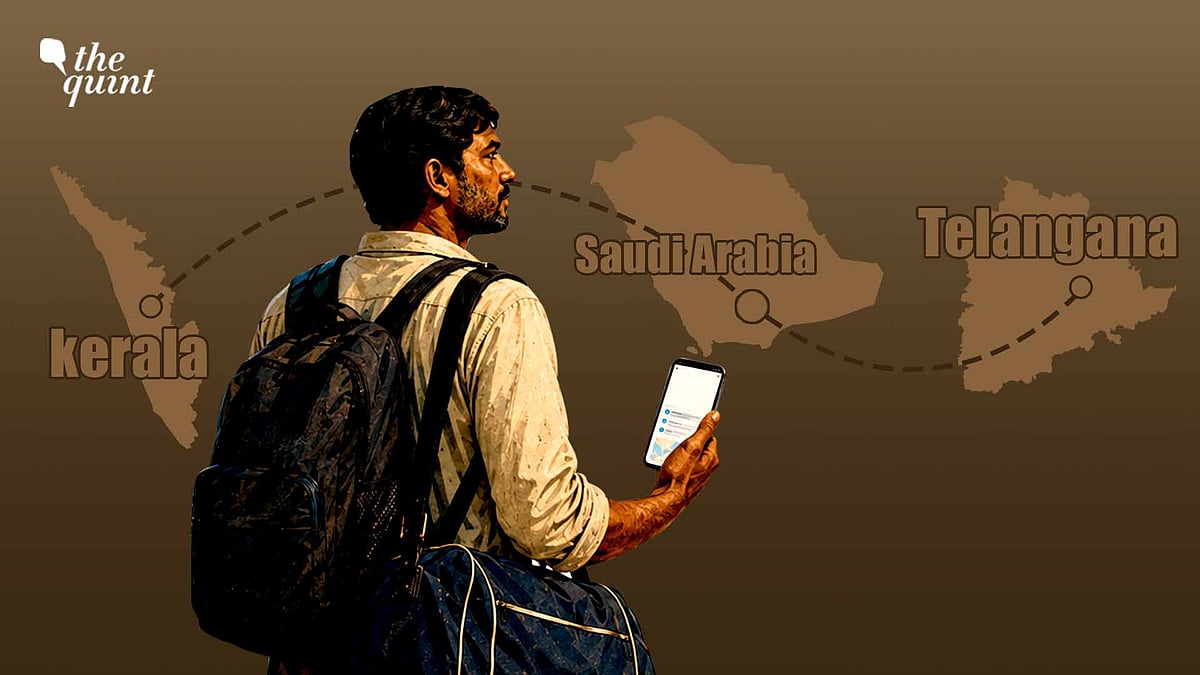
In his pocket was a Samsung Galaxy A32, and inside it, an AI assistant app, the thing that had finally done what years of letters could not: drawn him a line, straight and sure, from Palakkad to this very doorstep, almost 1,200 km away.
Beside him stood his friend, Maniyan Nair, who he had brought along for courage.
Ismail raised his hand and knocked. And waited to learn whether a promise could survive that long.
Maniyan Nair (left) and Mohammed Ismail in Hyderabad.
(Photo: Special Arrangement)
Flashback to Abha
To understand the significance of the knock, one has to go back to 1995, to a silent town called Abha, folded high into the Asir Mountains of southern Saudi Arabia, a thousand kilometres from Riyadh. It is a place of thin, cool air and long shifts, where men from a dozen countries came to earn what their home villages could not give them.
Among them were two workers who could not speak each other's language.
One was Edla Lachanna, a Telugu-speaking man from Dharmapuri, in present-day Telangana, who counted his riyals the way careful men do, with the whole shape of a future in mind. He had a plan: a house, in his village, on his own soil. The other was Ismail, a Keralite from Palakkad, a man who had left school after Class 7 but had learned, somewhere along the way, the older arithmetic of trust.
Ismail was a tailor in the town; Lachanna, a fuel station worker.
Then he went home to Dharmapuri. And he did not come back to Abha.
Ismail's tailoring shop, in that quiet mountain town, doubled as the neighbourhood's post office and its bank, not by any official arrangement, but by the slow logic of trust that grew among men far from home.
"Because I knew a little Hindi and a little English, the area postman used to dump all the letters from India in my shop," he told The Quint in an exclusive interview. "Every day, or every couple of days, the migrant workers from in and around the town would come to collect them. We all knew each other. We trusted each other. We shared our food and we shared our money."
Ismail's accommodation was a little safer than most, and it had an almirah, and in a place with few banks and fewer options, an almirah was a kind of wealth.
"Friends used to give me their savings to keep safe," he said. "I would put the money in a small paper envelope, fold it myself, and write the name and the date on it."
An envelope. A name. A date. It was the whole banking system of a homesick community, run out of a shopkeeper's almirah on the strength of nothing but a man's word. Lachanna's riyals went into one of those envelopes in 1995, and there they waited, while the world that made them possible slowly disappeared.
Nobody planned the silence that followed. It simply arrived, the way it does in migrant lives, where a job ends, a town changes, and two men who once shared a neighbourhood in the mountains lose the thread that tied them.
Lost in Transit
Ismail moved to another town and kept working. He worked until 2006, then returned to India himself, carrying a debt that was not a debt in the ordinary sense. He did not owe Lachanna for something he had taken. He owed him for something he had been given to protect. That is a heavier kind of owing.
He tried to give it back. He wrote letters to the only address he had. He waited for replies that never came. Letters, it turns out, are easy for the years to swallow. One after another they went out and vanished, and the money stayed in Ismail's keeping, and the friend he wanted to repay stayed lost.
For a man who left school at 13, there were no tools left to try. The address led nowhere. The letters had failed. Time was doing what time does.
Then, last month, an ordinary moment changed everything. He watched a friend in Palakkad speak into his phone, asking questions aloud and getting answers back.
What came back astonished him. For years, when he had asked people about Dharmapuri and the old address, everyone gave him a different answer, and none of them led anywhere.
"But the AI app told me Edla was a family name," he said. "It gave me the routes, the train numbers, the bus stands, the bus numbers, hotel locations, the fares, the rates, everything. It built my confidence. I called my friend Maniyan, and he said he would come with me. We booked the tickets and boarded the train on Tuesday."
On Tuesday, the two men set out from Palakkad by train and bus, travelling north, out of Kerala and up into the dry Telangana interior, following a route a machine had promised and only a human heart would have bothered to travel.
And so we come back to the door, to the knock, and to the family who opened it to find a stranger from Kerala speaking a name they never expected to hear.
A Reunion Across the Seas
What happened next had waited 31 years to happen.
Lachanna had forgotten about the money entirely, time had wiped the ledger clean on his side. But the moment the screen lit up with the face of the Keralite at his family's door, something older stirred in him. He did not recognise the debt. He recognised the friend.
"Tears rolled down my cheeks. I felt so relieved, and so did he," Ismail said. "He has changed a lot in all these years. But he knew me at once. He looked at me and asked, 'You travelled all this way, just to give back my money?'"
Then Ismail counted the notes into the hands of Lachanna's family. Rs 25,000. The 3,000 riyals of 1995, carried across two countries and returned at last in the currency of home.
And he said the thing he had come so far to say: that for three decades this had sat on his conscience like a stone, and that now, finally, he could set it down.
He had guarded a stranger's savings through two countries and 31 years. He spent nothing. He forgot nothing. He let neither the dead letters, nor a schooling that ended at 13, nor the sheer, swallowing size of India stop him. In the end, closing the account took only two things, a machine clever enough to find the door, and a man old-fashioned enough to knock on it.
Speaking to The Quint, Lachanna's son, Abhilash Edla, said the family was stunned to see a Keralite arrive at their doorstep, explaining that he had come to return money his father had once entrusted to him.
"What a moment it was, true friendship, true comradeship," said Abhilash, who runs a small business.
Bheem Reddy Mandha, Vice Chairman of the Telangana government's NRI Advisory Committee, called it a real-life story of the friendship and comradeship of migrant workers, arriving at a time when others work to sow division. "Such gestures inspire us to hold our morals high," he said.
As this story was being filed, Ismail was still in Hyderabad, in no hurry to leave.
"I'll head back in a day or two. I speak Hindi, and I wanted to see this city and taste the food here," he said, with the ease of a man who has finally set down a burden. "I'm relieved. What else is there to do now?"
Back home, his own life has quietly prospered in the years since Abha: one son is a software engineer in Qatar, another is a professor, and his daughter is married. The savings he guarded were never his own—but the account, at last, is closed.
(The author is an independent journalist and author of River of Grey Flowers.)
- Access to all paywalled content on site
- Ad-free experience across The Quint
- Early previews of our Special Projects
Published: undefined