For Surat’s Textile Workers, Warmer Nights Mean No Escape From the Heat
By 2050, over 80 percent of nights in Surat could remain unusually hot. Workers are already feeling the impact.
advertisement
(As extreme heat claims more lives across India, independent climate reporting has never been more essential. Become a member and power our journalism.)
It was 40 degrees in Surat.
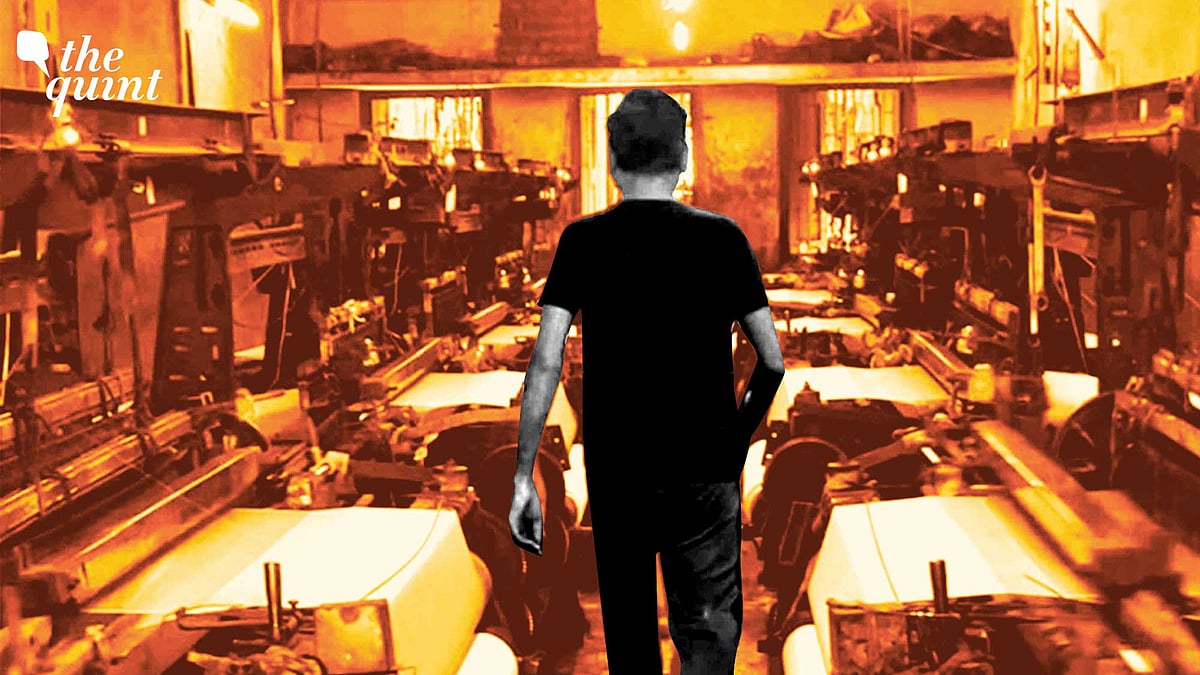
A worker, dressed only in a vest and shorts, moved between four power looms. Metal clunked against the thread and hot air blew from the machines. Each machine had three to four bright white lights, adding heat to heat. There was one fan in the corner, and a couple of windows on the wall, barely a foot away from the factory in the next building.
It was 40 degrees in Surat. But inside the textile unit, it was hotter still.
This is where lakhs of textile workers in Gujarat's textile hub spend 12-hour shifts, alternating between days and nights every week. Most migrate from Odisha, while others come from places like Uttar Pradesh, Bihar, and Jharkhand, in search of work. They produce an estimated 30 million metres of raw fabric daily, making Surat India's largest textile hub.
"When the motor is on, hot air comes out of it," Sonu Mishra, a worker from Ayodhya, who has been working in Surat's textile units for over 20 years, told The Quint. "There's nowhere for the hot air to go. You can't stand next to the machine even for five minutes without being drenched in sweat, even after removing your clothes, in just your baniyan."
Nights Offer No Relief
The number of unusually hot nights in Indian cities has risen by 32 percent over the last decade because of climate change, with Surat among the affected cities, as per an analysis by non-profit Climate Central and consulting initiative Climate Trends.
A 2025 World Bank report, meanwhile, warned that by 2050, more than 80 percent of nights in Surat could remain unusually hot, leaving workers with little opportunity to recover from daytime heat.
For textile workers, that seems to already be happening.
Sonu Mishra has been working in Surat's textile units for over 20 years.
(Photo: Tanishka Sodhi)
Ranjan*, a migrant worker from Odisha, said heat has changed the way he works and manages his health. “The hot air from the machines feels like fire. The heat makes me more sleepy during night shifts, but if I sleep, I get into trouble with the seth,” he said.
For Ranjan, the consequences extend beyond exhaustion. Living with HIV for the past three years, he is expected to take his antiretroviral medication at the same time every day. But during the hot summer nights, he sometimes skips his medicine because he worries it makes him even sleepier during work.
For Ranjan, the consequences extend beyond exhaustion.
(Photo: Tanishka Sodhi)
"When the body doesn't get relief overnight to cool down, the heat accumulates. The body cools itself through sweating, but that cooling only works if sweat can evaporate," said Abhiyant Tiwari, Health and Climate Resilience Lead at NRDC India and one of the architects of South Asia's first Heat Action Plan.
"In humid cities like Surat, sweat doesn't evaporate as efficiently. When workers spend long hours generating body heat through physical labour in already hot and humid environments, and nights don't cool down, the body never fully recovers."
The urban heat island effect accelerates this. As cities expand and urbanise, with more concrete, more roads, and fewer trees, surfaces absorb heat during the day and release it slowly through the night, shrinking the window of natural cooling.
"Hotter nights are riskier in terms of health. Prolonged exposure to heat without adequate recovery can increase the risk of chronic health conditions. Strengthening research on its long-term health impacts will help India build more effective policies to protect communities in a warming climate," he added.
Heat Comes at a Cost
One of the ways the workers cope with the heat is stepping outside every few hours to get some relief from the hot box that the factory becomes. But that is not something that can afford to do too often, as they get paid as per production.
"My rate is Rs 9 per metre. I earn around Rs 1,200 a day. But if I spend time outside because of the heat, that Rs 1,200 will easily become Rs 800. I can’t afford to do that. Majboori hai, kya karein? (I am helpless, what can I do?),” asked Babula Mahapatra, who came from Ganjam to Surat in 2006.
Babula Mahapatra came from Ganjam to Surat in 2006.
(Photo: Tanishka Sodhi)
For five years, he was associated with the Pravasi Shramik Suraksha Manch, a union for migrant workers in Surat’s textile and power loom industries, where he said they repeatedly raised concerns about working conditions, including heat issues, with factory owners and local authorities, but nothing changed.
He has watched the heat worsen over two decades in the city.
Outside his home, the road offers little relief with not a single tree in sight.
Mahapatra says heat-related illnesses have become increasingly common among workers. High blood pressure, dizziness, and fainting are no longer unusual. Just a week before The Quint visited, he recalled, one worker collapsed inside the factory after complaining of high blood pressure.
The dangers are no longer anecdotal. In May this year, Surat reported its first suspected heat-related death. A migrant worker from Bihar, employed in a textile unit, fell unconscious while walking home, and later died at the hospital. As per reports, doctors said that his body was dehydrated, possibly due to prolonged exposure to direct sunlight and high temperatures.
While Surat has a heat action plan, prepared in 2018, the 34-page document only mentions textile workers in passing.
The conditions extend beyond the factory floor. In many parts of Surat's textile belt, workers live upstairs in the same buildings where they work. Since day and night shifts alternate, people who work the day shift sleep at night and then the same place is used by the night shift people to rest in the day.
"Imagine the state of the people who have to work 12 hours amid that noise—between 120 and 180 decibels—and then, in some cases, return to rooms above or next to the factory. The whole building shakes with the sound of the machine. There is no escaping the sound or the heat," said Aswin Vijay Badatya, who works with Aajeevika Bureau, an organisation that works to protect the rights and well-being of migrant workers.
Can Factories Adapt to Rising Heat?
This year, several labour unions, such as the Amazon India Workers Association and the National Hawkers Federation, demanded that India's labour codes should be reformed to include more explicit provisions for working in extreme heat.
Industry representatives in Surat acknowledged to The Quint that rising temperatures can be a challenge, but say that conditions vary widely across Surat's textile sector, with most following safety norms.
Ashok Jirawala, president of the Federation of Gujarat Weavers' Welfare Association and vice-president of the Southern Gujarat Chamber of Commerce and Industry, said that many of the worst conditions are found in older powerloom units that were built decades ago.
Jirawala also pointed to a labour shortage, arguing that workers today have greater bargaining power than before.
“Most factories are implementing ventilations etc. If they don't, workers will leave and go work at other factories, because manpower is less these days so they have the freedom to make that choice. But the textile industry is like our home, and we consider the workers our kids and do the best," he said.
A lane with textile factory buildings in Surat
(Photo: Tanishka Sodhi)
A 2025 study published in Earth's Future, titled 'Migrant Laborers in India Face Increased Heat Stress Driven by Climate Warming and ENSO Variability', found that this rise in heat stress has made it harder for workers to do their jobs, leading to a roughly 10 percent drop in their ability to work effectively. Surat was listed as among the top five cities affected by this.
Speaking about processing units, Jitu Vakharia, president of the South Gujarat Textile Processors Association, said many of them have invested in roof insulation, ventilation systems, and heat-recovery technology to reduce indoor temperatures and improve energy efficiency.
"We're working on heat recovery systems so that the heat generated by machines is reduced. We're also focusing on insulation and better ventilation," he said.
Vakharia acknowledged that not every unit complies with these standards, pointing to illegal factories operating without licences. "That isn't an excuse," he said. "If there is a problem, we should solve it. We work with this industry every day. If we don't understand the workers' problems, how can the industry function? Workers have to be the priority. Just as power is important, so are the workers."
Yet, workers interviewed by The Quint said many powerloom units continue to have poor ventilation, limited drinking water facilities, and little opportunity to escape the heat during 12-hour shifts.
Mishra has come to read his own body as a kind of instrument. "If I go home within six months, I'm fine. If I stay longer, my health gets affected."
He believes the city itself has changed. "Jungle bhi cut raha hai. Aage jaake oxygen bhi nahi milega. Jab nahi hoga toh shareer mein pata chalega. (They're cutting down the forests too. One day there won't even be enough oxygen. When that happens, our bodies will feel the consequences.)"
His suitcase rests above the mattress in his small room in Surat, always ready for the next journey home.
"Who doesn't miss home?" he asked. "When I go back, I don't feel like returning. But the day the money starts running out, that's the day I remember Surat."