
Assam Activist Pranab Doley's Arrest Has Fueled the Fight for Tribal Land Rights
The tribal community Doley is fighting for has defended the activist, claiming police charges are "unfounded".
advertisement
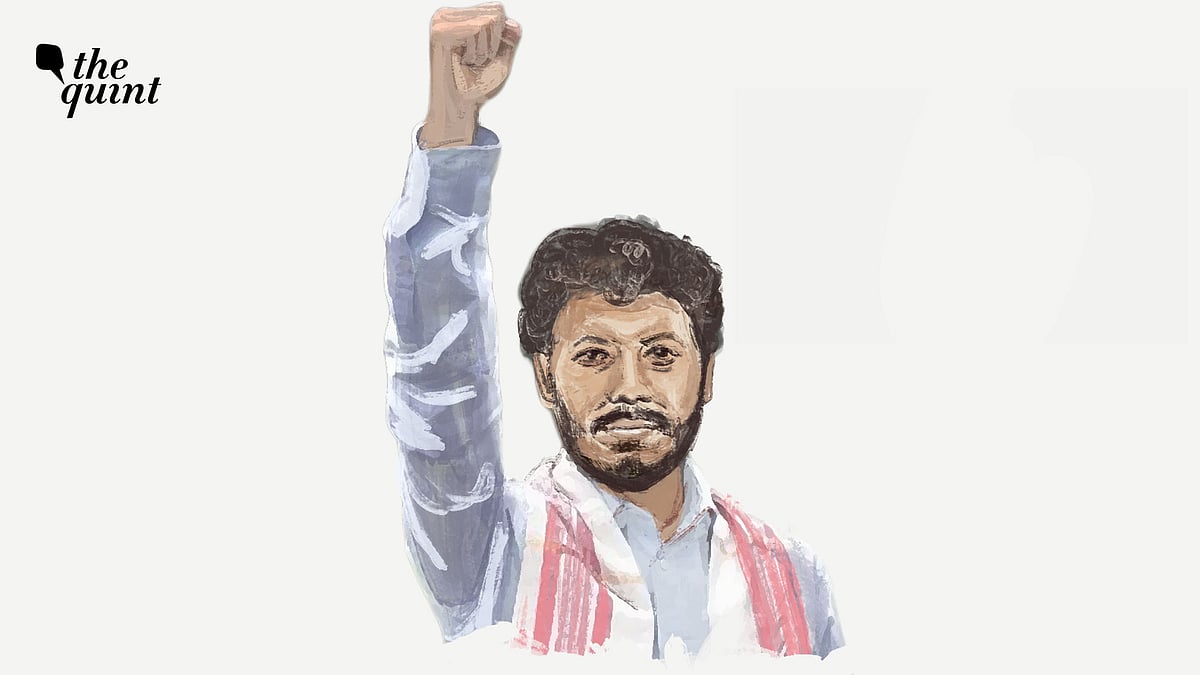
Days after Assam Police arrested prominent land rights activist Pranab Doley and at least four others for protesting against the construction of a five-star hotel near the protected wildlife habitat at Kaziranga National Park and Tiger Reserve (KNPTR), the protest remains strong.
About 30 protesters have been demanding their unconditional release even as they fight for their right to land with an indefinite strike that began on 13 July, a day after the arrests.
Doley and other activists had been protesting against the construction at Inglay Pathar, a patch of 60 bighas (about 37 acres) of agricultural land near the Hatikhuli Tea Estate, located about 2 km from the national park.
It has traditionally been cultivated by about 45 Adivasi families, belonging to the "tea tribes" community.
Protests continue in Kaziranga.
(Photo courtesy: Instagram/Kaziranga People's Festival)
“Because of the hotel, my family has lost 8.5 bighas," Geeta Gowala, a farmer and land rights activist who is among those evicted and currently leading the protest, alleged to The Quint.
On 30 May, Gowala, who has been fighting for her land for years now, found a "no entry" notice on her remaining 12 bighas of land. After she removed the sign, she was met with resistance from Assam Police Battalion officers.
Videos of the incident were shared on social media. In them, Gowala can be seen asking the police to vacate her property, for which she has now been charged with obstruction of police work.
The Gauhati High Court on 1 June heard a petition filed by 20 Adivasi families. The Bench led by Justice Arun Dev Choudhury issued notices to the Assam Tourism Development Corporation (ATDC) on the matter and sought a response in four weeks.
For Gowala and others who are being denied use of their ancestral land, the question is not one of income alone, but of land rights, ecological concerns and identity. Following the incident, the protest against the hotel project found its feet again, led by community leaders like Gowala. Now, Doley's arrest has further fueled the fire.
Why Was Doley Arrested?
While the protest and opposition against the hotel plan has been ongoing for years, things came to a head on 28 June when Doley, convenor of the organisation Greater Kaziranga Land and Human Rights Protection Committee (GKLHRPC), and other activists gathered at Rongajan field near Inglay Pathar. GKLHRPC advocates for land and legal rights of around 100 villages in the KNPTR area.
Sub-Inspector Sujib Basumatary, in-charge officer of the Kohora outpost under the Bokakhat police station, filed a complaint against the gathering which formed the basis of the FIR against Doley.
The FIR alleged the gathered activists, including Doley, Amit Nag, Partha Keot, Rabi Tati, Rahul Tati, Rajiv Pegu, and Bhaskar Saikia, were armed with "machetes" and "sharp sticks", and trespassed into the premises of the site of the Tea Tribes Museum and the ATDC-Hyatt project.
The Quint could not corroborate whether weapons had been carried, though Doley's associates and other KNPTR locals deny it. Those named in the FIR include some of the petitioners from the 20 families being heard by Gauhati High Court.
Nevertheless, based on the FIR, Doley, Amit Nag, Bijit Kutum, Bhaskar Saikia and Rajiv Pegu were arrested on 12 July. Doley was arrested from the Sundarpur area of Guwahati and was taken to Dispur police station.
While being pushed inside a van, he shouted, “If we are not allowed to say what we feel, then how can we call this a democracy? They didn't produce any arrest memo. It is like I am being kidnapped.”
Doley was later handed over to Bokakhat police, who took him to Golaghat. The Quint reached out to Bokakhat police regarding the missing arrest memo but was denied a response.
Doley is currentlt held at the Golaghat District jail. A total of five protesters related to the issue are currently in custody.
Speaking to The Quint, Lakshman Bawri, who belongs to the tea tribe community and is an associate of Doley, refuted the allegations of the police.
Protests against the arrest of Pranab Doley and his fellow activists.
(Photo Courtesy: Youth for Bokakhat)
Doley, who himself is a resident of a fringe village of Kaziranga, has been opposing land and human rights violations in the Kaziranga area for many years.
The activist has earlier contested Assembly elections twice from the Bokakhat constituency as an independent candidate. In the Assembly elections this year, despite contesting without backing and funds generated through crowdfunding, Doley managed to receive around 15,000 votes.
Advocate Santanu Borthakur, the legal counsel for the arrested activists, told The Quint that more than 10 charges, including criminal conspiracy under Section 61(2), committing rioting under Section 191(2), and unlawful assembly under Section 190 of the Bharatiya Nyaya Sanhita (BNS), have been imposed.
Meanwhile, the Indigenous Rights and Protected Areas Initiative of the Indigenous Peoples Law and Policy Programme, at the University of Arizona’s James E Rogers College of Law, condemned Doley’s arrest.
State Opposition leaders condemned Doley’s detention as well, with Sivasagar MLA and Raijor Dal leader Akhil Gogoi accusing the BJP government of “putting tribal people in jail for the sake of capitalists” on 12 July.
Assam Congress president Gaurav Gogoi called it “an attempt to silence any voice critical of the government and turn citizens into mute spectators”.
A Hotel at the Disputed Site
In 2022, the Supreme Court had directed that every protected forest should have a 10 km-long eco-sensitive zone (ESZ), where no infrastructure projects would be allowed. And yet, KNP remains among the few national parks in India without a notified ESZ.
Responding to why this was the case, a forest official, who was earlier serving in KNP, told The Quint that there was no significant reason for not having the ESZ, and that in the absence of a declared one, a radius of 10 km outside the park has been enforced by the Supreme Court as the proposed ESZ (as per an order dated 11 December 2018).
The official, who spoke on the condition of anonymity, further added that since KNP is a floodplain, animals move towards high ground during floods.
"An infrastructure project like this can block the corridors, thus hampering safe passage of animals during floods. This might lead to an increase in the human-animal conflict in the area,” the forest officer said.
Responding to an RTI query earlier in 2025, ATDC officials had stated that the said land would be handed over to Juniper Hotels, which operates as Hyatt Hotels globally, through an MoU between ATDC and the luxury hotel chain signed on 23 September 2023.
In August 2024, the Principal Bench of the National Green Tribunal (NGT) took suo motu cognisance of the issue of construction of a luxury hotel in Inglay Pathar.
In February 2025, the Eastern Bench of the NGT reversed the Assam government's decision to hand over the land at Inglay Pathar for construction of a luxury hotel near Kaziranga, citing the apprehensions over the project being "premature" at that time.
Meanwhile, Assam Chief Minister Himanta Biswa Sarma, while addressing the media at the ongoing Assembly session, supported the construction of the hotel inside the national park, stating, “Even inside Corbett National Park, there are luxury hotels and resorts.”
Reacting to this, Debadityo Sinha, who works on climate justice and ecosystems at the Vidhi Centre for Legal Policy, told The Quint:
The Quint reached out to Juniper Hotels as well as ATDC. A response is as yet awaited from both.
Indigenous and Tribal Right to Land
The 60 bighas of disputed land at Inglay Pathar have been used for agriculture by the 45 Adivasi families living in the nearby Hatikhuli Tea Estate for generations. As per a statement released by GKLHRPC, Inglay Pathar is an Adivasi-owned community grazing land that borders the KNP.
However, Geeta Gowala tells The Quint that in the early part of 2022, the Assam government earmarked 60 bighas of this Adivasi-owned land for the construction of Hyatt Group's luxury hotel, along with a proposed tea tribe cultural museum.
Soon after, the government went ahead and reclassified the agricultural and community grazing land without holding any consultation with its tribal owners.
The affected families continue to live in the nearby tea estate, though they are no longer practicing cultivation on the disputed land. The families have also been offered a compensation of Rs 3 lakh each from the Chief Minister’s Relief Fund.
However, Bawri said, “The government is offering everyone a compensation of Rs 3 lakh, irrespective of how much land that person might hold. There should be a measurement of the land and compensation should be provided according to that.”
Speaking to The Quint regarding the complicated land use scenario in the state, independent researcher Bonojit Hussain said, “Since 1954, there has been no land survey in Assam due to various reasons. Earlier governments also didn't resolve the ambiguity regarding land. But one key difference between those governments and the current is that this government is weaponising the ambiguity.”
Bokakhat's BJP MLA and Agriculture Minister Atul Bora said commercial establishments, like this hotel, will create jobs for locals and boost the area’s economy. Subrat Talukdar, convenor of the Bhumi Adhikar Joutho Sangram Samiti (BAJSS), an umbrella organisation bringing together several land rights organisations across the state, however, thinks of these words as empty promises.
Talukdar further added that protests against the arbitrary arrests of Doley and other activists, and the forceful acquisition of tribal land by the government, will continue indefinitely.
(Nabarun Guha is an independent journalist reporting on news and politics from Assam.)
- Access to all paywalled content on site
- Ad-free experience across The Quint
- Early previews of our Special Projects
Published: undefined