
'Alive or Dead?' Bihar Families Wait for Missing Kin a Month After Nepal Floods
The disaster has struck fear in the hearts of migrant workers employed in Nepal and their families back in Bihar.
advertisement
The Quint is telling the full story of how climate change is reshaping lives in India. Help us do more. Become a member.
Sandip Yadav, 27, spent five days in Nepal last week, desperately searching for his elder brother Vijay. A piece of cloth, a mobile phone, a shoe, or a witness—anything—that could help him trace his missing brother, but he returned empty-handed.
“We are waiting for the Nepal government to declare the missing persons as dead. We can’t perform last rites until the government gives us a death certificate,” Sandip tells The Quint.
A month has passed since the devastating floods struck northern Nepal, and with it, the hopes of the bereaved families in Bihar—who had lost contact with their loved ones—are fading. Yet, they await a response from the Nepal government to determine whether their loved ones should be considered alive or dead.
A resident of Hapur village in Bihar's East Champaran district near the Nepal border, 46-year-old Vijay had been employed in Nepal for over 10 years.
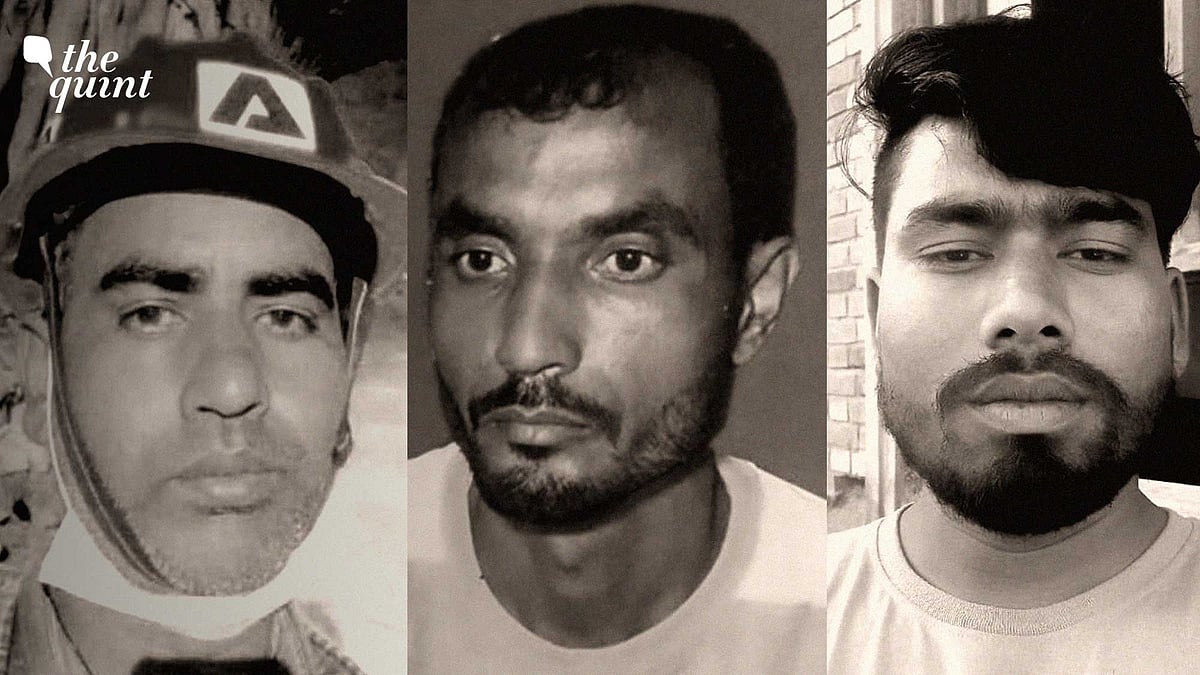
Vijay Kumar Yadav.
(Photo: Special Arrangement/The Quint)
In Unchi Dih village, about eight kilometres from Hapur, 34-year-old Umesh Shah’s family has slowly started believing that he is no more, but, somewhere at the core of heart lies a fading hope.
“Ankh se dekhe nahi hain to kaise bata dein ki jinda hain ki murda. Ankh se dekhenge tabhi kuch bata sakte hain (I haven't seen it with my own eyes, so how can I say if he is alive or dead? I can only tell once I've seen it),” Umesh's elder brother Rakesh laments.
But the family is not willing to wait for long.
The Disaster
On 26 August, flash floods originating from the Nepal-Tibet border struck the river corridors of Upper Trishuli-1, Rasuwagadhi, Trishuli, and Devighat in the Rasuwa and Nuwakot districts of Nepal. According to the latest report, 1,453 bodies have so far been recovered from the flood-affected areas. Many, however, are still reported missing.
Nepal has steep mountainous terrain and more than 6,000 perennial rivers, making a major part of the country ideal for hydropower plants. There were more than a half dozen hydropower plants operating in the flood-affected areas alone—and another half a dozen projects being constructed.
These plants attract thousands of cross-border workers, especially from Bihar. Since the Line of Control is porous, the movement of workers is easy. Post the disaster, hundreds of workers employed at these plants are missing as the flash floods damaged the power plants.
Umesh, too, was working in the same area as a welder at another hydel power project. He had been working at a hydropower company in Kathmandu for 15 years. The company used to deploy him and other workers to various sites. Trishuli was his recent assignment.
"He had gone back to work just 20 days before this (the floods) happened," says Rakesh.
Umesh Shah.
(Photo: Special Arrangement/The Quint)
Umesh was not the only one from his family working in Nepal. His brother Rakesh works at a hydropower company in Kathmandu, and his father, Bhikhari Shah, 55, works at a rice mill.
'We Got Information from News'
Vijay had spoken to his wife on the phone on the night of 25 August, the day before the flood. Little did they know it would be their last conversation. Vijay's family learned about the flood through news.
"We saw on the news that everything had been washed away by the floods. We were terrified," Sandip recounts.
Upon learning of the incident, his family began calling on his mobile, but it was switched off every time. The very next day, Sandip and some other family members set out for Nepal. They first went to a hotel in Kathmandu where flood survivors were being sheltered.
From Kathmandu, they traveled to Trishuli. What they witnessed there left them devastated. "The destruction was horrific, and the roads were blocked. We had no choice but to return," Sandip says.
Sandip and others set out for Nepal again on 20 September. They scoured the flood-affected areas for four days, travelling more than 400 kilometres, but found no leads whatsoever.
First, they went to Kathmandu, where the company’s office is located. The company representatives informed them that there were no traces of missing persons. If they found anything, the families will be informed.
From there, they travelled to Rasuwa, but found nothing. They then reached Betrawati, only to face disappointment. Next, they went to Kalika Sthan, but again, they found nothing.
Vijay’s family consists of his wife, two sons, and a daughter. Sandip mentions that he still calls Vijay's mobile phone number once or twice a day, hoping for a miracle.
A day after the flash floods, Umesh's brother Rakesh, too, reached Kathmandu. "We are thinking of going there [to Trishuli], but the route is blocked. The bridge has collapsed, so there is no way to get there,” he tells The Quint. He says that apart from Umesh, his other relative Brij Kishore is missing since the flash floods.
Brij Kishore.
(Photo: Special Arrangement/The Quint)
Umesh's family consists of his wife Babita Devi and four children.
Both the Yadav and Shah families have provided blood samples in Nepal for DNA testing. On Umesh’s behalf, his father gave a blood sample at a hospital in Birgunj, while Vijay’s son provided a sample in Kathmandu.
Saurabh Suman Yadav, District Magistrate of East Champaran, tells The Quint, “We are constantly in touch with authorities in Nepal. Our Embassy in Nepal is also talking to the Nepal government regarding this.”
'Will Never Work in Mountain or River Area'
With over a dozen workers from Bihar missing in Nepal, the tragedy has brought back a familiar ghost: the question of lack of job opportunities in Bihar itself.
As per government data, between the years 2020-21 and 2024-25, a total of 992 Bihari migrant workers lost their lives in disasters and accidents across other states and countries.
"Out-migration from Bihar is very high—and it's only increasing. In 1998-1999, at least on person from 45 percent rural households would migrate to other states for work. That percentage increased to 62 when we did a second round of research in 2009-10, and it was 65 percent when we did a third round in 2016,” says Amrita Dutta, author of Migration and Development in India: Bihar Experience.
The families of the missing individuals The Quint spoke with express anger and frustration over the lack of job opportunities in Bihar. They argue that had work been available in the state, their loved ones would not have gone to Nepal and would have been spared this tragedy.
"Even if we could find a modest job paying Rs 15,000-20,000, we wouldn't leave. We might have earned less, but we would have stayed closer to home. When we work elsewhere, we only get to visit home for a week once a year or every five to six months," Sandip states.
Rakesh, however, adds: “Darr lagne laga hai hum logon ko. Aisa baadh dekhne ke baad hum log ab khola ke paas kaam nahi karenge. Shahar me kaam milega to karenge (We have started to feel afraid. After witnessing such a flood, no one wants to work near a river anymore. They will only work if they find employment in the city)."
(Umesh K Ray is an independent journalist covering news and politics from Patna, Bihar.)
- Access to all paywalled content on site
- Ad-free experience across The Quint
- Early previews of our Special Projects
Published: undefined