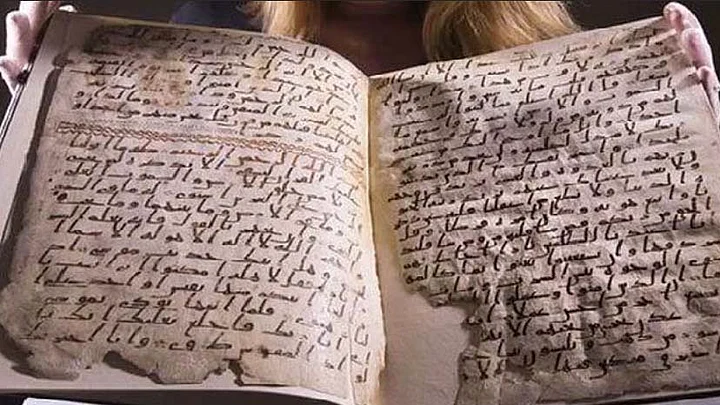
Researchers at the Birmingham university in UK have discovered that fragments of a Quran manuscript in the varsity library are among the oldest in the world, dating back at least 1,370 years, close to the time of Prophet Muhammad.
Radiocarbon analysis has placed the parchment on which the text is written to the period between AD 568 and 645 with 95.4% accuracy.
The test, which was carried out in a laboratory at the University of Oxford, places the parchment close to the time of Prophet Muhammad, who is generally thought to have lived between AD 570 and 632.
Consisting of two parchment leaves, the Quran manuscript contains parts of Suras (chapters) 18 to 20, written with ink in an early form of Arabic script known as Hijazi.
Dr Alba Fedeli, who studied the leaves as part of her PhD research, said: “The two leaves, which were radiocarbon dated to the early part of the seventh century, come from the same codex as a manuscript kept in the Bibliotheque Nationale de France in Paris.”
“According to Muslim tradition, the Prophet Muhammad received the revelations that form the Quran, the scripture of Islam, between the years AD 610 and 632, the year of his death,” said Professor David Thomas, Professor of Christianity and Islam and Nadir Dinshaw Professor of Inter-religious Relations at the University of Birmingham.
Find out more about the discovery in the video below.