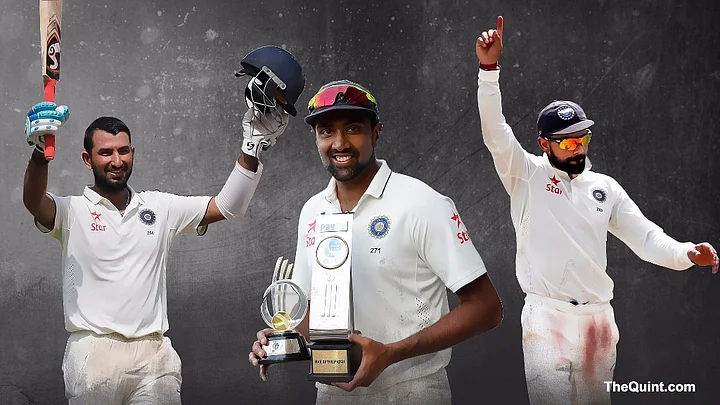
India completely outplayed New Zealand in the third and final Test match of the series at Indore as the host dismissed the Kiwis for just 153 in the last innings to register a massive 321 runs victory. With that, India also completed the whitewash by sweeping the visitors 3-0 in the series.
The Quint brings you the report card of Indian players who took field against New Zealand during the Test series.
Ravichandran Ashwin
Ravichandran Ashwin imposed himself all over the visiting New Zealanders. 27 wickets — the second-best return by an Indian in a 3-Test series — explain the damage the off-spinner caused in the Test series.
He had a complete stranglehold over the Kiwis and his success had perhaps the single-biggest influence on the outcome of the series. Credit to Ashwin, his success was not because the pitches were square-turners or dust-bowls — his wickets were a result of some very tactful bowling on good sporting wickets.
Many things stand out from Ashwin’s performance in the series — his consistency, repeatedly picking up the big wickets, his hunger for a contest and his fitness levels. That he also picked up the bulk of his wickets bowling the conventional off-break speaks about his control.
Of the 15 players the Kiwis fielded in the series, Ashwin dismissed 13 at one point or another. This series was the fifth consecutive series — starting with the tour of Bangladesh in June 2015 — that Ashwin has finished as the highest wicket-taker in the series.
He doesn’t score a perfect score for two reasons: One, his poor returns with the bat, and two — by his own admission — the fact that he took a little longer than he himself liked to settle into a rhythm.
Cheteshwar Pujara
Cheteshwar Pujara finished the series as the highest run-getter from both sides. He scored three half-centuries in his first five innings and capped the series with his eighth Test century — a knock which was in stark contrast to the picture that has been painted of Pujara, the Test specialist.
In the second innings of the final Test at Indore, Pujara started as he always does, but he seamlessly shifted gears when the need arose, and scored the second 50 runs in his century from as many deliveries.
One got to see the assured and consistent Pujara at the crease; he only loses out on a few points for his failure to score in one inning and for the fact that for a player who has a reputation of being a big scorer, he failed to convert four starts in the series.
Ravindra Jadeja
At the end of the Test series, Ravichandran Ashwin admitted that Ravindra Jadeja was the perfect foil for him. Jadeja could be considered India’s third-best performer in the series; his performance is rated extremely highly not only for his series haul of 14 wickets, but also for his contributions with the bat (especially in both innings of the first Test).
Jadeja was extremely accurate and difficult to get away; this can be established from the fact that he was the most economical of all the specialist bowlers in the series, and the fact that 6 of his 14 wickets in the series were batsmen dismissed ‘LBW’.
Rohit Sharma
Rohit Sharma has ability and timing, and he put them to good use in the Test series against New Zealand. In difficult conditions, he scored runs with ease and he scored them when it mattered. Rohit started the series with a fluent 35 before throwing his wicket away.
In the second innings in Kolkata, with the team in a spot of bother, he scored a half-century; his 103-run partnership with Wriddhiman Saha for the seventh wicket all but shut the door on the visitor’s chances. He finished the series with yet another half-century, scoring a 62-ball 50 in the first innings in Indore.
Wriddhiman Saha
Wriddhiman Saha is not the in-your-face kind of cricketer of this generation. Yet, he was a huge contributor to India’s clean sweep of the Kiwis. Batting at number eight, he scored two half-centuries in the Kolkata Test — both of which bailed the Indian team out of trouble and set up the match.
He was named Player of the Match in the second Test. Behind the stumps, Saha didn’t have too many opportunities come his way — yet he was magnificent with his glove work on demanding pitches. While keeping in the fourth innings, Saha only conceded 2 byes in a total of 213.3 overs.
Ajinkya Rahane
Ajinkya Rahane got starts in five of the six innings he batted in the series, but his two telling contributions came when the team needed it most. In the first innings of the Kolkata Test, India were 46 for 3 after opting to bat first; Rahane chipped in with a calming 77. In the first innings of the final Test at Indore, India were 100 for 3 when Rahane combined with Virat Kohli and helped the team out of trouble with a magnificent 365-run partnership.
Rahane missed out on a maiden Test double hundred, but his 188 in Kolkata became his highest score. The Mumbai batsman was a crucial contributor to Ravichandran Ashwin’s success with the ball; although there were a few which slipped away from his hands, Rahane was generally safe in the slip cordon.
Virat Kohli
Virat Kohli had a magnificent series as Captain; his selection of players for conditions, bowling changes, setting of fields, getting the crowd involved — he got almost everything right.
With the bat, Kohli was slow to begin — scoring 9, 18 and 9 in his first three innings. But his 45 in the second innings at Kolkata was a statement; it was not the quantum of runs, but the manner in which he scored the runs that was impressive.
India were reeling at 43 for 4 when Kohli scored those 45 runs — stamped with class and authority, and filled with some stunning shots. He carried that form to Indore and scored a magnificent 211 — his second double century in Test cricket.
Mohammed Shami
Mohammed Shami’s series returns — eight wickets at an average of 30.37 — are not a fair representation of his performance in the 3 Test matches against New Zealand. The speedster ran in hard and bowled quick; he didn’t get to bowl too many overs with the new ball, but he was very effective with the old ball and got it to reverse too.
He picked up six wickets in the Kolkata Test match and even contributed with the bat, scoring 14 in the first innings and adding a crucial 35 runs for the last wicket in the company of Wriddhiman Saha.
Murali Vijay
New Zealand appears to be Murali Vijay’s bogey team; in two Tests against the Kiwis prior to this series, he had scores of 26, 13, 2 & 7. In this series, he only managed two respectable scores in six innings — 65 and 76 in the first Test match at Kanpur.
Vijay has been India’s best Test batsman over the last couple of years, but in the home series against New Zealand, he only managed a total of 186 runs — scoring 45 runs in the last four innings in the series. He looked good while he was out there in the first two innings, before receiving two brilliant deliveries in the second Test match.
Umesh Yadav
Umesh Yadav struck only twice in the series; he gave India its first breakthrough in the series when he dismissed Martin Guptill LBW in the first innings in Kanpur. His second success came in New Zealand’s second innings in the final Test in Indore when he dismissed the other opener Tom Latham LBW.
In between though, Yadav ran in hard and did a very good job in keeping the pressure; his economy rate of 2.69 was the best among the quicks from both sides.
Rest of the Cast
India had to change its playing XI in each of the three Test matches in the series — some forced because of injuries and some for tactical reasons.
The Quint believes one Test match isn’t enough to rate a player and hence doesn’t give rating points for the four players who got a solitary outing in the series.
Among those who played just the one Test match in the series, Bhuvneshwar Kumar (6 wickets in the series) had the most influential performance. His 5 for 48 in the first innings in Kolkata decimated the New Zealand top order and was chiefly responsible for India’s crucial 112-run first innings lead. To put Bhuvneshwar Kumar’s performance in context, it was the only 5-for by a pacer from both sides in the series.
On his return to the Indian Test team Gautam Gambhir looked good in both the innings, scoring 29 & 50. KL Rahul (32 & 38), who opened for India in the first Test, too looked good, but he could be held guilty of not converting starts into a big score. Shikhar Dhawan (1 &17) had a largely forgettable series; coming into the XI as a replacement opener, the left-hander played two poor strokes that brought about his dismissals in the Kolkata Test.