Ishtayaq Ahmed, 54, does not wait for the toss. The Srinagar-based cab driver walks upstairs, switches on the television and settles onto the floor with his two daughters and son. Once the first ball is bowled, the room falls silent.
For nearly three decades, cricket has been his constant. Through curfews, shutdowns and prolonged disruptions, match days offered familiarity. International fixtures were followed closely. Domestic tournaments were debated in detail. Players from Mumbai, Delhi and Punjab became household names in Kashmiri homes.
Yet for years, Ishtayaq watched with a lingering question: when would cricketers from Jammu and Kashmir appear on that screen in a way that felt permanent?
This month, that distance narrowed. Jammu & Kashmir have won their maiden Ranji Trophy title, beating eight-time champions Karnataka, in Karnataka. 66 years since their maiden campaign, the region has the crown of India's premier domestic red-ball competition.
For decades, he consumed domestic cricket as an observer of other states’ journeys. Victory and defeat felt distant. Now the names are familiar. The accents in post-match interviews sound like his own.
"This is not like before," he told The Quint. "Now, when we watch, we feel proud in a different way."
Jammu and Kashmir’s Ranji Trophy triumph has already redrawn what feels possible. For a region that has followed cricket intensely but could never win the premier first-class tournament, the moment carries weight far beyond the scoreboard.
Across Kashmir, it has shifted conversations inside homes, altered how parents assess risk and given young cricketers, especially those from modest backgrounds and rural districts, something tangible to defend their ambitions with.
Cricket in the Shadow of Uncertainty
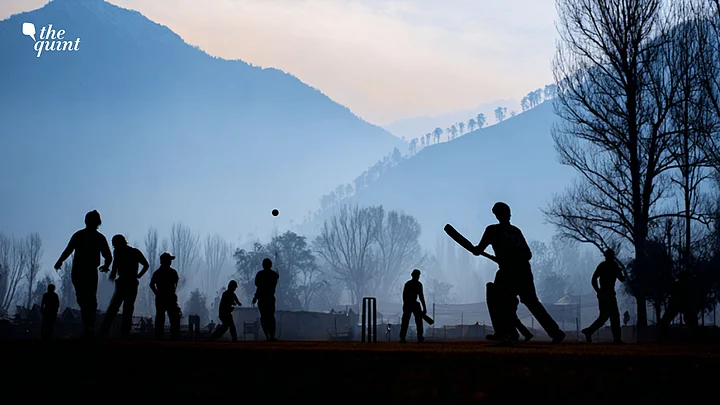
In many Kashmiri neighbourhoods, cricket begins with improvised equipment and uneven grounds. A plastic bat is often a child’s first possession. Tennis balls are taped to add weight and create swing and seam movement.
Wickets are drawn in chalk against compound walls. Boys clear debris from playfields themselves and collect small contributions to level pitches before organising local matches.
Passion has never been scarce. Pathways have not.
Nasir Bhat, 27, from Kulgam, told The Quint formal talent scouting barely reached rural areas during his early playing years. Selection trials were typically held in Srinagar or Jammu, requiring hours of travel for opportunities that sometimes lasted only minutes.
“Until my early twenties, I had hardly seen proper talent hunt programmes,” he said.
Zahoor Farooq, 24, recalled standing in long queues during open trials, unsure whether he would face more than a handful of deliveries. The expense of travel meant that even one unsuccessful attempt felt consequential.
Exposure often came through private leagues outside the region, which demanded money and networks. Without those, progression slowed. Several promising players, Zahoor said, gradually moved toward stable employment because the next step in cricket felt invisible.
For years, ambition routinely exceeded access. Talent existed, but structure did not always meet it halfway.
The Battle Inside Homes
If infrastructure posed one barrier, family negotiation posed another.
For many young cricketers, the most consequential discussions unfold at the dinner table.
Salik Bhat, 29, from north Kashmir, said that relatives frequently compare him to cousins who have secured government jobs or migrated abroad. As he grows older, the scrutiny intensifies.
“They tell you to change your passion,” he said.
He describes conversations in which cricket is framed as delay — a postponement of stability. His family does not oppose him directly, he said, but concern surfaces through reminders about competitive exams, suggestions to consider alternative careers and questions about income.
During Ramazan, he continues to train while fasting. Practice sessions stretch for hours under modest facilities. There are no physiotherapists monitoring hydration or specialised recovery programmes. He returns home exhausted, conscious that fatigue must not resemble doubt.
He recalled how young cricketers were often labelled irresponsible for prioritising practice over immediate employment.
“Sometimes it feels like you are fighting a battle quietly every day,” he told The Quint.
That fight is also financial.
Zakir Hussain travels daily from his village to Srinagar for training, spending Rs 260 on transport each day. His father works as a labourer. When practice extends over weeks, each session becomes a calculation.
He said that some days he weighs whether to attend practice or save money for household needs. Skipping sessions risks falling behind. Attending them risks adding pressure at home.
“Parents are not against our dream,” he told The Quint. “They are afraid of what happens if it does not work.”
For years, that fear shaped decisions. Without visible success stories from within the region, caution appeared justified.
For Girls, the Scrutiny Is Relentless
For women cricketers, negotiation carries additional layers.
Mansha, 23, who requested anonymity, told The Quint that choosing cricket often requires repeated justification. Extended hours on the field attract comment. Travel to matches invites questioning. Visibility on social media can trigger backlash.
Her father has received calls from relatives after seeing her practise. A photograph from a local match circulated on WhatsApp groups, prompting tense conversations at home.
“My father asked me what cricket would give me,” she told The Quint. “He said he had spent so much on my education.”
She explained that boys are often granted time to experiment with uncertain careers. Girls are expected to demonstrate certainty much earlier.
“There is more fear for girls,” she said. “More judgement.”
Facilities for women remain fewer, and competitive opportunities narrower. Informal discouragement often precedes formal barriers. Some players withdraw not because they lack ability, but because sustaining constant negotiation becomes exhausting.
For years, the absence of visible breakthroughs made resistance difficult to challenge. Without examples to point to, defending ambition required both persistence and persuasion.
A Breakthrough That Feels Personal
This is not the first time cricketers from Jammu and Kashmir have appeared on big stages. Fast bowler Umran Malik, batting all-rounder Abdul Samad, bowlers Yudhvir Singh Charak and Rasikh Salam Dar have all featured in the IPL in recent seasons, carving individual paths into Indian cricket’s most visible league. This year, Aquib Nabi was also picked up by Delhi Capitals, another milestone for the region.
But this moment feels different.
Those were individual ascents. This is a collective arrival.
For the first time, it is not one name breaking through — it is an entire side carrying the region to the final stage of India’s most prestigious domestic competition.
When Aquib’s performances helped power the team forward, celebrations spilled beyond cricket grounds into markets and tea stalls in Baramulla, Shopian and Anantnag.
In Baramulla, Zubair Ahmed, captain of the local cricket club where Aquib played in his initial days, described the shift as psychological.
“For a long time, we did not have idols in J&K cricket,” he told The Quint. “Now young players can point to something and say they are from here.”
Individual success had offered glimpses. This run has offered belonging.
Earlier, aspiration relied heavily on imagination. Now it has proof.
When Zubair first began offering structured coaching, attendance was modest. Parents were cautious. Cricket was treated as an extracurricular activity rather than a serious pursuit.
Now, inquiries have multiplied.
“Earlier, we struggled to convince families,” he said. “Now they are convincing us.”
Instead of dismissing cricket outright, parents are asking about tournaments, exposure, and progression.
The breakthrough has changed the conversation.
A Screen That No Longer Feels Distant
Back in Srinagar, when a wicket falls, Ishtayaq does not just applaud. He smiles — the kind that lingers.
For decades, domestic cricket unfolded at a distance. Now it feels like a mirror.
The structural gaps remain. Financial strain persists. Social pressure has not vanished. But something foundational has shifted.
In homes where cricket once felt like a gamble, it now carries evidence. In academies where attendance was uncertain, it comes with conviction. In conversations once dominated by doubt, there is less left to argue.
For 67 years, Jammu and Kashmir participated in the Ranji Trophy without reaching its final stage. That absence shaped expectation as much as performance.
That expectation has changed. The ceiling has broken.
And once a ceiling breaks, it rarely returns intact.