
ADVERTISEMENTREMOVE AD

Why the Opposition Struggles to Turn Democratic Threat Into Mass Anger

Opposition parties have failed to link threats to democracy with the adverse impact it will have on people's lives.

Published
story-hero-img
i
Aa
Aa
Small
Aa
Medium
Aa
Large

Indian democracy has been widely considered a success story, in spite of its failures, mainly because it was being heavily invested in by the subaltern groups historically at the receiving end of exclusion and inequality. Muslims and Dalits, who were at the bottom of social development, continued to trust the elections and their voting right to ameliorate their vulnerabilities. Democracy is thus a way of mediating elite interests against the cocerns of the subaltern.

The Bharatiya Janata Party (BJP), however, is now converting elections into an intra-elite conflict between the political parties. The recently concluded Assembly elections were fought around vote chori, special intensive revision (SIR), delimitation, ghuspaithiya, and the role of the Chief Election Commissioner (CEC).

Strictly speaking, none of these are directly the common voters' concerns. One might only say that it will eventually impact their quality of life and economic opportunities if they don’t get to vote.

But in the immediate outcomes, as of now, they remain percievably more of a concern for the political parties whose supporters are being excluded from the voter list through the SIR, their proportion is being reduced through the delimitation, and other electoral malpractices being condoned by the CEC.

This is a red herring set up by the BJP to delink elections from the social, economic, and welfare demands of the voters. 

ADVERTISEMENTREMOVE AD

How Anti-Incumbency Gets Deflected

Bihar, under Nitish Kumar, witnessed growing anti-incumbency in the last Assembly elections, but once the narrative shifted to vote chori led by Rahul Gandhi and Tejashwi Yadav, anti-incumbency and other related issues got waylaid and the BJP-JD(U) combine inched back to a major success.

What the BJP is doing is to disconnect the macro-narrative from governance at the micro-level. While the Opposition is set up to campaign around issues concerning their own survival, the BJP continues to seemingly deliver on the ground and offer a relatively better service delivery, provide infrastructure, and social welfare concerning people's everyday survival. The Opposition's struggles against malpractices get projected as against people’s concerns.

If people are convinced of a relatively better service delivery on the ground by the BJP, and also see the Opposition campaigning for issues related to their own survival, the game is set for the BJP to win the elections. 

This also partly explains why the BJP doesn’t suffer anti-incumbency as other parties do.

The BJP tends to stay on in power once they win a state—whether it’s Assam, Madhya Pradesh, Uttar Pradesh, and not to mention Gujarat.

Why is there no visible "anti-incumbency" in the BJP-ruled states? Why is the BJP able to aggregate its own social base in each election and does not seem to lose the voters who have decided to vote for them?

In West Bengal, the calculation began from the previous Assembly election results. Then, it's a matter of how to add extra voters, either through deletion or through addition. But the question remains: how is the old social base so stable?

Opposition’s Mobilisation Problem

Opposition parties are reeling under the impression that people will come out in big numbers to resist the electoral malpractices, especially the deletion in the voting list. It is not clear though, as to why the Opposition parties are unable to organise them for street demonstrations if there are large numbers of deletions.

If 27 lakh voters were wrongfully deleted in Bengal, the Trinamool Congress (TMC) could have organised a dharna organising 5 or 10 lakh of them.

With the Congress, one might say there is no organisation or cadre on the ground to do so, but this is not the case with the TMC.

It is either that people are not responding to the vote chori or electoral malpractices campaign, or are worried that coming out in the open claiming to have been deleted is an affirmation of the doubtfulness of their citizenship status. In either case, there is something serious for the Opposition parties to ponder over.

Opposition parties cannot put the onus on the common people to get mobilised. If it’s seen as a battle between political parties, as it seems to be, there is no reason for people to risk everything to stand by any political party. Except for the cadre, common people will get mobilised only by their immediate concerns—like the workers in Noida got mobilised for better wages—but they may not see electoral malpractice as an issue that concerns them immediately.

In fact, there was a fair amount of discontent with the TMC and the Dravida Munnetra Kazhagam (DMK). Instead of addressing those complaints, the parties got busy fighting for their own survival, which might be seen by the common people as an obfuscation of real issues on the ground. If Tamilians are unhappy with the DMK, will they gather around the party against delimitation?

Added to this, the BJP is blocking legitimate funds to the states, for instance, the MNREGA funds to Bengal were stalled but there is no visible anger against the BJP for that. Why?

The ‘Double Engine’ Model

The BJP, as a follow up to the neoliberal, transactional model of governance and politics, has carried the logic further through its 'double-engine sarkar' model, which effectively means states will do better with better fund allocation only when they align with the Centre.

The removal of the Aam Aadmi Party (AAP) in Delhi was an explicit and brazen experiment where the AAP was blocked from working through the LG office, and the message was clear, that only if the BJP comes to power will there be developmental activities in Delhi. Delhites seem to have fallen in line.

Pragmatic and transactional character of politics is not leading to anger against the Centre for blocking funds. Again, Opposition parties are on the backfoot, not knowing whether the lament against the Centre will mobilise anger against the BJP or demonstrate their own ineffectiveness. 

The Need for a New Agenda

Neoliberalism is not only an economic model of growth but is also a cultural phenomenon, that impacts the way people assess and valuate political processes. In a transactional model, there is little space for struggles against injustice, unless it directly impacts the people’s everyday lives.

Opposition parties have failed to link the threats to democracy with the adverse impact it will have on people's lives. This needs an effective narrative; it is not given in the exclusive narrative against electoral malpractices.

Finally, the Opposition parties have done better when they came up with their own agenda or vision. It was clear with the campaigns on caste census and samvidhan bachao. The BJP and the RSS were compelled to respond to the caste census campaign by Rahul Gandhi. Not only did he do it single-handedly, without either his party support or media presence, but also managed to create enough pressure on the BJP.

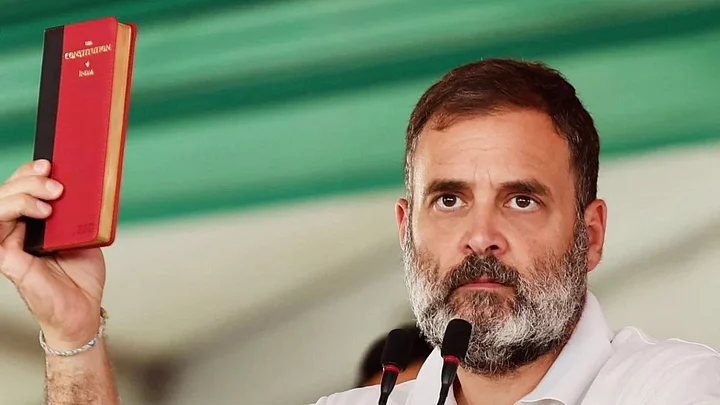
Similarly, samvidhan bachao campaign and its impact are visible in the electoral outcome of 2024.

Opposition parties can only successfully respond to issues thrown up by the BJP as part and parcel of an independent narrative and agenda they champion. They need to undoubtedly protest and resist against electoral malpractices, but such a campaign will succeed only if it is connected and grounded in people's everyday concerns.

This requires some hard thinking, as it’s the last hope to save democracy and the Constitution.

(Ajay Gudavarthy is a political theorist, analyst, and columnist in India. He is associate professor in political science at Centre for Political Studies, Jawaharlal Nehru University, New Delhi. This is an opinion piece. All views expressed are the author’s own. The Quint neither endorses nor is responsible for them.)

Speaking truth to power requires allies like you.
Become a Member
Monthly
6-Monthly
Annual
Check Member Benefits
×
×