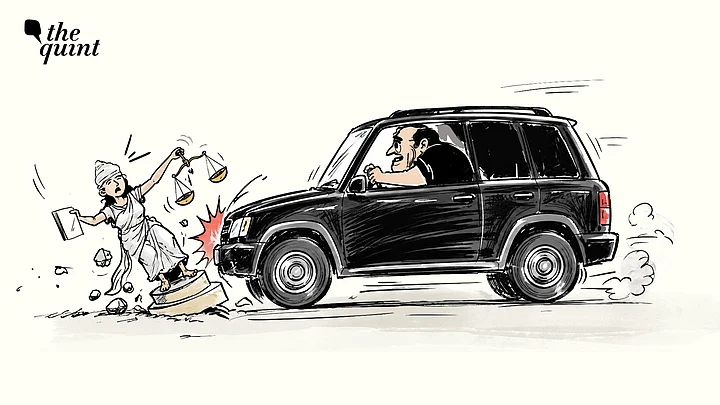
On 21 September, in Greater Noida West, a speeding Mahindra Thar struck a scooter and threw a couple onto the road, leaving them bloodied and broken. The driver fled the scene.
Neeraj, 40, a lawyer practising before the Supreme Court, was declared brought dead by the hospital. His wife remains in a coma with 18 fractures across her body. Her pelvic region is crushed. Medical bills exceed Rs 7 lakh, as reported in the news the next day.
The Thar came from the wrong side of the road. It was speeding, and allegedly, the occupants were consuming alcohol. As per news reports, Section 106(2) of the Bharatiya Nyaya Sanhita (BNS) has been invoked, but that is not legally sustainable, as the section stands suspended at the government's directive.
Also, the Delhi High Court, while dismissing a PIL seeking enforcement of Section 106(2), famously called the hit-and-run section, held that the power to enforce the section by notifying the date on which the provision would come into force was with the Central government, and not the court.
Be that as it may, despite registering the FIR under Section 106(2), the accused can only be prosecuted under Section 106(1), which is bailable and carries a maximum punishment of five years.
Two Crashes, Two Applications of Law
On 25 June, 34-year-old Sarthak Mattoo’s motorcycle was hit by a Mahindra Thar near the Rajokri flyover in southwest Delhi. He was taken to the hospital by PCR but was declared brought dead. The occupants of the SUV allegedly fled the scene.
The accused was arrested, but was later released on bail as they were booked under Section 106(1) of the BNS, a bailable offence.
Three months later, another road incident in Gurugram produced a remarkably different public and institutional response. On 13 September, biker Shivani Chauhan, known on social media as Sia, was riding on Golf Course Road when a car allegedly followed and rammed her motorcycle.
She was thrown onto the road and suffered minor injuries. The incident was captured on motorcycle-mounted cameras and circulated widely on social media. The videos of sparks flying from the dragging motorcycle became a public spectacle and gave a perfect opportunity for the media to capitalise on it.
The accused was arrested and booked under the charge of attempt to murder. While Sarthak died in a road accident, his case received comparatively little sustained public and media attention, and the accused was released on bail.
The two cases are not legally identical, and the charges must ultimately depend on evidence and the accused's alleged conduct. But the contrast raises a larger question: why should the intensity of public outrage determine the intensity of institutional attention?
A death without a viral video is no less a death. Sarthak's family did not have the benefit of a media trial and public outrage. In an ideal system, neither should they need one. That is the objectivity the law must have, leaving no scope for discretion.
The BMW That Changed Everything (and Nothing)
This news may still be fresh in our memories: the grotesque accident caused by Sanjeev Nanda.
On the morning of 10 January 1999, Sanjeev Nanda, grandson of former Naval Chief SM Nanda and son of arms dealer Suresh Nanda, drove his brand‑new, unregistered BMW through a police barricade on Lodhi Road in Delhi at high speed while heavily intoxicated, killing three policemen and three civilians.
Nanda, instead of stopping, drove to a friend’s house and tried to wash the blood and flesh off the car before being arrested that afternoon. His blood alcohol content confirmed he was drunk.
Without getting into the legal intricacies, the result was that for killing six persons, the accused had to undergo two years of rigorous Imprisonment, two years of community service, and Rs 50 lakh as a fine, a pittance in 2012 for the family of an arms dealer.
The case did not serve as a deterrent for habitual offenders and violators of traffic rules, and India continues to be the world’s capital of deaths in road accidents.
No wonder in Delhi-NCR we often see SUVs driving carelessly, with zero regard for traffic rules and no empathy for human lives. This is much more worrying with the exponential increase in two-wheelers on Indian roads due to increased delivery-person culture.
The Pune Crash: When Parents Become Accessories
Twenty‑five years after Sanjeev Nanda’s BMW mowed down six people in Delhi, in May 2024, a 17‑year‑old boy in Pune rammed a Porsche into a motorcycle. The two riders, both aged 24, died on the spot. The boy was allegedly drunk.
The boy’s parents, a realtor named Vishal Agarwal and his wife Shivani, were accused of conspiring to replace their son’s blood sample with the mother’s at Sassoon General Hospital.
The boy’s grandfather and father allegedly pressured their driver to say he had been behind the wheel. The Juvenile Justice Board initially granted the minor bail and asked him to write a 300‑word essay on road safety, as if an essay could bring the two young lives back to life.
The media attention this case got, like in the case of Sanjeev Nanda, and the father of the accused boy was arrested and had to go through pre-trial imprisonment of 22 months before he was released on bail by the Supreme Court. Had there been no extensive media coverage, another road death would have passed by, affecting none.
The moot point is that 25 years after Nanda, India’s motor‑accident laws still treat death on the roads as a minor offence, and privilege as an alibi. The Pune case shows that the country had learned nothing except how to hide the evidence more carefully.
Why s Negligence Law So Weak?
When the Indian Penal Code (IPC) was enacted in 1860, Section 302 punished murder where there was an intention to cause death, while Section 304 covered culpable homicide, including acts committed with the knowledge that they were likely to cause death.
In theory, deaths resulting from seriously reckless conduct could fall under this provision.
But as factories, mines and railways expanded under the British rule, British officers, engineers, and managers increasingly oversaw operations largely staffed by Indian workers.
In 1870, Section 304A was introduced, creating a separate and much softer offence for causing death through a rash or negligent act without intention or knowledge. The maximum punishment was just two years' imprisonment, a fine, or both.
With sentences capable of being suspended pending appeal, an officer could potentially finish his posting and return to Britain before his case was finally decided.
This was not simply a workplace-safety reform. Critics have argued that the provision also gave colonial officials greater protection from serious criminal liability for deaths caused by negligence.
For 153 years, from 1870 to 2023, Section 304A remained the backbone of India's law on negligent deaths—covering everything from road crashes and industrial accidents to deaths caused by medical negligence.
A colonial-era provision survived into independent India and continued to offer relatively light punishment.
The BNS, enacted in 2023, finally attempted to increase these penalties.
Section 106(1) provided up to five years' imprisonment and a fine for causing death by negligence
Section 106(2) provided up to 10 years for causing death through rash or negligent driving and then fleeing without reporting the incident
The distinction mattered. A driver who causes a death and then flees—leaving the victim without assistance and avoiding accountability—has made an additional choice beyond the original negligent act.
But the provision triggered massive protests by truck drivers in December 2023 and January 2024. Transporters, including the All India Motor Transport Congress, argued that drivers involved in genuine accidents could face severe punishment for fleeing because they feared mob violence at accident sites.
On 2 January 2024, the government announced that it would not bring Section 106(2) into force without further consultation. The hit-and-run provision consequently remained on hold.
But that concession created another problem: the protection was not limited to truck drivers fearing mob violence. It also benefited drivers of SUVs and luxury cars who drink and drive, violate traffic rules or dangerously speed—and then flee after causing a fatal crash.
Comparison with the English laws
England's law on vehicular death has evolved differently.
When India was establishing Section 304A in 1870, England had no statutory definition of negligent homicide either. But English common law recognised manslaughter by negligence.
Judges developed the doctrine through cases, and by 1925, the test was established in R v Bateman: for manslaughter, negligence must be so gross that it "showed such disregard for the life and safety of others as to amount to a crime against the State and conduct deserving punishment."
While in colonial India, the British were shielding themselves; back in England, the courts were reforming the laws.
In 1988, England enacted the Road Traffic Act, creating the specific statutory offence of "causing death by dangerous driving." A person is guilty if they cause death by driving "dangerously on a road."
The test is objective, leaving no space for discretion either by police or by the courts. It asks a simple question: would a competent and careful driver consider this manner of driving dangerous to human life?
Why this difference? England developed statutory motor offences based on decades of case law refining negligence doctrine. By the time the statute was drafted, judges understood that ordinary carelessness was insufficient for criminal liability, but gross recklessness was criminal. The law codified this judgment.
India never had this development. Section 304A remained a colonial holdover for two years, unchanged.
The US has moved even further. In California, a fatal hit-and-run can lead to serious felony charges, including vehicular manslaughter and, in some circumstances, second-degree murder. Fleeing a crash involving death can itself carry three to four years in prison, with additional penalties depending on the underlying offence.
Driving on the wrong side without justification creates an obvious risk of a head-on collision. It is not simply momentary carelessness but active creation of danger.
The logic behind tougher hit-and-run laws is that fleeing is more than failing to report an accident: it means abandoning a seriously injured person and potentially destroying evidence.
In Florida in 2025, an Indian national driving a truck allegedly made an illegal U-turn in a crash that killed three people. A decision apparently made to save a few minutes ultimately exposed him to the possibility of a lengthy prison sentence.
What Reform Should Look Like
Since Section 106(2) was put on hold in January 2024, deaths caused by negligence remain punishable under Section 106(1), with up to five years' imprisonment—higher than the old two-year limit, but below the ten-year ceiling proposed for hit-and-run cases.
India's motor-death laws need a clearer distinction between genuine accidents and deliberate recklessness.
A death caused by an unforeseeable tyre burst, sudden brake failure or an unexpected obstacle should not automatically result in criminal imprisonment if the driver exercised reasonable care.
The driver should, however, be required to stop, call emergency services and assist the victim. Faster settlement of insurance claims through Motor Accident Claims Tribunals (MACTs) could also help reduce conflict after crashes.
But conduct such as deliberately driving on the wrong side, speeding at 140 kmph, drunk driving or jumping a red light is fundamentally different. If such behaviour causes serious injury or death, the law should recognise that the driver consciously chose to create a serious risk to others.
That is the distinction the law needs to make: between unavoidable misfortune and a deliberate choice to act recklessly.
India's Section 106 should embody this distinction.
For unavoidable accidents (sudden tyre burst, unexpected mechanical failure, unforeseeable obstacle): No criminal liability, only civil liability. Insurance covers the death, though the driver may owe damages if negligent vehicle maintenance contributed to the accident.
For traffic violations causing accidental death (broken headlight, poor visibility, failure to signal): Liability depends on the degree of negligence. A broken headlight may attract civil liability, but driving at night at 80 kmph with a broken headlight could amount to recklessness and attract criminal liability.
For reckless conduct with a high risk of death (wrong-side driving, excessive speeding, drunk driving, racing): Maximum imprisonment of ten years and a mandatory fine. The driver knowingly engaged in dangerous conduct, making it akin to Part II of Section 105 of the BNS (Section 304 IPC).
For hit-and-run (causing death through reckless or negligent driving and then fleeing without reporting or helping): A mandatory five-year enhancement over the base sentence. Fleeing is a deliberate choice to abandon the victim and potentially destroy evidence.
This approach protects genuine drivers from criminalisation for accidents while holding reckless drivers accountable.
The truck unions' argument was legitimate but misdirected. They said that Section 106(2) would destroy their industry because drivers fear imprisonment for genuine accidents or lynching if they did not flee.
The answer is not to lower the punishment for hit-and-run. The answer is to remove criminal liability for accidents due to unavoidable reasons altogether and make the distinction as objective as possible to eliminate any type of discretion.
(The author is a lawyer at Delhi High Court and Supreme Court of India. This is an opinion piece and the views expressed are the author's own. The Quint does not endorse or is responsible for them.)