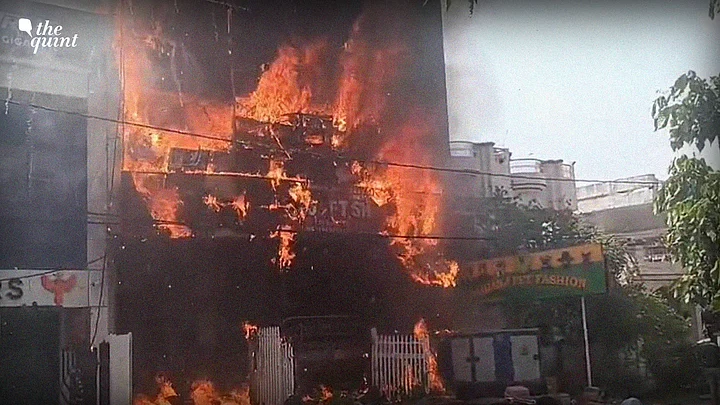
Earlier this week, a coaching centre in Lucknow caught fire, leading to the death of at least 15 children. This is not the first time such an event has been reported. A similar mishap took place in Surat, where 22 children lost their lives in a fire in a coaching centre in May 2019, and in 2024, where two students drowned when a coaching centre was flooded in Delhi.
Safety in India’s coaching industry can only be ensured through a specific law regulating coaching centres.
As of 2022, the coaching industry in India was valued at Rs 58,000 crore. Estimates suggest that this number will cross Rs 1 lakh crore by the end of this year.
An industry this size must necessarily be regulated by a specialised law. However, not only does India lack a specialised law to regulate coaching centres, the coaching industry continues to be forcefully regulated under the Shops and Establishments Act.
Why Coaching Centres Are Not Another Shop
Every state in India has its own Shops and Establishments Act. These Acts are not legislations designed to ensure safety in establishments. At their core, they are labour laws enacted to ensure safe and humane working conditions for workers employed at these establishments. The preamble of the Delhi Shops and Establishments Act, 1954, for example, reads as follows:
“An Act to amend and consolidate the law relating to the regulation of hours of work, payment of wages, leave, holidays, terms of service and other conditions of work of persons employed in shops, commercial establishments, establishments for public entertainment or amusement and other establishments and to provide for certain matters connected therewith.”
Clearly, these laws are not sufficient to ensure safety of establishments. Further, shops are marked by sporadic in-flow of customers/clients, which is starkly distinct from the several hundred children that populate coaching centres every hour. Therefore, the same legislation cannot be made to fit both scenarios.
The Bill That Could Have Changed Things
In February 2025, Dr Fauzia Khan from the Nationalist Congress Party (Sharad Pawar) had introduced the Coaching Institutes (Accountability and Regulation) Bill, 2024 in the Rajya Sabha.
Dr Khan’s Bill proposed a Coaching Institutes Regulatory Authority (CIRA), headquartered in Delhi with state/UT offices, comprising a Chairperson and at least seven members representing education, mental health, coaching institutes, parents, and students. This body would maintain a national database, mandate compulsory registration of coaching institutes, and frame codes of conduct on class strength, schedules, infrastructure, and student support, and conduct inspections. This body would also act as a grievance redressal body for students, and parents.
The Bill proposed that coaching institutes be held liable for student suicides where the suicide was either a result of undue academic pressure, negligence in addressing grievances, or inadequate counseling by the coaching institute.
Unfortunately, this Bill lapsed. The Bharatiya Janta Party (BJP) had then opposed this Bill on the ground that the Parliament lacked the competence to make a law on this subject. The BJP’s illogical argument was that, because “education” formed a part of the concurrent list, a law on this subject could only be enacted by the State Legislature.
Even on its face value, this ground for opposing the Bill is itself incorrect. Although the theme of this piece is not to uncover the BJP's political will (or lack thereof), it is appropriate to note that several notable legislations in the realm of education, ie, Right of Children to Free and Compulsory Education Act, 2009; the University Grants Commission Act, 1956; and the Institutes of Technology Act, 1961 have all been passed by the Parliament. And that, both the Parliament and the State Legislature are empowered to make laws on matters listed in the concurrent list.
Further, if a law enacted by the Parliament and the State Legislature are in conflict, Parliament’s law will prevail.
Following the lapse of Dr Khan’s Bill, Rajasthan introduced the Rajasthan Coaching Centres (Control and Regulation) Act, 2025. However, neither Dr Khan’s Bill nor the law in Rajasthan is sufficient to deal with infrastructural hazards at coaching centres. Both of these were introduced in light of a series of student suicides, and, therefore, they were both aimed at ensuring the mental and emotional wellbeing of children in coaching centres.
The Blueprint for Reform
In addition to protecting the mental and emotional wellbeing of students, it is equally important that these laws protect the very body of the child. It is, therefore, essential that either a specific law be enacted to regulate the safety standards in coaching centres, or the scope of previously proposed laws are widened, and reconsidered by the Parliament.
This law would have to ensure that the building by virtue of its construction, or design does not create a hazard for its occupants. Further, even if the building were to catch fire, sufficient means to escape must be provided. Apart from fire, aspects like ventilation of buildings must also be regulated, so that coaching centres can accommodate students safely.
Formulating construction/design standards for buildings would require considerable expertise of civil engineering and architecture and a field study of the requirements of coaching centres. The government can however, relieve itself of this burden by relying on the National Building Code of India (NBCI) published by the Bureau of Indian Standards. This code contains detailed guidelines for the construction and design of various categories of buildings, including "educational buildings".
The foreword to this code shows that, “The code contains regulations which can be immediately adopted or enacted for use by various departments, municipal administrations, and public bodies.”
Therefore, the guidelines in this code, specifically for “educational buildings”, can be implemented on an “as is” basis. This would greatly reduce the burden of the legislature, and at the same time, utilise the expertise developed over half a century of study and deliberation.
(The author is a lawyer practicing criminal and commercial law in Delhi. This is an opinion piece. The views expressed above are the author’s own. The Quint neither endorses nor is responsible for them.)