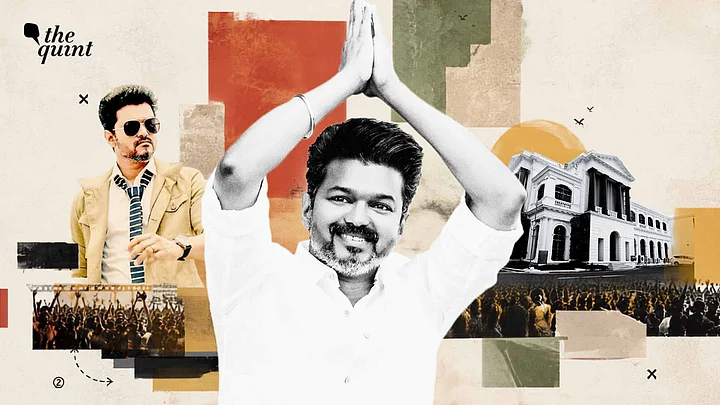
“Hey, shall I start a party of my own?… Shall I begin the campaign…?”
With these words, MS Gandhi, an Indian anti-terrorism squad officer played by the Tamil superstar Vijay, begins the song Whistle Podu in director Venkat Prabhu’s film GOAT–The Greatest of All Time.
“What did you say?” his colleague Kalyan asks.
Gandhi responds mischievously: “I said, ‘shall I open the champagne?’”
Kalyan replies, “Champagne? I heard ‘campaign’.”
Gandhi brushes off the question, and proceeds to dance up a storm in what may seem to most people like just another elaborate set piece typical of commercial Indian cinema. To regular Tamil film viewers, though, the messaging is/was unmistakable, here and in the entire film, starting with the character’s name, one initial removed from MK Gandhi a.k.a the Mahatma, and sharing a surname with India’s most prominent political family.
GOAT reached theatres just months after Vijay launched his political party, Tamilaga Vettri Kazhagam (TVK), in 2024, ending years of speculation about his ambitions. Whistle Podu was obviously conceived as a meta conversation between him and the fandom he expected to convert into TVK voters.
Jana Nayagan (People’s Hero), scheduled for January 2026, was to be his final release before his retirement from acting and shift to full-time politics. With the Central Board of Film Certification (CBFC) blocking Jana Nayagan, GOAT ended up being his last bow on screen preceding his first election.
Twenty months after Gandhi’s wink-wink wordplay on “campaign” and “champagne”, another man bearing that surname—the Congress’ Rahul Gandhi—shared the stage with Vijay at his swearing-in as Chief Minister, after TVK emerged as the largest single party in the Tamil Nadu elections last month.
Vijay heads a coalition government of secular parties including Congress. The question now preoccupying political circles is: has TVK joined Congress at the national level in the Indian National Developmental Inclusive Alliance (INDIA)?
Either way, since Vijay’s cinema has for years reflected his off-screen plans, it’s safe to surmise that pan-India politics is his long-term objective.
As the newbie politician turns 52 today, a good way to gauge his goals is to track his 40-year acting career—not just his films, but all his related choices— and study its role in the astonishing Tamil Nadu verdict.
Dad, Mom and Vijay 2.0
In the past decade, Tamil cinema critics have continuously linked Vijay’s anti-establishment positioning in films with the assumption that he would eventually transition into politics. But to fathom the meticulous planning involved in his rise to CM-ship, we must travel further back, into the 1990s, when the child star Vijay, son of singer-writer Shoba Chandrasekhar and director SA Chandrasekhar, stepped into adulthood. If, as it appears in retrospect, the moves the family made then were prompted by a vision of Vijay 2.0 now unfolding before us, then this must rank as the longest-running election campaign in Indian history, with portents for Vijay’s future in the profession.
It is standard practice for south Indian fans and media to bestow honorary titles on superstars, mostly men. (Sometimes this happens at the behest of stars themselves, but is made to seem organic. That’s a separate discussion.) Rajinikanth, for instance, is Superstar and Thalaivar (Leader). Unlike media coinages for north Indian stars—such as The Big B for Amitabh Bachchan—nicknames for southern stars now customarily run as prefixes in film credits. Vijay’s trajectory is uncommon in this regard. Rajinikanth was a box-office draw for over a decade before a text plate trumpeting “Super Star Rajni” surfaced in the credit rolls of his films. Vijay, however, had done just a couple of lead roles as an adult when, in 1994, he was credited as Ilaya Thalapathy (Young Commander) Vijay in Rasigan (Admirer) directed by his father and written by his mother.
The parents’ dreams got the better of them in later years, compelling Vijay in 2020 to formally distance himself from a party he accused Chandrasekhar of registering in his name without his consent.
More familial tension followed. Nevertheless, the anointment of 20-year-old Vijay as Ilaya Thalapathy 32 years back has stood him in good stead, and serves as an illuminating demonstration of image-building in operation.
Thalapathi (Commander) was Mani Ratnam’s 1991 Mahabharat adaptation with Rajinikanth and the Malayalam cinema stalwart Mammootty. By referencing a Rajinikanth blockbuster yet acknowledging Vijay’s juniority, “Ilaya Thalapathy” was a simultaneous testament to lofty aspirations and humility, foretelling success, implying authority and cultural rootedness.
Communications experts know the power of suggestion and repetition. Over time, the use of Ilaya Thalapathy embedded in the audience psyche a notion that Vijay was the next big thing in cinema, before box-office collections concurred. Once he became a superstar, it emphasised his youth vis-a-vis reigning kings Rajinikanth and Kamal Haasan. Both were in their 60s when Vijay made a carefully timed graduation to Thalapathy in Mersal’s credits in 2017.
In the 23 years between Rasigan and Mersal, Vijay acted across genres, with increasingly political content in the last decade. In 2009, he consolidated his fan clubs in the state to form the Thalapathy Vijay Makkal Iyakkham (People’s Movement), which gradually turned to social service and tested waters in local body elections, before metamorphosing into TVK.
Punchlines are Not Policy Papers
In terms of political ambition and frequent roles as reformer, vigilante or leader, Vijay’s path resembles Rajinikanth’s, but the point of divergence between them throws some light on the younger star’s sensational election debut. After keeping everyone guessing for decades, Rajinikanth finally announced his entry into politics when he was in his late 60s. He then dithered over the question of standing for elections. In his 70s, he ultimately opted out of politics on health grounds.
Vijay, in contrast, has been decisive in risking a fresh start while age is on his side. This is just one of numerous factors that contributed to his electoral slamdunk despite having no known abilities in policy formulation or governance.
At the core of ongoing developments in Tamil Nadu are two defining characteristics of modern society: first, that in the Internet Age, surface knowledge of a million subjects has replaced depth in some, and second, that human beings set the bar of expectations low for celebrities. Having probably understood this, and detected the people’s desire for an alternative to the parties dominating his state, DMK and AIADMK, Vijay chose not to limit the space he could occupy by defining it precisely.
Instead, he tapped that voter dissatisfaction with a blend of rigorous image management, issue-based commercial cinema, social service, and an occasional—very occasional—clearly but not comprehensively articulated opinion on a hot-button topic on which he could not be asked to elaborate since he does not give interviews to the press.
An adoring citizenry filled in the blanks for Vijay, projected their wishlists on to his vagueness and silences, presumed good intentions where no policy was specified, and assumed intentions would translate into sound policy and administrative efficiency. Punchlines delivered by fictional characters are not policy papers attributable to the actor playing them, but some political parties lent gravitas to Vijay’s filmography and painstakingly constructed persona by attacking him over his films, thus complementing his efforts to blur lines between him and his screen roles.
Vijay’s works in the past decade-and-a-half have addressed a range of socio-political concerns and systemic issues.
Director AL Vijay’s Thalaivaa (Leader) in 2013 focused on xenophobes in Maharashtra targeting non-Maharashtrians, especially Tamilians. AR Murugadoss’ Kaththi (Knife) released the next year revolved around an anti-capitalist farmers’ rebellion. Atlee’s Mersal in 2017, which was about corruption in the medical sector, critiqued actual policies of the Central government. The film’s pointed statements included a cutting comment on GST (Goods and Services Tax) in healthcare by Vijay’s character. Murugadoss’ Sarkar in 2018 exposed electoral fraud. Atlee’s Bigil (Whistle) in 2019 was about India’s corrupt sports administration.
Which Came First? The Neta or the Suspicious Rivals?
The parallel tracks in Vijay’s journey have had a symbiotic relationship for a while. His films bolstered his image as a future politician. Likewise, viewers, politicians and press read deeper meanings into his films than they may have otherwise because they assumed he was headed for politics. For example, Thalaivaa’s tagline, “Time To Lead” is believed to have angered the then CM, actor-turned-politician J Jayalalithaa of the AIADMK, who apparently saw it as Vijayspeak for a challenge to herself. Thalaivaa was released in the state only after concerted attempts to assuage her anger.
Against the backdrop of this real-life drama, Thalaivaa’s story of an Australia-based dancer (played by Vijay) returning to India and taking on the mantle of his father, a crime lord who fights for Mumbai’s poor, almost reads as a declaration of Vijay’s own willingness to shoulder life-altering responsibilities in public interest, at great personal cost to himself.
An editorial on Tamil Nadu politics is not where you might expect a Harry Potter citation, yet the writer JK Rowling’s boy wizard is perhaps the least esoteric means of getting through to Vijay’s political rivals.
In Harry Potter and the Half-Blood Prince, Harry asks Professor Dumbledore why he, and not another child, was The Chosen One. Dumbledore explains that when the evil Lord Voldemort heard a prophecy about a baby born to destroy him, he baselessly assumed that Harry was the one. By setting out to kill him, Voldemort instilled in the boy a determination to resist, and unknowingly equipped him with tools for their conflict, including the willingness of others to fight for him.
Like Voldemort, every politician who needlessly got after Vijay played a part in making him exactly what they feared: a threat.
Turning Points Served On A Silver Platter
Thirteen years after Thalaivaa, the Central Government-controlled CBFC’s decision to stall Jana Nayagan robbed Vijay of his grand goodbye to acting, but got him sympathy. It was a useful diversion from the fatalities in a stampede at his rally in Karur in September 2025, which raised questions about TVK’s organisational capabilities and his leadership. Jana Nayagan’s difficulties “helped Vijay, who was under pressure following the Karur tragedy, regain public respect,” the film critic GP Ramachandran wrote on The Aidem.
The BJP’s Tamil Nadu unit had already elevated Vijay’s stature by outraging against Mersal. While protesting what it construed as criticism of Hindutva and the Centre in the film, the party underlined his minority religious identity (he’s Christian), incessantly referring to him by his full name, C Joseph Vijay, rather than his mononymous screen name. But it grossly under-estimated his popularity and Tamil Nadu’s secular ethos. Mersal and its lead star received a tsunami of support from the Tamil audience and industry.
The film became a huge hit, and Vijay rubbed salt into a humiliated BJP’s wounds by issuing a thank you note to well-wishers on a letterhead with his full name and the words “Jesus Saves” emblazoned across it. The triumph in a confrontation with the most formidable force in India today became a turning point for Vijay.
This episode, Jana Nayagan’s continuing difficulties and TVK’s secular post-election alliance are instrumental in the average liberal’s favourable view of Vijay. The actor was certainly brave to star in Mersal in the present political environment but, as a section of liberals point out, he has not actually spelt out his position on the BJP beyond loosely describing it as an ideological opponent. His election victory was “achieved without the burden of ideological clarity, sustained grassroots engagement, or any meaningful history of public service”, the filmmaker Leena Manimekalai wrote on Truecopy Think.
Foresight, Mixed Messaging and Spin
There was a time when Vijay’s inexperience combined with star power would have at best got him an MLA-ship and some seats for TVK, not an entire state. A disturbing lesson from this election is that in public spheres today, your worst shortcoming can, if given the right PR spin, be a USP. Vijay’s films have implied an equivalence between him and MG Ramachandran, the legendary actor-politician. But MGR, unlike Vijay, entered politics several decades before becoming CM. In that period, he continued to act, using films as a medium for messaging, while accumulating political and administrative proficiency.
Vijay has taken a more dramatic road by quitting acting and switching completely to politics, making no bones about wanting to head the government from the word go. While this clarity comes off looking good in contrast to Rajinikanth’s indecisiveness, it also means Vijay single-mindedly pursued a job for which he lacks experience. Yet, the fact that he exited films when he is reportedly one of India’s highest paid actors, has meant that he’s being seen (harking back to Thalaivaa’s plot) as one who sacrificed immense potential wealth to selflessly serve his people.
Now that Vijay’s a victor, even some analysts have adopted this line. They’re also euphemising his refusal to do interviews, calling it a preference for “direct communication” with the masses.
This aspect of Vijay’s career is a comment on the times we live in. On the other hand, the fact that he remains unscathed by contradictions in his positions on women is a reminder of the timelessness of patriarchy. While TVK’s manifesto contains schemes for women, his online army habitually unleashes virulent verbal violence on women, yet he is perceived as a pro-woman politician. The voter reaction to such mixed messaging mirrors the audience response to mixed messaging on gender in his films, and indeed, to gender politics in men-centric commercial cinema everywhere.
Remember that Bachchan became the poster boy of the discourse on consent in sexual relations simply because his character immortalised the line “No means no” in the Hindi film Pink (2016), despite his many problematic roles antithetical to this stance, especially the song Jumma chumma de de from Hum (1991), which is an anthem for the misogynist’s conviction that women are teases and a woman’s no could mean maybe/yes. Vijay too has played predator and protector of women on screen. In keeping with commercial cinema’s penchant for condoning sexual harassment and violence by the designated hero of the plot, his character in Murugadoss’ Thuppakki (Gun) in 2012, for instance, stalks the heroine and touches her inappropriately through long-drawn-out scenes, after which she falls for him.
In this regard, Vijay has mimicked most Indian male superstars. He stands out from the rest in another respect, though.
Seven years after he relinquished the appellation Ilaya Thalapathy for Thalapathy, GOAT ended on a battle between two Vijays, the protagonist Gandhi and his son Jeevan, juxtaposed against a cricket match featuring Mahendra Singh Dhoni in Chennai.
Dhoni “is the oldest player in the league but his energy and speed have not slackened one bit,” says the commentator, while Gandhi bashes up Jeevan, adding, as Gandhi vanquishes the young man, “Age is just a number. A lion is always a lion.”
This meta narrative distinguished the then 50-year-old Vijay from male superstars who, in their 60s and 70s, still find cringe-worthy ways to play down their age on screen. If you watch GOAT now, then in an ironic way, it also spotlights his comparative youth in a political arena packed with elderly men.
Signalling Vijay 3.0
Given that Vijay’s filmography of the last decade hinted at his political plans, it’s not a stretch to read into them the rest of his roadmap.
At Level 1, his works have asserted and celebrated the Tamil identity. At Level 2 is his fan base across south India. Makkal Iyakkham members in Kerala in particular have reportedly been clamouring to metamorphose into TVK since the Tamil Nadu results were announced. Vijay is so popular in the neighbourhood that there’s even a Malayalam feature film about his fans, 2017’s Pokkiri Simon: Oru Kadutha Aaradhakan (A Hard-Core Fan). At Level 3 are the aids for a possible Vijay 3.0 in New Delhi.
Despite the post-pandemic explosion of pan-India hits from southern India’s film industries, Vijay has so far not enjoyed renown outside the south. However, with the curiosity generated by his ascent to CM-ship, if a new audience samples his works on OTTs, they will discover a filmography replete with ingredients common to commercial cinema across India, some of which spawned successful dubbed versions or hit remakes (such as Thuppakki that yielded Holiday: A Soldier Is Never Off Duty in Hindi starring Akshay Kumar). Since Vijay has already effectively leveraged his films in an election, there’s no telling how he might transpose that strategy on to a national stage.
Anyone assuming that a Vijay can happen only in Tamil Nadu because of Tamil voters’ affinity for film personalities needs a reminder that for every MGR and Jayalalithaa who shone in politics, the state’s voters also turned away a Sivaji Ganesan and Kamal Haasan. And let’s not forget stars elsewhere in India who’ve won elections despite publicly displaying ignorance about basic matters. Besides, there’s no comparison between Vijay’s graph and the longer road traversed by MGR and Jayalalithaa.
Vijay is not just a product of Tamil Nadu. He is a product of our times. And in these times, he’s not the first Indian politician to convince voters of his aptitude for governance based on charisma, perception and the conversion of fans to votes.
Arguably, an open avowal of the future politician’s ambitions beyond Tamil Nadu came in the song Aalaporaan Thamizhan from Mersal. The celebratory number begins in Punjab after Vetrimaaran, played by Vijay, wins a wrestling match against a local. A Punjabi man had mocked the prospects of this “Madrasi”, but Vetri’s skill earns the spectators’ admiration, while kind Punjabi women help his wife when she goes into labour on the sidelines and delivers a baby (who grows up to be another Vijay). The entire crowd, across communities, then joins Vetrimaaran as he dances and sings: "The Thamizhan (Tamilian) will rule..."
When taken literally, it’s a song about domination or a global embrace of Tamil culture, catering to Vijay’s primary constituency, Tamil Nadu. His proclivity for in-cinema electioneering gives the segment added meaning though—as a signal to Tamil voters about his impending rebirth, and the filmmaker envisioning this Thamizhan winning over and ruling a world beyond his home.
(Anna MM Vetticad is an award-winning journalist and author of The Adventures of an Intrepid Film Critic. She can be reached at @annavetticad on Twitter, at @annammvetticad on Instagram, and at AnnaMMVetticadOfficial on Facebook.)