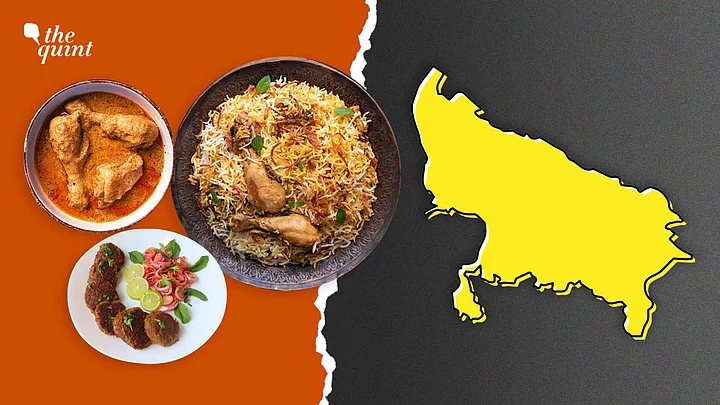
In October last year, at the 43rd UNESCO General Conference in Uzbekistan, Lucknow was named a 'Creative City of Gastronomy'—the second Indian city after Hyderabad to enter the network. UNESCO’s own citation singled out galawati kebab and awadhi biryani among the dishes that earned the city its place.
Now, six months later, when the Uttar Pradesh government has published its One District, One Cuisine (ODOC) list of 208 dishes meant to be marketed to those very tourists UNESCO was sending Lucknow’s way, neither the galawati nor the biryani has made the cut.
Of the 208, not one is non-vegetarian. The two dishes UNESCO had named in Uzbekistan had become unprintable in Hazratganj.
Much has been said this week about the cultural cost of that editing—the kebabs, the qormas, the centuries of Ganga-Jamuni tehzeeb that quietly fell off the page. I want to take a step back and look at something else: the bill the state is about to receive for it.
Because what looks, on the surface, like a question of taste is in fact a question of GDP, of behavioural framing, of what tourists spend, and where they spend it.
ODOC is not a cultural error with economic side-effects. It is an economic error wearing cultural clothes.
The Omission Was Always the Design
Some context first. ODOC was launched on 24 January this year by Union Home Minister Amit Shah at Lucknow’s Rashtra Prerna Sthal, on UP Statehood Day, with Chief Minister Yogi Adityanath present.
It was modelled on the state’s One District One Product (ODOP) programme—and pitched as a vehicle to give “national and global recognition” to local flavours as well as create employment for artisans, youth, and women. On 6 May, the Cabinet notified the final list of 208 dishes.
To understand what was always going to be in it, however, you have to go back further. When the Chief Minister announced ODOC in November 2025, within days of Lucknow’s UNESCO win, the dishes he chose to name in his own announcement were Lucknow’s chaat, Banaras’s malaiyo, Meerut’s gajak, Agra’s petha, Mathura’s peda, Moradabad’s dal, and Khurja’s khurchan.
All vegetarian. Every one. The omission that is now being explained as inadvertent was, from the outset, the design.
What Tourists Spend and Where
The World Food Travel Association estimates that tourists spend roughly a quarter of their total travel budget on food and beverages. In higher-end destinations, that goes up to more than a third. That is a larger share than is spent on accommodation in many cases, and almost all of it is captured locally.
A tourist who stays in a chain hotel sends most of their room-rate revenue out of the city. A tourist who eats at Tunday, Raheem, Lalla, or Mubeen’s leaves their money inside a three-kilometre radius of Chowk.
UP’s tourism department itself projects Rs 70,000 crore in tourism contribution by 2028. Conservatively, a fifth of that—Rs 14,000 crore—will move through plates and counters. The ODOC list is a directive about which plates and counters those rupees can legitimately be steered towards by the state’s marketing machinery.
To excise the kebabs and biryanis of Lucknow from that machinery is not to leave the rupees neutral. It is to redirect them towards sweets and snacks that are excellent in their own right, but that do not draw the international culinary tourist UNESCO has just begun sending.
The Psychology of What Gets Remembered
This is where the behavioural science begins to sting. What the psychologists Amos Tversky and Daniel Kahneman called the “availability heuristic”—the way human beings estimate the importance, or even the existence, of a thing by how easily examples of it come to mind—is exactly what is at work here.
Tourists, by and large, do not arrive in a city with a comprehensive map of its kitchens. They arrive with a list: an explicit one in a guidebook, an implicit one assembled from Instagram and government-tourism websites. What is on the list shapes what is in their mouth, which shapes what they tell their friends, which shapes the next list.
The state's official menu of UP—which is what ODOC will become—is the most consequential menu architecture imaginable. What is omitted from it will, quite simply, be eaten less.
What Happens to a City’s Self-Image
There is also the harder behavioural question of what the omission does to the city’s own self-image. Claude Fischler, the French sociologist who has spent 40 years studying what he calls the “incorporation principle,” argues that we become, in some imaginative sense, what we eat—and that what a place is told it eats becomes what its own people believe about themselves.
A young cook from UP in the post-ODOC era will be entering an industry in which the state, the apex tourism authority, has officially declared that her city’s cuisine is sweet, vegetarian, and largely confectionary (with edible oil in Kanpur Dehat and bakery in Noida).
The galawati, kakori, or achari she might have chosen to specialise in is no longer flagged as the city’s own. Over a generation, the consequence of this is not just lost dishes; it is lost vocation.
The kitchen does not narrow because cooks stop being talented. It narrows because the rewards stop pointing in the directions where the talent used to go.
A Cuisine Is an Archive
Arjun Appadurai, in a 1988 paper that has since become canonical in food anthropology—How to Make a National Cuisine: Cookbooks in Contemporary India, observed that what we today call “Indian cuisine” was assembled, not discovered. The cookbook authors of post-Independence India made deliberate choices about which dishes from which regions would enter the national repertoire. The cuisine, Appadurai argued, was a construction.
ODOC is the same process, in real time, at the leve of a state. Appadurai’s worry, four decades ago, was that constructed cuisines tend to flatten regional difference in the name of national legibility. ODOC has done something stranger: it has flattened internal difference, within a single state, in the name of a legibility, that even the state’s own citizens do not recognise as their own.
Italian historian Massimo Montanari, whose Food is Culture has shaped a generation of European food studies, makes a point that should haunt anyone drawing up a list like this. Cuisines, he writes, are not natural objects but historical archives—records of every contact, every conquest, every migration a place has experienced. To prune the archive is to forget the contacts.
The galawati is a record of a Nawab’s love for kebabs and the ingenuity of a court cook who responded with a hundred-spice paste. Banarasi malaiyo—the foam-light winter dessert that exists in Kashi for two hours each morning between November and February, set overnight in the dew, sold before the sun touches it—is a record of a city that organised its sweet-makers around a meteorological window. To strike these from the official list is to strike from the record of UP itself the very fact that such contacts and conditions ever existed.
In Brillat-Savarin’s much-quoted line from 1825—“Tell me what you eat, and I will tell you what you are”—the state has just told us what UP eats. The trouble is that UP itself, sitting down to dinner tonight, will recognise almost none of what is on the official plate.
There Is Still Time to Fix This
Cabinet Minister Rakesh Sachan, answering for the omissions this week, said they were “not intentional”—and that dishes could be added if recommended. That door is worth walking through. But a cuisine cannot be assembled in petition, dish by dish, district by district, until somebody at a desk decides which Lucknow, Agra, or Banaras is real.
The original framing of ODOC—that every district keeps its culture, pride, and history alive through its unique taste—was the right one. The list as published does not yet match it. The dishes that carry the culture, pride, and history of those districts are mostly the ones missing.
There is still time to fix this. The fix will not arrive by adding a line item or two to the spreadsheet. It will arrive when whoever drew up the list realises that a cuisine is not a marketing asset to be curated, but an economy to be respected, an archive to be preserved, and a behavioural environment in which young cooks decide what to spend a life learning.
Lucknow has just been told, by UNESCO, that the world wants to eat what it cooks. Lucknow’s own government has just told the world that what it cooks is something else entirely. Of the two, only one will pay the bill.
(Sadaf Hussain is an author, chef, food writer, podcaster, and two-time TedX speaker, who was among the top 8 on MasterChef India in 2016. This is an opinion piece, and the views expressed above are the author’s own. The Quint neither endorses nor is responsible for the same.)