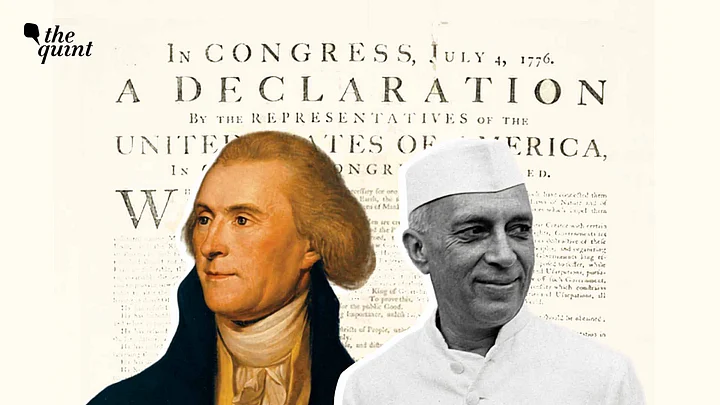
The Declaration of Independence has long stood as one of the modern world’s most resonant political texts. Its 250th anniversary invites reflection on its impact beyond the United States that emerged from the 13 American colonies that issued it—particularly among anti-colonial movements. Few such movements absorbed the Declaration’s spirit as thoroughly and creatively as India’s.
For Indian nationalists, the Declaration was not merely an American artefact; it was a universal charter of political modernity, articulating principles—popular sovereignty, natural rights, the legitimacy of resistance to tyranny—that spoke directly to their own struggle against British rule. Its influence was neither linear nor uniform, but it contributed to the intellectual atmosphere in which Indian nationalism matured, shaping its vocabulary, its aspirations, and its critique of empire.
India’s Search for Rights
The British Empire had long justified its rule by claiming to bring constitutional rights to its subjects. In practice, however, it denied those rights to Indians. This contradiction was starkly apparent to the early Indian nationalists, who were often educated in English and steeped in liberal political thought. They saw in the American Revolution a precedent for their own demand for the “rights of Englishmen,” and the Declaration of Independence—which asserted that “all men are created equal”—provided a moral lens through which the hypocrisy of imperial rule could be brought into focus.
In his 1901 publication Poverty and Un-british Rule in India, Dadabhai Naoroji emphasised that British governance in India violated the principles Britain purported to represent. In his Home Rule speeches, Bal Gangadhar Tilak argued that India’s social and economic grievances persisted because political power remained entirely in British hands, noting that without authority over trade, society, and governance, Indians could not secure prosperity or reform. Similarly, Lala Lajpat Rai observed that although British political thought professed liberal doctrines—that the state existed for the people, and that liberty and equality were fundamental—these principles were not applied in India, where imperial interests consistently overrode the rights and dignity of the governed.
In fact, American colonists had enjoyed even greater political rights than Indians—yet they found British rule to be intolerable. And as the Declaration noted, governments derive their “just powers from the consent of the governed.”
The American Revolution, and the Declaration that animated it, thus served as a critique of colonialism, a promise of a more just political order, and a warning: empires that ignore their subjects’ aspirations cannot last.
In his speeches in the Imperial Legislative Council at the beginning of the 20th century, Gopal Krishna Gokhale framed Indian political aspirations in terms of constitutional rights and representative government, echoing the Declaration’s assertion that people may alter or abolish governments that fail to secure their rights. By this point, Indian nationalists were increasingly embracing the idea that sovereignty resided in the people, not in imperial authority. Constitutional reforms within the Empire would not be enough.
Nehru and the Global Legacy of 1776
Before independence, the freedom fighter Jawaharlal Nehru, who would become India’s first prime minister, emerged as a particularly articulate interpreter of the American Revolution. In The Discovery of India, which he wrote while in prison in 1942–45, Nehru described the Declaration as a “landmark in the long human struggle for freedom.” That struggle also included the French Revolution, Ireland’s fight for independence, and the anti‑colonial movements of Asia and Africa.
Nehru admired the audacity with which the American colonies challenged the world’s most powerful empire. What impressed him, however, was not only the Americans’ assertion of independence, but also their articulation of a political philosophy grounded in a universalist conception of freedom and human equality—one that “inspired countless people in Europe and elsewhere.”
In the Declaration of Independence, Nehru saw a template for transforming particularist grievances into universal claims, and his rhetoric often channeled the Declaration’s spirit. The Karachi Resolution, which the Indian National Congress adopted in 1931, reflected his belief that political independence must be accompanied by social and economic justice. And his historic “tryst with destiny” address, delivered on the eve of independence in 1947, carried the Declaration’s sense of moral purpose and historical rupture.
The Declaration’s message—that legitimate government rests on popular consent and exists to secure the rights of all—shaped the vocabulary of resistance far beyond India. Ho Chi Minh quoted directly from it when he proclaimed Vietnamese independence in 1945. African nationalists, from Kwame Nkrumah to Jomo Kenyatta, drew on its principles to argue that colonial rule violated universal human rights. In the Caribbean, it served as a reference point for debates on autonomy and federation.
These movements did not imitate the American model mechanically. Instead, they drew inspiration from its ideals, which they adapted to their own contexts and complaints, and blended with Indigenous traditions.
250 Years of Contradictions
The socialist-minded Nehru, an early admirer of the Russian Revolution, was certainly not an uncritical devotee of the US, which in many ways failed to live up to the Declaration’s principles. In particular, while the Declaration proclaimed universal equality, the US tolerated slavery, the dispossession of Indigenous peoples, and the exclusion of women and Black people from political life.
Nehru was not alone in recognising this contradiction. While BR Ambedkar drew on American constitutionalism while drafting independent India’s constitution, he warned that political democracy would be hollow without social democracy—an implicit critique of America’s failures.
But India, too, struggled to realise the Declaration’s ideals fully. While the nationalist movement often spoke of universal rights, social iniquities stemming from India’s caste system, gender inequality, and communal tensions complicated their implementation. And despite independent India’s commitment to democracy, the country endured episodes of authoritarianism—most notably, the 21-month “Emergency” of 1975–77.
Globally, while the Declaration has been invoked to justify liberation, it has also been used to rationalise interventions that contradict its principles. And though its universalism has been celebrated, it has also been challenged, with some thinkers arguing that its Western Enlightenment framework does not fully capture the history, culture, or aspirations of non‑Western societies.
A Contested Legacy
The 250th anniversary of the Declaration of Independence invites renewed reflection on the unfinished work of freedom. The document remains a touchstone for movements seeking dignity, equality, and self‑rule, and it continues to challenge countries, including the US and India, to measure themselves against the ideals they profess.
But in a century marked by rising inequality, resurgent authoritarianism, and the emergence of new forms of domination, measuring up will become only more difficult.
The democratic trajectories of both the US and India have been marked by aspiration and contradiction, by soaring ideals and sobering lapses. Despite the Declaration’s endorsement of equality, the US has failed adequately to face the entrenched legacies of slavery, racial discrimination, and imperial overreach. And though India has built a constitutional democracy of remarkable scale, it has not been immune to authoritarian drift or the curtailment of civil liberties, and deep social inequalities persist.
But both democracies have refused to abandon the promise of their founding commitments. Each has repeatedly returned to the principles first articulated in 1776—popular sovereignty, individual rights, and the moral superiority of self‑government—as a compass for self‑correction.
The enduring power of the Declaration of Independence thus lies not in its perfection, but in its capacity to inspire successive generations worldwide to expand the boundaries of freedom and to renew and hone their own democratic experiments. Far from a relic of the past, the Declaration represents a living challenge to all societies that claim freedom as their foundation. India is no exception.
(Shashi Tharoor, a former UN under-secretary-general and former Indian Minister of State for External Affairs and Minister of State for Human Resource Development, is a member of the Indian National Congress. This is an opinion piece, and the views expressed above are the author’s own. The Quint neither endorses nor is responsible for the same.)
Copyright: Project Syndicate, 2026.