
ADVERTISEMENTREMOVE AD

Hierarchies of Invisibility: UGC Debate Highlights the OBC Identity Conundrum

As UGC stays caste rules, large sections of OBC remain in a historical blindspot floating in the eye of the storm.

Published
story-hero-img
i
Aa
Aa
Small
Aa
Medium
Aa
Large

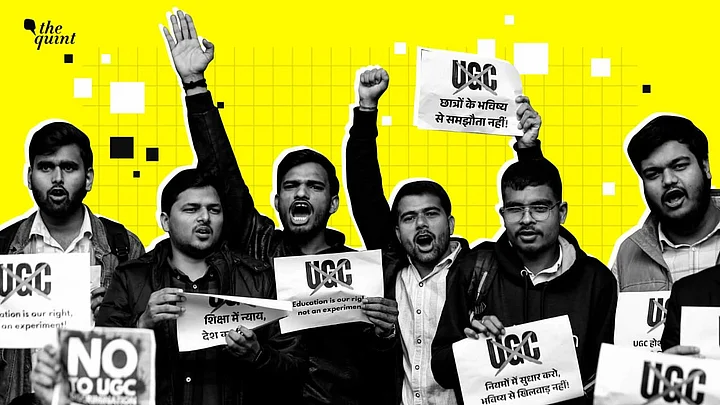
Upon the notification of the (now stayed) University Grants Commission (UGC) guidelines concerning caste discrimination on college campuses in India, there was much distress within large sections of savarna society.

The collective tantrum of indignant rage made mainstream visible by savarna interlocutors in the media (and eventually the courts themselves) was a classic affirmation of savarna fragility.

Much of this hinged on the inclusion of Other Backward Classes (OBC) within the category of communities which can file grievances of caste discrimination on campus, in addition to the historically recognised categories of Scheduled Castes (SC) and Scheduled Tribes (ST). This move left the ‘general’ savarna castes as the only group without access to this redressal.

ADVERTISEMENTREMOVE AD

Degrees of Marginalisation

While this is sociologically sound, it nonetheless created a hysteria among savarnas that they were about to be ‘singled out’ for casteism, ostensibly by a slew of ‘fake cases’. Despite there being no historical pattern which suggests mass misuse of fake casteism complaints to target savarnas (in fact much evidence points in the opposite direction where legitimate accusations and rights are often bypassed by the overwhelmingly savarna administrations), the narrative of savarna-victimisation took root and was fanned extensively via social media and pliable news anchors.

However, it was not just the savarnas. A section of SC thinkers and activists were also left in disquiet by the OBC inclusion into this protected category, even as many OBC themselves remained indifferent (or in some cases even against) the same. This needs to be understood and unpacked in a historical context.

The Other Backward Classes list is a vast aggregation of communities whose ‘backwardness’ varies greatly by geography, community size, remoteness and access to land ownership. It lumps in nomadic and semi nomadic tribes, denotified tribes, artisan castes, ‘untouchable’ caste Christians and Muslims, Shudra communities who became landed and ‘dominant’ in the past century or so, and even some savarna communities in specific geographical pockets have been listed as ‘backward’.

Taken together, the 'OBC' term stands for all and for none since the variation in relative privilege and precarity between thousands of castes/tribes of different kinds, means there is no singular OBC experience.

While this could also be said to be true for SC, ST, and even Savarna groups—the variation within OBC truly defies singular flattening even for discursive purposes.

As a result there has been an attempt to differentiate between ‘upper OBC’ and ‘lower OBC’ and many variations thereof. But fundamentally, the ‘OBC identity’ has come to be associated with a small group of landed-castes owing to their regional political clout and mobilising power.

The Rohini Commission in 2017 stated that such castes, roughly about 1 percent of OBC communities, have taken over 50 percent of reservation benefits meant for all OBC communities. It is this cohort that is often visible on campus as ‘OBC’.

This is where the SC disquiet comes from. These ‘visible’ OBC communities’ historical experience of caste has not been grounded in untouchability and brute violence. In postcolonial India, many of these OBC communities, having benefited from the meagre land reforms, ended up with pockets of feudal power which frequently have been wrought upon SCs, STs and non-landed OBCs.

For the latter groups, especially SCs, to see folks from such ‘visible’ OBC castes who have a historical record of inflicting caste atrocities, now get included in UGC regulations alongside their own, can be disconcerting.

The OBC Gap

This is not to say that OBCs, from even such landed and ‘visible’ communities, are immune to casteism on campus. The university is the site of extreme caste exclusion and terrifying epistemic violence which spares none (including savarna students on occasion).

The decades of Ambedkarite mobilisation, Buddhist assertion and Dalit consciousness, have in recent years have manifested in small but vocal identitarian claims on the discourse and space. SC scholars remain incredibly precarious and persecuted, but such assertions are a semiotic commune to hold onto in rough waters.

Kanshiram’s ‘bahujan’ umbrella welcomes OBC to this commune—but many ‘visible’ OBC stay off it, even if ideologically aligned. This creates a vocabulary gap, an intellectual isolation—a double disaster in the grim and scathing university landscape.

This OBC gap is further complicated by the fact that many such ‘visible’ landed OBC groups are linked to regional political parties which are of decent political clout. Yet, their record on caste-justice has been historically spotty at best with respect to SCs. Furthermore, very few have thus far taken a closer look at the cultural capital aspect of casteism which aggregates the most in spaces like academia, arts and elite civil society. This ideological indifference (and sometimes provocation) creates triggering fractures for many SC.

Even in the context of the UGC guidelines, most OBC political leaders welcomed the stay which effectively stops for the time-being the OBC inclusion into the caste protected category. Many OBC academics/intellectuals, including some who have made a career writing about caste, have been conspicuously silent as the storm of savarna backlash and abuse rages on.

Such positions further exacerbate the SC mobilisation which has thus far been bearing the brunt of the savarna rage and has been fighting it head on.

Meanwhile the large sections of OBC, beyond the ‘visible’, remain largely unheard and unseen. As per the Rohini Commission, about 1977 OBC communities availed less than 2.6 percent of OBC reservation benefits. Much of these communities are often dispersed, micro-populations or remnants of historical artisan labours which are now rendered obsolete in the age of mechanised industry.

They drift through cities and slums, ghost populations unaccounted for, among some of the most precarious in India. To bring them to campus, to higher education and ignite possibilities should be a national priority—yet they languish invisible and out of discourse.

This is the OBC that needs to be brought on campus, protected on campus and educated on campus, that the UGC and the Supreme Court have missed and OBC ‘visible’ stakeholders have overlooked. They remain a historical blindspot floating in the eye of the storm.

(Ravikant Kisana is a professor of Cultural Studies and author of the book 'Meet the Savarnas'. He can be contacted on X/Instagram as 'Buffalo Intellectual'.The views expressed in this article are the author's own and do not reflect or represent his institution.This is an opinion piece, and the views expressed above are the author’s own. The Quint neither endorses nor is responsible for the same.)

Speaking truth to power requires allies like you.
Become a Member
Monthly
6-Monthly
Annual
Check Member Benefits
×
×