
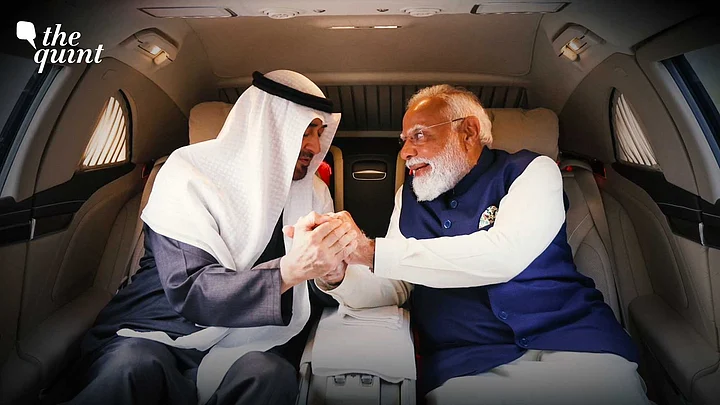
Earlier this week, India played host to what has perhaps been one of the shortest visits by a Head of State to the country. UAE President Sheikh Mohamed bin Zayed Al Nahyan paid a three-hour-long visit to Delhi to meet Prime Minister Narendra Modi, which Foreign Secretary Vikram Misri described as being "extremely substantive".
Mohamed bin Zayed was accompanied by a high-profile entourage.
Five agreements were signed and seven announcements made during the visit, covering defence, space, energy, food security, and investment. The most eye-catching agreement was the one on defence cooperation, where the stated objective is to work together.
In official terms: "To establish Strategic Defence Partnership Framework Agreement and expand defence cooperation across a number of areas, including defence industrial collaboration, defence innovation and advanced technology, training, education and doctrine, special operations and interoperability, cyberspace, counter-terrorism."
A Three-Hour Visit, a Strategic Signal
The short visit together with this agreement has immediately fuelled speculation that the India and the UAE are seeking a defence cooperation to offset the Saudi-Pakistan defence pact announced in September last year, and which Turkey is now seeking to join, establishing an Islamic North Atlantic Treaty Organisation (NATO).
While this premise is doubtful, it is certain that in West Asia's rapidly evolving strategic and security landscape, some major realignments are taking place. The Saudi-Pakistan pact certainly caused disquiet in Delhi, coming as it did soon after Operation Sindoor. The government had expended considerable effort in cultivating relations with the Saudis.
While it is doubtful that the Saudis will ever come to Pakistan’s aid in case of any conflict with India, the entry of Turkey, and through it Qatar, changes the equation. While Turkey is overtly anti-India, Qatar follows a more discreet Islamist policy.
On the other hand, ties with the UAE have been growing dynamically since at least 2015, when Modi made his maiden visit to the Emirates as PM. Underpinned by the strong people-to-people ties—Indians form the largest expatriate community in the UAE—a series of other factors enabled this.
Why the Gulf Turned Away From Pakistan
One was India’s rise as an economic, military, and technological power. Another was the Gulf countries’ growing disillusionment with their former client state, Pakistan—its descent into political instability and terrorism, and its refusal to participate in the Yemen war in 2015.
The rise of political Islam in the region—both the Shia variant through Iran and its proxies, and the Sunni variant through the Muslim Brotherhood following the Arab Spring—combined with the unwillingness of the US, the region’s primary security guarantor, to intervene decisively, forced Gulf monarchies to reassess their strategies.
The rise of ISIS, which actually dismantled borders between Iraq and Syria, if even for a short while, added another layer of urgency.
The monarchies felt the most threatened, as they would be the first casualties of political Islam. Preservation of the regimes through the preservation of the nation state became the biggest priorities of the Gulf states, including the UAE.
Ebtesam al Ketbi, Director of Emirates Policy Centre—the UAE’s top policy think tank—had told this writer soon after ISIS was dismantled in Iraq that the main drivers of the UAE’s foreign policy became the preservation of the nation state.
“Preserving the nation state from non-state actors, fighting terrorism, spreading tolerance, and modernity in the region—these are the UAE’s main goals.”Ebtesam al Ketbi
To that end, the UAE has participated in the blockade of Qatar, alleged to be supporting the Muslim Brotherhood and its many avatars; supported President Fatah al Sisi of Egypt in overthrowing the Muslim Brotherhood government of Mohammed Morsi; joined the war in Yemen against the Houthi rebels, armed and supported by Iran; backed Khalifa Haftar against Islamist forces in Libya; and formally designated the Muslim Brotherhood a terrorist organisation.
India as a Natural Strategic Partner
Another strategy the UAE has followed has been to diversify its strategic partnerships, even as the US remains its principal ally.
This is why India, geographically closer to the UAE, with a strong navy, and relations with the Gulf region spanning centuries, became a natural choice.
“India is a rising power, and I would say the UAE is looking to India [as] balance for the security in the region with its maritime forces."Ebtesam al Ketbi
India was also a promising investment destination country for the UAE, holding the world's second largest sovereign wealth fund.
Although a defence cooperation between India and the UAE was signed in 2003, Modi’s 2015 visit marked a turning point. The two countries agreed that their National Security Advisers would meet every six months and institutionalised regular counter-terrorism dialogues—the first such arrangement India entered into with any country. In 2016, bilateral ties were elevated to a strategic partnership.
Abu Dhabi’s ADNOC became the first foreign company to build strategic oil reserves in India. Joint military exercises became routine, and the two even cooperated during the Yemen conflict, with the UAE-backed soldiers receiving medical treatment in India.
In line with its policy of diversification of partnerships, the UAE even became the first GCC country to adopt the Abraham Accords, normalising relations with Israel. This opened up avenues for further trilateral collaboration between India, Israel, and the UAE, and establishing a framework for the "Middle Eastern Quad" in the I2U2 (India Israel US UAE) format (for now on the backburner).
A Partnership That Doesn’t Need a Formal Alliance
President Mohamed bin Zayed’s visit, therefore, fits within a long-term strategic arc. What has changed, however, is the regional context.
Till most recently, the regional and security policies of the UAE and Saudi Arabia had largely converged. However, there is now a growing rift between the two—in Yemen, where the UAE has been forced to withdraw; in Sudan, where the UAE backs the RSF militia while the Saudis back the government; and in Somalis, where the UAE is believed to have, at least covertly, recognised the breakaway region of Somaliland.
On the other hand, Islamism remains anathema for the UAE, most recently evidenced in its declaration of withdrawing sponsorships of Emirati students in the UK because of rampant Islamism there.
Of the countries shaping the idea of an “Islamic NATO”, at least two—Turkey and Qatar—are overt supporters of political Islam. It is, therefore, inevitable that the UAE would seek informal alignments with countries such as Morocco and Bahrain, whose policies increasingly converge with its own.
In this regard, the UAE and India, already connected in myriad ways—the UAE accounts for at least half of India’s total trade with the GCC, with bilateral trade crossing $100 billion—would definitely seek to promote and deepen their partnership both militarily and strategically.
The condemnation of "terrorism and violent extremism in all forms and manifestations” in the joint statement and pledge to deepen counter-terrorism cooperation has to be seen in this context. The recent agreement on energy security where the UAE will supply 0.5 million metric tonnes of LNG annually over 10 years starting 2028, for instance, will ensure that India 's LNG dependence on Qatar eases.
That said, India has historically avoided formal military alliances, with the notable exception of its 1971 treaty with the Soviet Union. Moreover, Saudi Arabia remains, as does Qatar, valuable partners for India.
Therefore, any defence agreement, even with a close friend such as the UAE, with whom India has almost no points of divergence, will undoubtedly factor in all this, though much may continue to unfold discreetly.
(The author is an award-winning journalist specialising on Eurasian affairs. This is an opinion piece and the views expressed above are the author’s own. The Quint neither endorses nor is responsible for the same.)
