
ADVERTISEMENTREMOVE AD

The Moscow-Taliban Military Deal: What's in it for India?

India's approach to Afghanistan cannot but align with that of Russia and China, writes Aditi Bhaduri.

Published
story-hero-img
i
Aa
Aa
Small
Aa
Medium
Aa
Large

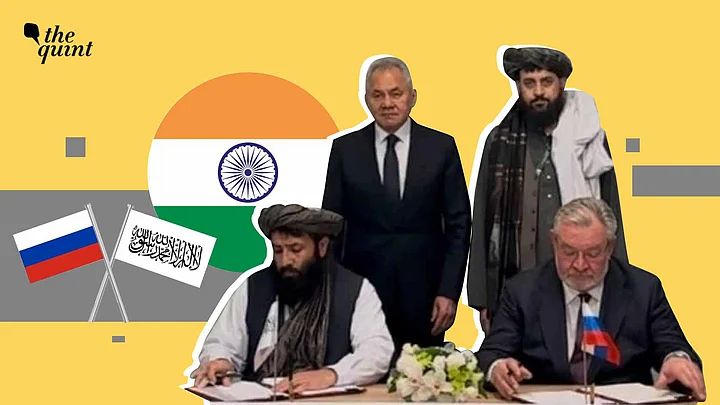
The Taliban had once fought Russia. But, given there are no permanent enemies in geopolitics, the two sides recently signed a military-technical agreement on the sidelines of the International Security Forum in Moscow.

Confirming the deal on 27 May alongside Russian Security Council Secretary Sergei Shoigu, Taliban Defence Minister Mullah Yaqoob Mujahid stressed that cooperation with Russia was of great importance to the Taliban. Meanwhile, Zamir Kabulov, the Russian special envoy for Afghanistan, underscored that the deal focuses mainly on repairing Russian-made equipment, and could pave the way for future defence contracts between the two sides.

This makes a lot of sense because a large amount of Russian and former Soviet military equipment has remained in Afghanistan for decades. At the same time, hundreds of Afghans have studied in Russian and Soviet technical institutes.

Even the US and the NATO had relied on Russian helicopters, particularly the Mi-17, to build Afghanistan’s air force after the fall of the first Taliban government in 2001. After all, Afghan pilots and technicians were familiar with the aircraft—and they were also considered suitable for Afghanistan’s difficult terrain. 
ADVERTISEMENTREMOVE AD

Afganistan's Soviet Moorings

While not much is known about the agreement, what is striking is that the deal comes against the worsening Afghan-Pakistan relations. Pakistan has been bombing Afghanistan for almost a year now, under the pretext of striking alleged Tehreek-e-Taliban Pakistan (TTP) havens.

These strikes, though most intense in the provinces bordering Pakistan, have not spared Kabul either.

Earlier this year, a deadly airstrike conducted by the Pakistan Air Force struck the Omid Drug Rehabilitation Center, a sprawling 2,000-bed facility in eastern Kabul, causing mass casualties. India had strongly condemned these strikes. With Afghan air force and air defence system almost non-existent, Pakistan has had an upper hand, emboldening it to carry out attacks on Afghanistan.

Given this background, the Moscow deal is a major achievement for the Taliban government.

After returning from Moscow, Yaqoob claimed that once the agreement is implemented, Pakistan would no longer dare to carry out attacks inside Afghanistan. Pakistani officials, however, have rejected that assertion, reiterating that the defence deal would not deter Pakistan to strike TTP camps. 

The threat of the TTP, which has been waging an insurgency against the Pakistan government, however, is a fig leaf for Pakistan’s objectives in Kabul—which is regime change. In order to evaluate the full import of the Moscow-Kabul defence deal, it is important to acknowledge the intersection of two dynamics. The first is loss of strategic depth for Pakistan in Kabul; and the other is American control of the strategic Bagram airbase in Afghanistan.

Currently, the US is distracted by Iran, but once that is resolved, it will again focus attention on Bagram, essential for keeping an eye on China—recognised as the US' greatest challenge—and Iran. Then, there is Afghanistan’s cache of resources—an estimated $1 trillion in untapped mineral reserves, including lithium, cobalt, and rare earth elements, critical for AI, critical technologies, semiconductors, etc.

India-Pakistan Friction & the Afghan Connect

For Pakistan, the loss of influence in Kabul has further been compounded by the Taliban’s growing proximity to India. India has consistently been dispatching humanitarian aid to Afghanistan, even after Pakistan stopped all transit trade between India and Afghanistan. 

India's aid diplomacy is anchored both in pragmatism as well as in its centuries-old friendship with the Afghan people. Such aid assumes greater significance when Pakistan has also suspended all border trade with Afghanistan.

This has resulted not only in enormous losses for Afghan businesses, but also aggravated the humanitarian crisis in the country, as supplies of crucial commodities like medicines ceased. Added to this has been Pakistan’s forced repatriation of Afghan refugees on its territory into Afghanistan.

Some 2-3 lakh Afghan refugees have been pushed into Afghanistan, adding to the crisis. The World Food Programme has warned that Afghanistan is already facing near-record levels of malnutrition, with nearly five million mothers and children affected. Pressures are mounting with the closure of the border with Pakistan, repeated floods and earthquakes, and returning communities.

The Taliban allege this is deliberate as, given Pakistan's inability to dictate to it, it is looking for regime change.

Zabihullah Mujahid, the Taliban spokesperson, had in an earlier interview told Al Arabiya that Pakistan's objectives were "...aimed at destabilising the region," and that this is an "external mission assigned to them by a major power" to create insecurity and ignite conflict.  

He was probably alluding to US President Donald Trump's demands for the Taliban to return the strategic Bagram airbase to the US.

Why Both India, Russia Need Taliban for Geopolitics

In this context, Russia’s engagement with the Taliban remains crucial. It has the wherewithal to arm and prop up the Taliban militarily. But Russia’s military aid must be seen as part of its broader efforts to stabilise Afghanistan. For one, Afghanistan borders countries that are part of Moscow's sphere of influence, its southern underbelly. 

One of them—Tajikistan—hosts Russia’s largest military base. Russia will not brook any destabilising spillover into these countries, which are part of the Moscow-led Collective Security Treaty Organisation (CSTO).

At the same time, Russia does not want any return of US troops in the region. Here, its objective converges with those of China and Iran. 

To that effect, Russia took the lead in normalising relations with the Taliban, viewing it as the only force capable of countering extremist and terror outfits like ISIS-KP in the region. Therefore, it seeks to prop up the current Taliban regime, by dispatching humanitarian aid, supplies of grains, other food products, and more importantly, energy supplies. It is also engaged in constructing the trans-Afghan government.

The Taliban are currently in discussions with the Russians for potential induction of Afghan labour into Russia in order to mitigate unemployment and poverty in Afghanistan.

For India, Russia’s engagement with the Taliban can only be beneficial. Russia, officially, was the first country to recognise the Taliban regime as the legitimate representative of Afghanistan, paving the way for India to do so. Continuing with its humanitarian outreach to Afghanistan, India is wary of further turmoil there. Russian engagement could enable the Taliban to militarily counter Pakistan more effectively.

A striking fact is that during the earlier Taliban rule, Islamabad alone in the region had good relations with the group. It is now Islamabad alone that is at conflict with it.

Even as the deal was being negotiated, National Security Advisor Ajit Doval was in Moscow to attend a security conference, where he outlined India's concerns, warning against double standards in the fight against terrorism.

Russia understands India's concerns. It was the country that took the strongest position against the Pahalgam terror attacks a year ago. Russia, too, continues to be a victim of extremist terrorism. Given that Field Marshal Asim Munir is now Washington's blue-eyed boy in the region, India's approach to Afghanistan cannot but align with that of Russia and China. That is why Russia’s deepening engagement with the Taliban can only be welcomed by Delhi.

(The author is an award-winning journalist specialising on Eurasian affairs. This is an opinion piece and the views expressed above are the author’s own. The Quint neither endorses nor is responsible for the same.)

Speaking truth to power requires allies like you.
Become a Member
Monthly
6-Monthly
Annual
Check Member Benefits
×
×