
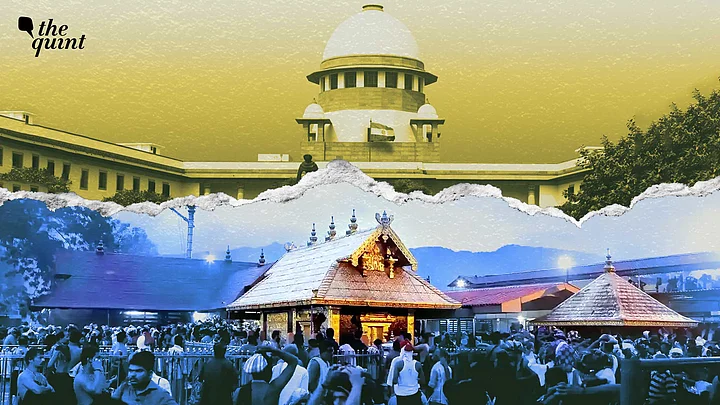
The legal fraternity and religious communities alike are watching closely at the Supreme Court proceedings right now.
Nearly seven years after the apex court’s landmark 2018 verdict permitting women of all ages into the Sabarimala temple, a nine-judge Constitution Bench led by Chief Justice of India Surya Kant is once again hearing the reference matter.
The Bench, comprising Justices BV Nagarathna, MM Sundresh, Ahsanuddin Amanullah, Aravind Kumar, Augustine George Masih, Prasanna B Varale, R Mahadevan, and Joymalya Bagchi, are not merely revisit the Kerala temple’s entry dispute. The reference has blossomed into a seminal constitutional exercise, questioning the interplay between religious freedom, equality, and the limits of judicial review—issues that will resonate across faiths, from mosques to fire temples.
The Supreme Court will examine broader constitutional questions: the scope of “morality” under Articles 25 and 26, whether Constitutional morality trumps religious practice, and even the validity of excommunication among Dawoodi Bohras.
With interventions from the All-India Muslim Personal Law Board and Jain organisations, the verdict will redraw the boundaries between religious denomination rights and fundamental freedoms in India.
From a 4:1 Verdict to a 9-Judge Reference
The saga began in September 2018, when a five-judge bench, by a 4:1 majority (then CJI Dipak Misra, Justices RF Nariman, AM Khanwilkar, and DY Chandrachud; Justice Indu Malhotra dissenting), struck down Rule 3(b) of the Kerala Hindu Places of Public Worship Rules, 1965, which banned women aged 10-50 from Sabarimala.
The majority held that devotion cannot be subjected to gender discrimination and that Lord Ayyappa devotees do not constitute a separate religious denomination. The court delivered four separate opinions written by: Chief Justice Misra, Justice Nariman, Justice Chandrachud and Justice Malhotra. Justices Nariman and Chandrachud concurred with the opinion of Chief Justice Misra. The dissenting opinion in the case was delivered by Justice Indu Malhotra.
However, review petitions followed, and on 14 November 2019, a five-judge bench headed by then CJI Ranjan Gogoi (3:2 majority) observed that issues in the Sabarimala review were common to other pending cases—women’s entry into mosques, female genital mutilation (FGM) among Dawoodi Bohras, and Parsi women married outside the community entering fire temples. Consequently, in January 2020, a nine-judge bench was constituted.
Custom, Legislation, and Constitutional Clash
In the Sabarimala judgment, the Supreme Court was examining the exclusion of a class of women (typically those between the ages of 10 and 50) from the Sabarimala Temple was historically justified on the basis of an ancient custom. This custom received statutory sanction through Rule 3(b) of the Kerala Hindu Places of Public Worship (Authorisation of Entry) Rules, 1965.
Rule 3(b) allowed the exclusion of "women at such time during which they are not by custom and usage allowed to enter a place of public worship." This rule was framed under the authority of the parent Kerala Hindu Places of Public Worship (Authorisation of Entry) Act, 1965.
Significantly, Section 3 of the 1965 Act mandated that places of public worship must be open to all sections and classes of Hindus, subject only to special rules applicable to religious denominations.
This legislative framework was then juxtaposed against competing constitutional provisions:
Article 25(1): Guarantee of freedom of conscience and free profession, practice, and propagation of religion.
Article 26: Right of every religious denomination to establish and maintain institutions and manage its own affairs in matters of religion.
Articles 14 & 15(1): Guarantees of equality before law and prohibition of discrimination on grounds of religion, race, caste, sex, or place of birth.
Thus, the core legal conflict emerged: a state-sanctioned custom excluding women (Rule 3(b)) was pitted against both the statutory mandate of universal access (Section 3 of the 1965 Act) and fundamental rights of equality (Articles 14, 15(1)) and religious freedom (Articles 25, 26).
The Seven Framed Questions
In February 2020, the nine-judge bench held the reference maintainable and framed seven broad issues. These include: the scope of Article 25 (freedom of religion) and Article 26 (rights of religious denominations); whether rights under Article 26 are subject to other Part III rights beyond public order, morality, and health; the meaning of “morality” (including if it means Constitutional morality); the extent of judicial review over religious practices; the meaning of “Sections of Hindus” under Article 25(2)(b); and whether a non-follower can challenge a religious practice via PIL.
Crucially, the bench is revisiting the essential religious practices test—the doctrine courts use to determine which rituals are integral to a religion and thus constitutionally protected. This test has been criticised as allowing judges to theologise; the nine-judge bench may either refine, restrict, or expand its application across faiths.
The Constitution of India enshrines freedom of religion as a fundamental right for all its citizens under Articles 25 and 26, subject only to public order, morality, and health. Yet, through judicial interpretation, the Supreme Court has substantially curtailed this textual guarantee by holding that what is protected is not all religious practices but only 'Essential Religious Practices'.
This is a judge-made test which requires courts to first determine whether a practice is religious, then whether it is 'essential' to the faith, and only then whether constitutional restrictions apply—has been widely criticised. Scholars have argued that judges lack both the competence and the authority to assume theological power, determining for diverse religious communities what lies at the core of their faith.
Through a doctrinal and statistical analysis of all relevant Supreme Court judgments post-2004 and High Court judgments post-2015, it demonstrates that the essentiality standard has undergone a fundamental shift, particularly after Acharya Jagadishwarananda (2004), rendering practically no practice capable of protection.
The Essential Religious Practices test rests on a handful of Supreme Court decisions that have progressively narrowed religious freedom.
Shirur Mutt (1954) is the foundational case, where the Court observed that what constitutes an essential part of a religion is primarily to be ascertained with reference to the doctrines of that religion itself—though ironically, this case actually rejected the Attorney General's contention that only Essential Religious Practices should be protected.
Further, Durgah Committee (1962) misinterpreted Shirur Mutt to hold that only essential practices are protected and that courts must distinguish between what is religious and what is superstitious. Mohd. Hanif Qureshi (1959) introduced the optionality test, holding that a practice is not essential if an alternative exists. Acharya Jagadishwarananda (2004) further entrenched the doctrine by introducing the recency test (practices must be followed from the inception of the religion) and the 'but for test' (a practice is essential only if its absence would fundamentally change the nature of the religion).
Shayara Bano (2017) applied both the optionality and 'but for' tests to strike down triple talaq, while Indian Young Lawyers Association v. State of Kerala (2018) added that even if a practice is held essential, it must still satisfy constitutional morality. Finally, Aishat Shifa v. State of Karnataka (2022), the Hijab ban case offered a potential departure, holding that the Essential Religious Practices test was never meant for individual claims absent State reformatory action.
The Road Ahead
The Sabarimala reference has now absorbed other major religious controversies. In February 2023, a Constitution Bench referred the validity of excommunication among the Dawoodi Bohra community (a practice where religious heads can ostracise members) to this nine-judge bench.
Additionally, issues regarding Muslim women’s entry into mosques, the constitutionality of FGM in the Dawoodi Bohra community, and Parsi women’s rights to enter fire temples after inter-faith marriage are all tethered to the answers this bench will deliver. Thus, the nine-judge bench’s eventual ruling will not only decide Sabarimala but will serve as a master framework governing religious freedom, gender justice, and denominational autonomy across all Indian religions.
The answers to the seven framed questions will determine whether Indian constitutional law moves towards a more uniform standard of “Constitutional morality” overriding religious customs, or carves out a wider, more deferential space for denominational practices.
Beyond Sabarimala, the fate of mosque entry for women, FGM, Parsi fire temple access, and Dawoodi Bohra excommunication hangs in the balance. Whatever the outcome, this judgment will rank alongside Kesavananda Bharati and the Ayodhya verdict as a defining moment in India’s secular jurisprudence.
For instance, certain Jain organisations and Muslim organisations have filed submissions before the Supreme Court in the Sabarimala Reference matter, arguing that the regulation of religious practices should be left to the adherents of that religion, and that a person belonging to one religion should not be permitted to challenge the practices of another. They contend that a religion’s internal authority and autonomy to define and govern its own practices are protected under Article 25, and that whether a particular practice is religious or not is a matter for the religion’s followers to decide—not the courts—unless an internal dispute between different factions within the religious denomination cannot be resolved internally.
The larger question has evolved into a constitutional laboratory where the competing claims of gender equality, religious autonomy, and judicial review will be stress-tested. Moreover, the bench’s ruling on the essential religious practices test will either empower courts to scrutinise faith-based discrimination or restrain them from entering theological thickets.
(Areeb Uddin Ahmed is an advocate practising at the Allahabad High Court. He writes on various legal developments. This is an opinion piece and the views expressed above are the author’s own. The Quint neither endorses nor is responsible for them.)
