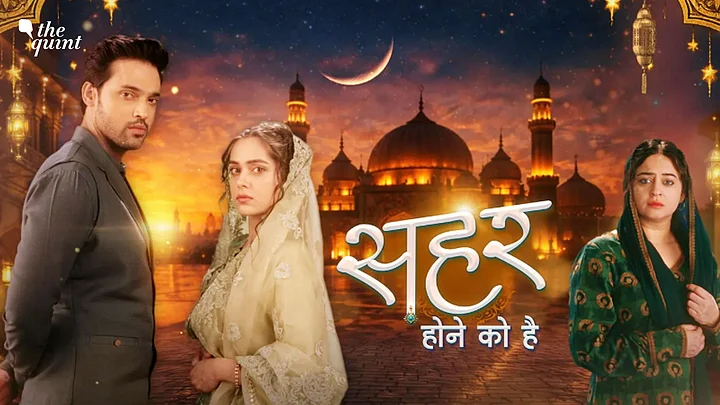
Colors TV has been airing a primetime show with a beautiful Urdu title, 'Seher Honai Ko Hai'. ‘Seher’ means the dawn, daybreak, or the first rays of hope after a dark night; it is also the name of the female protagonist. Despite my usual discernment, the trailer’s soft décor pulled me right in, and I binge-watched eleven episodes.
It is Lucknowi Zardosi meets Karan Johar on TV production budget. The lead actor has a sharp jawline like a North Indian Karthi; the female lead is fresh-faced. Their skin tones match their garments seamlessly, creating a soothing, seductive visual palette.
Tired Spatial Politics
The soft aesthetic, however, masks the reproduction of Muslim exceptionalism. The show’s economy centers on the mosque, the madrasa, and the Muslim community in Lucknow. It offers a clichéd version of Islamic urbanism: an abundance of minaret-shaped silhouettes and a generous dash of shrill green – that tired trope Bollywood employs whenever it portrays Muslims or Pakistan. The line between Indian Muslims and Pakistan has been actively blurred by the ideological machineries of the state, with television and Bollywood carrying the propaganda torch.
I grew up in Lucknow in the 1990s in the wake of Mandal-Kamandal. I do not harbour liberal delusions of multiculturalism, but the city’s spatial landscape was punctuated by the presence of burqa-clad Muslim women like figures in a relief print. Perhaps that is why I recoiled seeing Muslims being reproduced through a lens of exceptionalism, especially in Lucknow. As per the 2011 Census, 26.36% of Lucknow City is composed of Shia and Sunni Muslims. Political anthropologist Raphael Susewind’s research on Muslim urban belonging in North India has canvassed a range of sophisticated long-term spatial data to constitute an Index of Dissimilarity (D-index). The index measures the level of segregation and calculates the percentage of one group that would need to relocate to a different sub-area to achieve an even distribution relative to the other group. Lucknow’s D-index is at 0.23, which means that it is one of the least segregated cities in the study of 11 cities (Mumbai, Ahmedabad, Jaipur, Lucknow, Aligarh, Bhopal, Hyderabad, Delhi, Cuttack, Kozhikode and Bangalore). While that of Ahmedabad is at its highest at 0.71, given the prolonged history of communal riots and state neglect.
Miserable Muslim Women
The women in this show are miserable. By episode eleven, I was exhausted of the Tai Chi moves women undertook to dodge patriarchal control while being beaten black and blue.
Women are forbidden from working and restricted to madrasa education. As I watched, I thought of the Instagram reel showing the Taliban claiming wives as property. In the serial, a woman who dares to take a job in the bank has her face blackened by a mob following a Mufti’s (a high-level legal expert in Islamic jurisprudence) verdict, much like a Khap Panchayat.
Why would the show portray Indian Muslims as the Taliban?
Islam is portrayed purely as punitive, and the Muslim man as one who resorts to domestic violence at the drop of a hat.
Men have multiple wives who co-exist in stereotypical ‘good’ wife and conniving wife dynamics; women exist only in relation to the men in their life. There is only one ‘modern’ family – a household of doctors. The daughter-in-law is also a doctor who does not wear a burqa, travels on her own, but her uterus is governed by a fatwa prohibiting IVF. It begs the question: in the eyes of the dominant, can one even be a non-religious Muslim? What is Muslim modernity allowed to look like?
Then there is the sexual chemistry between Seher, who is 16 and the male lead. Epsteining has long been naturalised in our country, where child marriages were once legitimate and continue to be practiced. It comes as no surprise that the audience in the comments section on social media is gushing over what they consider a love story. The male lead is perpetually angry, traumatised by his mother’s suicide, which he views as haram (forbidden by Islamic law). He works himself into fits of rage, beating anyone who transgresses his idea of right conduct. Who needs the prefrontal lobe of a 16-year-old to be developed, when the man is seen softening his armor – a sign that he is falling in love? In this sitcom, women exist for scripts of control to be written on their bodies.
Conclusion
The show’s makers deploy a tired but winning formula: combine two-dimensional khol-eyed men with suffering but enterprising Muslim women, and season it with one-dimensional Islam. At a time when Bollywood is the frontline of fascist machinery, shows like this are not just entertainment. It is no coincidence that the movie Haq (based on the landmark Shah Bano case, which advocated for maintenance rights of divorced Muslim women) has been released in our times of saffron onslaught. It is a bitter irony that the threat against Muslim women has never been louder than it is from the state itself.
From the hijab ban to the implementation of the Uniform Civil Code (UCC) to the online auction of prominent Muslim women; from AI-generated deepfakes to the release of Bilkis Bano’s rapists; and from bulldozer raj to the anti-conversion laws, the list of state-sanctioned atrocities continues with total impunity.
Yet the idiot box in our bedrooms wants us to believe that the Muslim man is the only problem, and the Hindu state the only savior. When will there be a seher – a dawn for the Muslims of India?
(Dr Ujithra Ponniah is a Senior Researcher at the Southern Centre for Inequality Studies (SCIS), University of Witwatersrand, South Africa. This is an opinion piece, and the views expressed above are the author’s own. The Quint neither endorses nor is responsible for the same.)