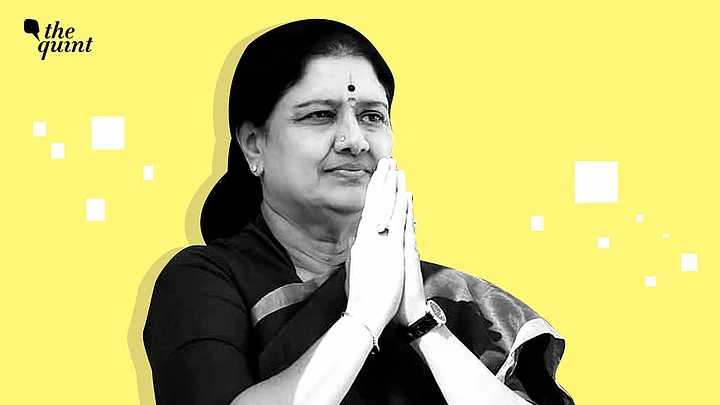
More than five years after her release from prison, VK Sasikala, the close aide of late All India Anna Dravida Munnetra Kazhagam (AIADMK) supremo J Jayalalithaa, has taken her most decisive political step yet by launching a new party in Tamil Nadu. But the question that looms large is whether this move signals a genuine comeback or is a reminder of her political isolation.
'Chinnamma' Sasikala was released from prison on 27 January 2021, after serving a four-year sentence in the disproportionate assets case, a conviction that not only ended her immediate political ambitions, but also fundamentally altered her standing within the AIADMK. What followed was a prolonged and ultimately unsuccessful attempt to reclaim control of the party she once dominated from behind the scenes.
With the formal announcement of the All India Puratchi Thalaivar Makkal Munetra Kazhagam (AIPTMMK) and its symbol—a coconut grove (thennanthoppu)—Sasikala has now chosen to carve out a separate political identity.
In doing so, she has effectively relinquished her claim over the AIADMK, which is firmly under the leadership of Edappadi K Palaniswami.
From Shadow Power to Political Isolation
For decades, Sasikala operated as the most influential figure in Jayalalithaa's inner circle, wielding considerable power without holding formal office. Her proximity to the former Chief Minister allowed her to shape both party decisions and governance, earning her the reputation of a “shadow power.”
In the aftermath of Jayalalithaa’s death in 2016, Sasikala briefly stepped into the spotlight, assuming charge as the AIADMK's interim general secretary and playing a decisive role in installing Palaniswami as Chief Minister after O Paneerselvam contested her role in the governance. But Sasikala's rapid fall was just as dramatic. Internal dissent, factionalism, and legal troubles culminated in her expulsion from the party in 2017.
Perhaps the biggest political setback for Sasikala was not her conviction that followed, but the fact that the AIADMK has largely moved on since.
Most second-rung leaders, many of whom once owed their rise to her patronage, have now consolidated behind Palaniswami’s leadership. His position as general secretary is no longer seriously contested within the party.
Even leaders who were once seen as her potential allies have drifted away. Panneerselvam, who at one point maintained communication channels with Sasikala during the AIADMK’s factional battles, has since charted his own course, with several expelled and sidelined leaders choosing to align with other political parties, including the Dravida Munnetra Kazhagam (DMK).
This exodus underscores a crucial reality: that Sasikala is no longer the rallying point she once was.
Legal Constraints and Leadership Vacuum
Sasikala’s political challenge is a significant legal barrier that continues to restrict her electoral role.
Following her conviction in the disproportionate assets case, she remains disqualified from contesting elections until 2027 under the Representation of the People Act. This effectively confines her to functioning as an organisational figurehead, without the legitimacy that comes from directly seeking a public mandate.
Her legal setbacks extend beyond electoral disqualification.
While being in prison, Sasikala had staked claim to the leadership of the AIADMK, asserting continuity over the party’s legacy. However, a series of legal battles over control of the party name, symbol, and leadership did not go in her favour. Courts and the Election Commission of India (ECI) ultimately recognised the leadership under Palaniswami, dealing a decisive blow to her attempts to reclaim the party.
V Pugalendhi, once a close aide of Sasikala, told The Quint that with the launch of a separate political outfit, Sasikala has, in effect, moved beyond that legal and political contest. He noted that this step weakens any residual claim she may have had over the AIADMK’s identity.
"Unlike the AIADMK during its peak years, when a network of senior leaders, district secretaries, and regional strongmen ensured booth-level mobilisation, Sasikala’s outfit currently lacks a credible second line of leadership. There are no recognisable faces with electoral experience or independent mass appeal who can translate her political messaging into votes on the ground."V Pugalendhi
"This absence poses a structural challenge. Without strong intermediaries, the party risks remaining overly centralised around Sasikala, limiting its ability to expand beyond pockets of personal loyalty. In a state where electoral success depends heavily on local leadership, caste equations, and grassroots networks, the lack of such a framework could hinder her prospects," he added.
Taken together, legal constraints and organisational weaknesses leave Sasikala in a constrained position, able to lead in name, but without the institutional depth or electoral access needed to mount a serious political comeback.
Community Influence: Advantage or Limitation?
Community influence has long been both an asset and a constraint in Sasikala’s political journey.
During Jayalalithaa leadership, Sasikala was widely seen as a key force in consolidating the Mukkulathor (Thevar) community within the AlADMK. This consolidation gave the party an influential social base, particularly in the southern districts.
A Ramapandian, a Thevar outfit leader, told The Quint that the political landscape has undergone a significant shift since Jayalalithaa’s demise, and with Palaniswami assuming control of the party, the internal social balance within the AIADMK has tilted.
"The Gounder community, a dominant caste group in western Tamil Nadu, started exerting greater influence over party structure and decision-making. This shift diluted the earlier centrality of the Mukkulathor bloc within the party and contributed to a gradual fragmentation of its vote bank."A Ramapandian
At the same time, Sasikala’s traditional support base has faced increasing competition. Leaders from both the DMK and factions within the AIADMK have made inroads into the same community space. More critically, her nephew TTV Dhinakaran has emerged as a direct claimant to the Mukkulathor vote, further splitting what was once a consolidated base.
"As a result, what once served as Sasikala’s core strength has increasingly become a limitation," Ramapandian added. "In regions like southern Tamil Nadu and parts of the delta, where she might have once expected dominance, she now faces a crowded and competitive field."
"While that network may still provide her with a residual support base, the political arithmetic has fundamentally changed. The post-Jayalalithaa realignment within the AIADMK, coupled with the rise of competing claimants within the same community, has scattered the vote bank."A Ramapandian
Electoral Strategy vs Political Contradictions
Even as Sasikala reiterates her call for a “unified” AIADMK, the launch of her own political outfit has exposed a fundamental contradiction in her strategy, raising questions about its electoral viability.
R Rajashekar, a political strategist who has worked with political parties of Tamil Nadu, noted that any direct contest between her new party and the AIADMK could split the traditional vote base, particularly in regions where Jayalalithaa-era loyalties remain intact. Such a division is likely to weaken both sides, potentially benefiting rivals like the DMK.
"At the same time, a decision to refrain from contesting aggressively in the interest of 'unity' could render her outfit politically insignificant. It’s a classic Catch-22. Contesting weakens the AIADMK vote, but not contesting weakens her own party."R Rajashekar
Dr P Narasinga Moorthy, a political science professor, told The Quint that Sasikala's inability to contest the elections raises critical questions about leadership and candidate selection. "Without a strong second line, fielding credible candidates across constituencies could prove difficult. Her influence may not be strong enough to ensure vote transfer to proxy candidates, especially in a politically fragmented landscape."
"Given these limitations, it is unlikely that her party will contest all 234 Assembly constituencies. Instead, she may opt for a selective strategy, focusing on constituencies in southern Tamil Nadu and parts of the delta where the Mukkulathor community has a presence. However, even in these regions, the vote base is no longer cohesive, with multiple claimants, including Dhinakaran's Amma Makkal Munnetra Kazhagam (AMMK)."Dr P Narasinga Moorthy
Adding to her challenges is the absence of a viable alliance. Tamil Nadu’s electoral landscape is heavily alliance-driven, particularly in Assembly polls. Yet, Sasikala currently finds herself without a natural partner. The National Democratic Alliance (NDA) is unlikely to accommodate her given its existing equations in the state, while aligning with the DMK remains politically untenable. Potential tie-ups with parties such as the Tamilaga Vettri Kazhagam or the Naam Tamilar Katchi also appear improbable due to ideological and strategic differences.
Can Sasikala Win Back Public Trust?
Unlike Jayalalithaa, Sasikala has never been seen as a mass leader with direct voter connect. Her political influence, observers note, stemmed largely from her proximity to power rather than personal charisma or an independent electoral base.
Even after Sasikala's release from prison in 2021, the stigma associated with the case has persisted in public discourse. For many voters, particularly younger ones, Sasikala is not associated with welfare-driven governance or grassroots leadership, but with an era marked by controversy and centralised influence.
Leaders of the AIADMK, especially under Palaniswami, have repeatedly distanced the party from her. Palaniswami had earlier asserted that “there is no place for Sasikala in the AIADMK,” signalling a clear attempt to delink the party’s current identity from her past influence. Several former ministers have echoed similar views over time, arguing that the party has “moved on” from the Sasikala era, and warning that her return could revive negative perceptions among voters.
Rajashekar pointed out that this internal rejection compounds her challenge externally. “It’s not just about electoral arithmetic; it’s about perception. Sasikala carries political baggage that is difficult to shed,” he said.
Seconding Rajashekar's opinion, a former AIADMK minister on the request of anonymity told The Quint that Sasikala had a limited grassroots visibility even when Jayalalithaa was alive. "She doesn't have strong grassroot-cadre connection. She had proximity only with the ministers, MLAs, second-level leaders, and bureaucrats when she was influencing the party earlier. None can reach her that easy."
He further added that unlike active political leaders who maintain continuous engagement with voters through campaigns, public meetings, and welfare outreach, Sasikala’s long absence from active politics has created a disconnect.
"Rebuilding organisational strength from scratch, while simultaneously attempting to reshape public perception, is a steep task. Further, Sasikala’s relatively low-key public persona may not resonate with the new generation of voters."A former AIADMK minister
"Without a compelling narrative that goes beyond legacy claims, a visible and sustained grassroots presence, and a leadership style that inspires confidence, Sasikala cannot transform her political re-entry into a credible mass movement or a sustained vote bank," the minister added.
All said and done, Sasikala’s strengths, her deep understanding of party structures, and her long-standing political networks cannot be entirely discounted. But politics in Tamil Nadu has evolved significantly since her exit.
With a reorganised AIADMK, a dominant DMK, and emerging players like Vijay's Tamilaga Vettri Kazhagam (TVK) reshaping the Opposition space, Sasikala’s new party enters an already crowded field.
Her comeback attempt, therefore, is not just about reclaiming lost ground, but about proving that she still has a place in a political order that has, in many ways, moved on without her.
(Vinodh Arulappan is an independent journalist with over 15 years of experience covering Tamil Nadu politics, socio-culture issues, courts, and crime in newspapers, television, and digital platforms. This is an opinion article and the views expressed above are the author’s own. The Quint neither endorses nor is responsible for them.)