
ADVERTISEMENTREMOVE AD

Samay Raina Didn’t Fight the System. He Settled With It

Instead of taking on the State-backed bullying apparatus that once banned him, the edgy rebel makes peace with it.

Published
story-hero-img
i
Aa
Aa
Small
Aa
Medium
Aa
Large

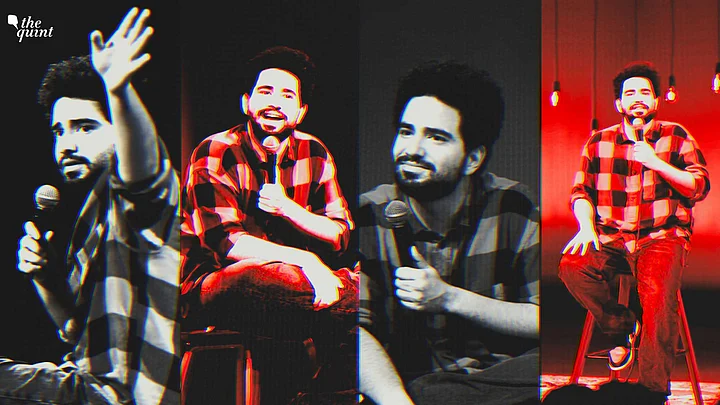
Last week, Samay Raina dropped his debut comedy special Still Alive on YouTube. It has already crossed 48 million views, merely a week later later.

To say this special has been successful would be an understatement. But to call it comedy would perhaps be an exaggeration. In truth, Samay’s ‘comedy’ special is essentially an 81-minute reality TV episode which has moments of humour and levity, but ultimately exists for the singular purpose, that is, the ‘comeback’ of Samay Raina.

One does not say this as a form of criticism or any sense of puritanism about what comedy is or should be. It is rather a commentary on spectacle and spectatorship discourse. 
ADVERTISEMENTREMOVE AD

Politics of Cancel Culture

A public cancellation or deplatforming is consumed by the audience as unscripted reality television. Not everyone following an unfolding online controversy is outraged or has a personal moral stake in it. So later, when an affected party comes back with its narrative, the audience returns to now consume the sequel to the drama whose lore they are already familiar with.

Samay understands this well and has astutely crafted his ‘comedy special’ as an acute insider’s POV narrative on the controversy which took away his stage. The jokes and the comedy almost feel like an afterthought in what is essentially his vehicle to reaggregate his audience base before he brings back his show. 

To be fair, even the audience is interested in Samay’s story, not his punchlines. The interest understandably comes from the scale of his cancellation, which itself reached stupendous proportions due to the outsized success of his show India’s Got Latent.

Based on Tony Hinchcliffe’s popular Kill Tony show format, Latent too invited ‘contestants’ to perform for a panel of selected judges in front of a live audience. This format is even now in deployment across the comedy/influencer landscape of urban India, where multiple such show events continue to exist. 

Latent Talents & the 'Dank' Manosphere

Where Samay’s show differed was in his absolute refusal to sanitise his content or ‘play it safe’. There were very few rules and the stage was accessible to many kinds of performers and performances. In an era where talent show-reality TV format has become irrelevant or heavily mediated, India’s Got Latent tapped into the sort of fanatical audience participation energy not seen since the days of the late 2000s MTV show, Roadies.

The unscripted, almost unhinged vibe of the show, often fuelled by its selection of guest judges (handpicked from the liminal crossover space between comics, influencers, lower-tier Bollywood and adjacent persons) who were not given scripts, notes, and handlers on how to carry themselves.

Tying it all together was Samay’s easygoing but crude ‘no-BS’ persona which lent the show a form of unpolished realism that became its hallmark. 

In doing so, the show broke many unspoken rules of Indian content production, including liberal swearing, controversial talking points and crude sexual jokes. India’s Got Latent sparked multiple debates about appropriate decency, propriety, and decorum for shows and performances.

Many were uneasy and wary of how Samay revelled in his branding as a foul-mouthed ‘real-speak’ guy who was not afraid of being cancelled by feminists, progressives, or even the moral-policing uncledom who balked at the use of ‘gaalis’.

This made him very popular among his core audience of young, right-leaning, conservative men who were giddily dipping into the ‘dank’ manosphere pool. 

Branding and Rebranding Self

Samay openly refused to reflect on and even mocked, not just the faux moral panic about ‘vulgarity of speech’, but even the legitimate questions raised by progressive liberals, feminists, and queer activists and thinkers.

In his mind, standing ‘up’ to such folks was being ‘fearless’ since one of the core tenets of the ‘manosphere’ was to frame gender and sexuality thinkers as the hegemonic order to whom politics and culture bends.

Thus, the bold stance to take was to ‘not give a damn’ about these people and refuse accountability. As he himself says in his special, all this changed when he ran afoul, with the conservative right-wing, i.e., the real hegemonic political and social order. His public stand changed accordingly.

Having felt the full weight of public cancellation by the political right, Samay took his show off YouTube and retreated into silence. Behind the scenes, he cooperated with the authorities, apologised for his content, and quietly built bridges with the very same brigade that had so hooliganistically led the calls for his deplatforming.

None of this suggested an irreverent, bold (if sometimes flawed) original voice who did not care about the ‘system’ and danced to his own tunes—as Samay had framed himself till now.

Instead, it revealed Samay as a balanced, risk-averse, status-quoist business man who seeks a settlement—and not a fight. Not a very sexy brand. How to hide this and repackage it for mass consumption again?

In Still Alive, Samay tells us how he sees the social media landscape. He insists everyone is playing a ‘character’.

Online persona is cultural cosplaying and has its own rules of permeability. So a ‘rough and foul-mouthed’ Samay can tone down and clean himself up for the correct stage as he confessed to doing so while being on Amitabh Bachann’s iconic TV game show, Kaun Banega Crorepati.

BeerBiceps, a.k.a. Ranveer Allahabadia, whose crude incest themed joke drew the biggest ire in the controversy, was performing the opposite "out of character" arc on Samay’s show. Samay explains that BeerBiceps had curated a big audience with his brand of being respectable and religious online, so the sudden shift to crudeness created a whiplash.

“A non vegetarian can eat veg food”, he explains, but the opposite is not a good idea. 

Social vs Reel vs Real and the Indian Bully-sphere

However, by reframing the online discursive space as one where everyone plays a character and suggesting that deviation from the said character is bound to create a backlash, makes the outrage appear to be almost a natural and normative phenomenon. In Samay’s own case, this is not true.

It was not simply some sections of the audience getting upset at the show’s content—it was a structural machinery of silencing and disciplining discourse getting into motion. From media channels, politicians, and public personalities, to police action, and legal cases piling up, even as goons openly threatened online and on the road—this was a well-oiled ecosystem that routinely targets activists, academicians, civil society personnel and even public personalities it wants to regulate and yield into submission. 

What Samay faced (and probably never expected to face) was anything but an organic outpouring of reaction to misplaced characterisation. Instead, it was the compounded force of a State-backed bullying apparatus that goes around gunning for anyone who runs afoul of it.

Though the reasons for such targeted bullying are often political and ideological, the apparatus has enough momentum and entropy within itself now to even target randomly or out of jealous and/or boredom. 

Instead of taking on this monster, however, Samay Raina, the edgy untamable, implacable rebel, makes peace with it.

Good Samaritan, Bad Rebel

In this special, while reflecting on the whole incident, the comedian talks about his mental health breakdown, his financial anxiety, his childhood bullying, the immeasurable anguish his parents faced, and his own trauma as a displaced Kashmiri Pandit.

Yet, he never really invokes directly the bullying apparatus and political goons whose direct intervention escalated the whole episode from an online controversy to a full-blown public flogging with legal repercussions. 

“You only fight when the fight is fair, when it is not fair you f*ck off from there”, he explains. Samay Raina has every right to disengage and settle his career and platform the way he wants (and a very successful European tour followed by the announcement of a comeback second season of the show validates his strategy). However, some fights should be fought even if they are unfair.

For a comedian or a content producer, the silencing-bullying machine is not a beast that one can negotiate or placate. One can only delay and evade. And every time someone dodges the fight, the machine grows bolder and stronger and inevitably crueler. 

Two days after Samay’s special dropped, Kunal Kamra appeared before the Maharashtra Legislative Council Privileges Committee which sought to investigate his show Naya Bharat where he allegedly ridiculed Deputy Chief Minister of Maharashtra, Eknath Shinde.

Kamra refused to apologise and said it would set a “terrible precedent" for artists exercising freedom of speech. 

One wonders if Samay realises that the biggest contribution to his safe comeback and his right to the stage is not from the entourage of influencers sharing his special as part of its publicity push—but from a comedian who picked the ‘unfair fight’ and refused to bow down. 

(Ravikant Kisana is a professor of Cultural Studies and author of the book 'Meet the Savarnas'. He can be contacted on X/Instagram as 'Buffalo Intellectual'.The views expressed in this article are the author's own and do not reflect or represent his institution.This is an opinion piece, and the views expressed above are the author’s own. The Quint neither endorses nor is responsible for the same.)

Speaking truth to power requires allies like you.
Become a Member
Monthly
6-Monthly
Annual
Check Member Benefits
×
×