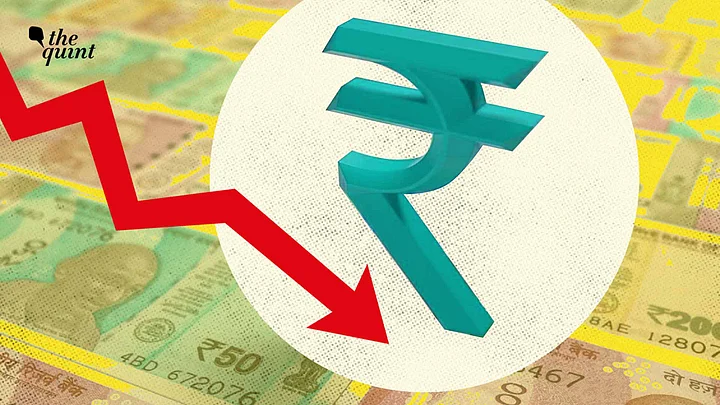
The rupee sank to 90.42 to a US dollar on 4 December before the Reserve Bank of India (RBI) intervened to pull it back to just above Rs 90 to a dollar.
The next day, the Monetary Policy Committee (MPC) decided to cut the RBI’s repo rate (the interest rate at which the RBI lends rupees to banks on their demand) by 25 basis points (0.25 percent) to 5.25 percent. In rupee’s context, the RBI announced a US dollar-rupee swap auction of $5 billion for a tenor of three years, to be held on 16 December.
The rupee dropped below 90 on 5 December as well.
Last year on 23 December, I had written a piece titled, ‘Rupee at 85 to a Dollar: Sinking Towards 100?’ for The Quint, and had hoped that it would not drop below Rs 90 in 2025. Unfortunately, the ‘managed float policy’ of the RBI could not ensure it.
With this sharp depreciation, the rupee is the worst-performing currency globally in 2025. Curiously, some quarters and commentators, close to the government are trying to pass off the falling value of rupee as a ‘smart move’, or ‘good for India’, or ‘nothing to worry about’.
Is the rupee depreciating by more than 6 percent during a year good for India? What does this mean for India’s trade deficit, external financing and investment, inflation and growth? Will rupee hit 100 to a dollar much before 2029, when the Narendra Modi government’s third term ends?
Double Whammy
Rupee depreciation against the US dollar is actually a double whammy.
First, the US dollar has been depreciating against most global currencies. The US dollar index closed at 105.97 on 6 December 2024. On 5 December 2025, a year later, it closed at 98.99. The US dollar effectively depreciated against global currencies by 6.6 percent. Correspondingly, all major global currencies strengthened against the US dollar, though by varying degrees.
Second, the Indian rupee depreciated against the US dollar. On 6 December 2024, the rupee closed at 84.67 to a dollar. On 5 December 2025, it closed at 89.95. The rupee depreciated by 6.2 percent against dollar in a year.
Rupee depreciating by 6.2 percent against the US dollar in the last one year, in a situation when where the dollar itself depreciated by 6.6 percent, is a body blow to the Indian rupee, causing serious injury to the Indian economy, exports, foreign financing and investments.
Three Fundamental Weaknesses
Three big weaknesses are responsible for this sorry state of the Indian rupee.
First, India’s merchandise trade has become a big foreign-exchange hole. October export declining by 12 percent and imports shooting up by 17 percent resulted into a massive trade deficit of $42 billion, sending shockwaves and making traders apprehensive as a precursor of drastic future.
India’s inability to secure a trade deal with the US, also with most other important markets—Europe and Canada included—makes merchandise trade weakness persist long. After entering a $100-billion annual deficit situation with China, India is now staring at a trade deficit with Russia becoming another big hole, exceeding $50 billion annually.
Second, strong capital inflows (foreign direct investment, portfolio investment, external commercial borrowings) used to bail India out of its trade deficit.
With belief in earning good returns from the Indian stock market rudely shaken, foreign portfolio investors (FPIs) have been persistently net-selling (more than $15 billion this year).
Net foreign direct investment (FDI), thanks to massive cash-outs by foreign start-up investors and repatriations by old investors, is contributing very small capital inflows. As the rupee depreciates sharply, with hedging costs going up, external commercial borrowings (ECBs) have become very costly reducing inflows.
India’s capital flows are at a huge risk, weakening the rupee rather than supporting it.
The government’s muddled policy in not permitting investments from China is hitting India both ways. While it prevents the FDI in the dynamic and futuristic sectors—computers, electric vehicles (EVs), solar cells and modules etc—it forces India to import the same machinery and equipment from China, causing a double drain on foreign-exchange (FE) reserves.
Third, the RBI has consciously increased its gold holdings, which effectively means exchanging US dollars for gold. The RBI has also sold US dollars and bought other foreign currencies.
These tactics have made a large portion of forex reserves illiquid, reducing the RBI’s flexibility to intervene effectively in the currency market. These three weaknesses have become structural and are likely to persist, making rupee quite vulnerable.
Smart or Dumb Move?
First of all, it is not a chosen move by the RBI. Rupee depreciation has been forced upon the central bank.
Is it smart?
Theoretical economists argue that currency depreciation makes exports competitive and imports costlier, which paves the way for closure/reduction of trade deficit by increasing exports and reducing imports.
But October merchandise trade data revealed that India lost exports not only to the US but almost all major countries, and across almost all major goods (barring smartphones). On the contrary, almost all major imports went up.
These facts of life tell that depreciating rupee is not improving India’s competitiveness to leg up exports, nor is it constraining India’s import dependence. If there is no product competitive, exports will not rise despite depreciation. And if there is no flexibility, imports will keep rising despite becoming costlier.
Involuntary depreciation of rupee is not a smart move. It is dumb helplessness.
The RBI believes that if it offers a dollar-rupee swap (selling dollars to the RBI now to receive them back after three years at a pre-fixed price), it will bring assurance, stability, and predictability to rupee by assuaging their edginess. The RBI had done similar swaps in February-March 2025 for $10 billion, when the rupee was trading at 87.46 to a dollar.
While it made sense for traders to sell dollars at the prevailing price and buy them back later at a reasonably good rate, the $10-billion swap could not prevent the rupee from weakening to 90.
The $5 billion dollar-rupee swap on 16 December will also attract numerous bids but will not make any appreciable difference to the rupee’s depreciating trajectory.
Will Accentuate Suffering
Many things—petroleum products, laptops, solar modules, etc—and services such as foreign travel and overseas education, have become costlier. As it is almost impossible for India to cut down petroleum and Chinese imports, or for Indians to reduce overseas travel and education, their misery will worsen if the rupee depreciates further.
The Indian diaspora sends hefty remittances from abroad (exceeding $100 billion a year). India’ services exports have also been growing and have crossed merchandise exports decisively. Remittances and export proceeds yield more rupee when rupee depreciates.
Remitters and service exporters should, therefore, be happy to get more for their bucks. Unfortunately, people’s psychology works differently in crunch situations. When the remitters and exporters expect rupee to further depreciate, they hold up, putting further pressure on the rupee, making it a self-fulfilling prophecy.
The Indian rupee seems to be in this situation currently.
Dollar returns on foreigners’ debt investments reduce sharply when the rupee depreciates. Foreigners becoming lukewarm about buying Indian government securities—and instead selling them—will hurt government borrowing as well. Unless redressed and credible calmness is brought in the rupee-dollar market, everyone will suffer.
In my December 2024 piece, I had conjectured that the rupee will cross 100 to a dollar before the Modi government completes its third term in 2029. The massive rupee depreciation in 2025 has hastened that path. I now believe that the rupee will cross 100 much sooner—most likely in 2027–28.
It is painful to see the rupee falling this fast.
(Subhash Chandra Garg is the Chief Policy Advisor, SUBHANJALI, and Former Finance and Economic Affairs Secretary, Government of India. He's the author of many books, including 'The $10 Trillion Dream Dented, 'We Also Make Policy', and 'Explanation and Commentary on Budget 2025-26'. This is an opinion piece, and the views expressed above are the author’s own. The Quint neither endorses nor is responsible for the same.)