
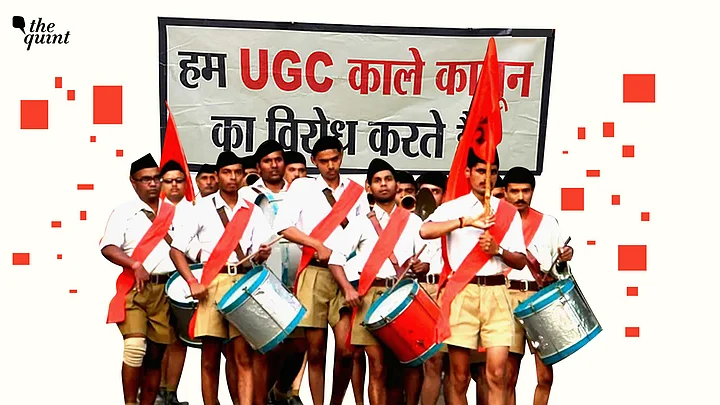
The three-day top body meeting of the Rashtriya Swayamsewak Sangh (RSS)—Akhil Bharatiya Pratinidhi Sabha (ABPS)—in Haryana concluded on a day when the Election Commission of India (ECI) announced poll dates for four states and UT, giving an apparent backdrop for the saffron brainstorming.
For public consumption, the RSS offers officially an agenda which remains the same for years—organisational expansion, social harmony, environmental protection, and so on. This opaqueness seeks to block deeper exploration into the ties of the RSS with the government run by its own political offshoot, as well as political and policy discussions.
The UGC Bone Stuck in BJP’s Throat
Top RSS functionaries publicly remained evasive on questions of the contentious UGC Resolution that has been stayed by the Supreme Court. Questions on the UGC resolution came up each day during the daily pressers by the RSS. Dattatreya Hosbole, the joint general secretary of the RSS, has an image of not ducking questions. But he too excused the UGC question, saying that the matter is sub-judice.
But the RSS, away from the public glare, is worried. The sense that the contentious UGC Resolution has ruptured the Hindu unity plank is troubling the RSS leaders.
More worrisome for the RSS leaders is the sense that the core saffron support base, which has been aggressive opinion makers since the launch of the Ram Janmabhoomi movement, is not just sulking due to the UGC resolution but also visibly restive.
The ABPS is a conclave where the RSS leaders from all parts of the country, holding positions as heads of sub-regions, share their most frank and honest ground assessments. They are uninhibited in sharing their accounts, and BJP’s representatives—party president and general secretary (Organisation)—only listen and take notes. The message to the BJP and to the government is simple from the RSS—put the genie of the UGC back into the bottle.
Politics at an Inflection Point
The Hindu unity plank faces a stress test as saffronisation project is beginning to abide by the law of reducing returns after the completion of the Ram Temple construction in Ayodhya in Uttar Pradesh. That is a grim assessment of the RSS functionaries, who believe that the politics of Hindutva is now under a shadow of growing economic challenges.
After Bihar where the National Democratic Alliance (NDA) had to bank on doles to win elections, the BJP-led government in Assam also followed the similar script.
Within the RSS, there is a growing acceptance of the views that the economic trajectory of the country is deepening economic divides with inequalities only rising in scale.
That the politics of Hindutva is now taking shelter in politics of doles is ringing alarms in the saffron camp. This risks the rise of the politics of identities on caste, regional, and linguistic themes against the RSS’ vision of a grand Hindu unity pivot.
At the RSS ABPS, affiliates who represent almost all shades of professions in the country have shared their frank views. The message is blunt — the promised prosperity is under clouds of hardships faced by small business units, farmers, the youth, and others.
The brainstorming seeks to cull out an actionable agenda for the party and the government. Signals from the Haryana ABPS of the RSS seek the Modi government to accelerate efforts to fulfil promises of economic prosperity for the masses. If the urgency is missed, Indian politics is now entering an inflection point stage, according to insiders in the RSS, when promises of doles may fail to beat anti-incumbency sentiments.
This was reiterated at the Haryana ABPS of the RSS. The statistics were offered to show that the expansion is a reality.
The RSS is aiming to have a presence at 10,000 population clusters. Shakhas are the RSS way to establish presence. Each village and each habitation now buzzes in speeches of the RSS functionaries. That is supplemented with regular outreach programmes which are designed to show that the RSS is a benign parent who helps the communities.
The RSS seemingly is seeking a larger role for the organisation in shaping the socio-cultural outlook of the country, while telling audiences that it’s an apolitical outfit. But politics draws strength from social and cultural currents. That should explain why the RSS is aggressively aiming for expansion. The BJP is possibly staring at a stage not far away from now when brand appeal of leaders could wane and anti-incumbency may intensify. The RSS seeks strength to provide cushion to the BJP in such times.
(Author is a senior Delhi-based journalist, who has reported on affairs of the BJP and the RSS for over two decades for India’s leading English dailies. This is an opinion piece and views expressed are the author's own. The Quint does not endorse or is responsible for them.)
