
Are we prepared for the climate crisis staring us in the face? The Quint wants to go big on telling the most important stories of our time. Support us to tell them. Become a member now.
Water remains a vital yet contentious resource in a world where geopolitical tensions intertwine with emerging environmental challenges.
The Indus Waters Treaty (IWT), signed on 19 September 1960, between India and Pakistan under the aegis of the World Bank, deftly encapsulates this complexity. This agreement elegantly fixes the rights and responsibilities of these neighbouring countries concerning utilising the Indus River system's waters. More than six decades later, this treaty is at the crux of renewed tensions and calls for renegotiation.
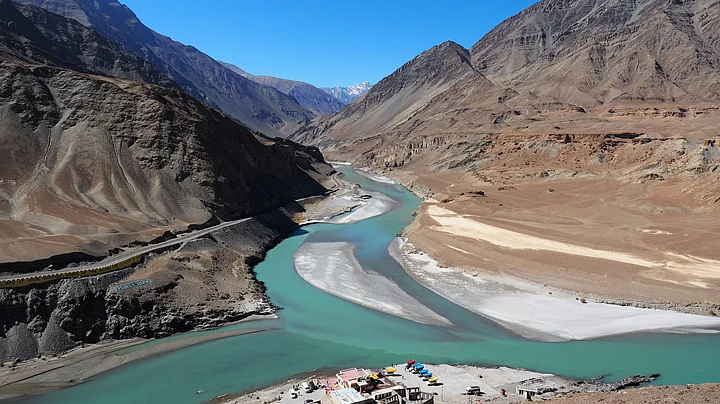
At the heart of this century-long dispute lies the Indus River. Originating in the Tibetan plateau, it meanders through the contentious Kashmir region before continuing into Pakistan, finally merging with the Arabian Sea. History reveals that the river's tributaries have served irrigation needs for millennia, and under British rule, vast canal networks were constructed to augment its potential. However, the partition of British India in 1947 led to the water channels being divided. The headworks remained in India, while most canals traversed into Pakistan.
The immediate aftermath of Partition saw India curtail water flowing into Pakistan in 1948. Both countries signed the Inter-Dominion Accord to prevent an impending crisis, granting Pakistan water from India in exchange for annual payments. Still, this was a temporary fix, and negotiations continued to seek a permanent solution facilitated by experts from the World Bank.