
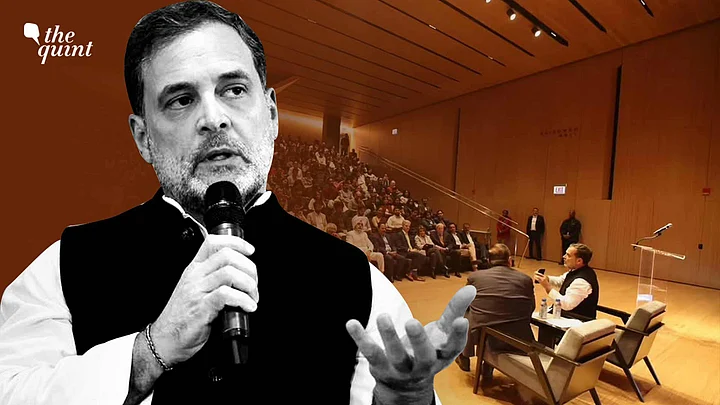
There has been considerable commentary on Rahul Gandhi’s views on Pakistan and Israel following his wide-ranging interview with Prof Robert Pape in Chicago. Rahul was invited by the Chicago Project on Security and Threats (CPOST) for a conversation on “The Iran War and India’s Role in the World.”
The first impression that emerges from the nearly one-and-a-half-hour interview is that Rahul is orthodox on ends and oppositional on execution. This is hardly surprising for an Indian Opposition leader.
His views on arms ties with Israel, conditional talks with Pakistan, a strong partnership with the US, and wariness of China are not fundamentally different from those of the Bharatiya Janata Party (BJP) government.
His criticism of Narendra Modi is essentially about competence and the conduct of foreign policy, rather than its broad direction. His charge is that foreign policy has “collapsed” after Operation Sindoor, that it has been reduced to hugs and photo-ops, and that Modi “will do whatever America and Israel say.”
He argues that Delhi has withdrawn from the international game and links this to the erosion of democracy at home. This is an Opposition critique of performance, not an attempt to lay out a fundamentally new direction for Indian foreign policy.
Rahul takes a “no fault” position, arguing that India's foreign policy should be determined by what is good for India. But his thinking becomes clearer when he says there is no going back in time, suggesting that classic non-alignment is best left to history.