
ADVERTISEMENTREMOVE AD

The Pujarini Pradhan Debate Wasn’t About Her. It Was About Us

As long as we view creators like Pujarini as exceptions to be explained, we will keep missing the larger story.

Published
story-hero-img
i
Aa
Aa
Small
Aa
Medium
Aa
Large

In the past week, the internet has been gripped by a familiar cycle. A new creator gained popularity and attention, only to be subjected to scrutiny that quickly shifted from curiosity to suspicion.

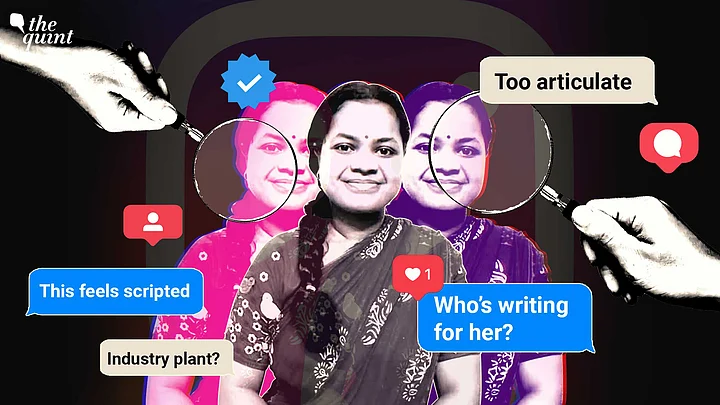
At the centre of this moment is Pujarini Pradhan, a rural homemaker from West Bengal who speaks about films, books, and life in her own honest voice, bringing together everyday experiences with thoughtful cultural commentary. Her content has sparked both admiration and doubt.

The doubt is telling.

It is marked by the usual commentary of whether the authenticity is a facade or whether she is an industry plant. My intent with this piece is not to go into that debate. What I am more interested in exploring is why the debate started in the first place.

ADVERTISEMENTREMOVE AD

The Internet Has Changed. Have We?

Over the past decade, India’s internet culture has undergone a profound transformation. Courtesy of cheap data, vernacular platforms, and smartphone penetration, the user base has dramatically expanded beyond metros.

Around 57 percent of internet users are from rural regions, with the number growing 4x that of urban India. This shift has not only increased access but also diversified expression and thought.

Voices that were historically excluded from mainstream discourse due to geography, language, or class are now participating in and shaping conversations. Cultural commentary, once the domain of English-speaking, urban elites, is now being produced in dialects, accents, and lived experiences that were previously invisible.

And yet, when confronted with this reality, many of us hesitate. We are willing to accept that rural India is online. But we are less willing to accept that it is articulate or analytical.

Who Gets to Have a Voice?

A recurring thread in the discourse around Pradhan is not just scepticism about her identity, but about her voice. The suspicion hinges on a subtle but powerful bias: that her level of articulation feels “too polished,” “too aware,” or “too intellectual” for someone from her background.

To understand this, one must recognise that intellectual authority is largely socially constructed. It is tied not just to what is said, but to who is seen as capable of saying it. In India, this authority has historically been concentrated among urban, English-educated, upper-class voices. So, if someone sitting at Blue Tokai in Khan Market says it, it must be right.

When someone outside this milieu speaks with similar clarity or depth, it disrupts an unspoken hierarchy. They then have to prove their intellect and understanding.

The reaction, then, is not always to expand our understanding of who can be articulate, but to question the authenticity of the speaker. In simpler words, the discomfort is not so much with the content as it is with the speaker.

The Tradwife Comfort Zone

Interestingly, the internet is not unfamiliar with homemakers. In fact, it has embraced a very specific version of them. The global rise of the tradwife aesthetic has made domesticity highly visible, even aspirational. From curated morning routines to soft-lit kitchens, the homemaker has been rebranded as a lifestyle ideal.

But there is a catch. The tradwife is allowed to be aesthetic, but not analytical. She can perform domesticity, but not interrogate culture. Her value lies in how she lives and cares for her family, not in how she thinks.

This is where creators like Pradhan disrupt the script. She is not presenting domestic life as a visual moodboard out of Pinterest. She is speaking from within it, but about things beyond it, like culture, society, behaviour, and more. Her homemaker identity is neither the main content nor the context.

This shift from performance to perspective is precisely what makes her harder to categorise. While the internet has made room for the homemaker as an image, it is still negotiating the homemaker as an intellectual voice.

ADVERTISEMENTREMOVE AD

The Collapse of Gatekeeping

Before the internet, cultural discourse in India was mediated by institutions like media houses, publishing networks, and academia. These gatekeepers determined who got to speak and whose voices were amplified. That system provided a certain predictability. Intellectual authority came with credentials, affiliations, and visible pathways.

The digital ecosystem has disrupted this entirely. Today, authority can be built through consistency and relatability. A homemaker in a village can command more attention than a columnist in a national newspaper.

This collapse of gatekeeping is both liberating and destabilising. It allows for a more inclusive discourse, but it also removes the familiar markers we use to assess credibility. In the absence of institutional validation, audiences often fall back on social cues like accent, appearance, or background to make judgments. The funny thing is that these cues are deeply shaped by class.

Negotiating Gender and Class Anxiety

The backlash against creators like Pradhan is not just about authenticity. It is about class and gender anxiety.

India has always had rigid, if often unspoken, boundaries around who belongs where. The digital space, by flattening visibility, disrupts these boundaries. When a rural creator speaks with confidence and nuance about culture, it unsettles a long-standing association: that intellectual labour is the domain of the privileged.

Cultural commentary has historically been a way for certain classes to assert authority. When that space becomes accessible to others, it can feel like a loss of control. The scepticism, then, becomes a way to reassert that control.

What this moment ultimately reveals is a gap between structural change and social acceptance. The infrastructure of the internet has democratised access. But our mental models have not evolved at the same pace. We are living in a reality where a rural, articulate woman is not an anomaly. And yet, our imagination still treats her as one.

This gap creates friction and manifests as disbelief, scrutiny, and the need to explain or expose what does not fit our expectations. But perhaps the question we should be asking is not whether such creators are real. It is why they still feel implausible to us.

ADVERTISEMENTREMOVE AD

Rethinking Credibility

If there is one takeaway from this discourse, it is the need to rethink how we assign credibility in the digital age. Rather than relying on proxies like class, language, or geography, we need to engage more directly with the content itself.

This requires a shift from gatekeeping to listening. It also requires an acknowledgement that intelligence, insight, and articulation are not exclusive traits of any one demographic. They are distributed, often unevenly recognised, across the country.

In many ways, the internet is ahead of us. It has already begun to normalise a plurality of voices, styles, and perspectives. It has already blurred the lines between who consumes and who creates, who observes and who interprets. The question is whether we are willing to catch up.

As long as we continue to view creators like Pujarini Pradhan as exceptions to be explained, rather than as participants in a new normal, we will keep missing the larger story. And in doing so, we will keep underestimating the very voices that are redefining what India sounds like.

(Farnaz Fatima has a postgraduate degree in Politics and International Studies. Currently working in advertising, she is interested in exploring the intersections of gender, mental health, and popular culture through her writing. This is an opinion piece, and the views expressed are the author’s own. The Quint neither endorses nor is responsible for them.)

Speaking truth to power requires allies like you.
Become a Member
Monthly
6-Monthly
Annual
Check Member Benefits
×
×