
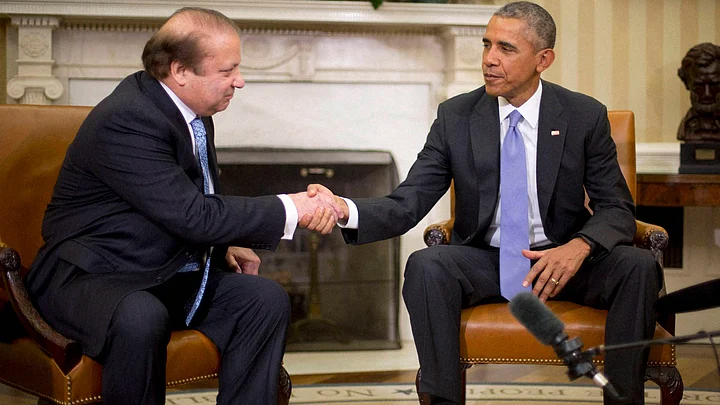
Pakistan Prime Minister Nawaz Sharif’s meeting with US President Barack Obama on Thursday, 22 October, in Washington, dwelt predictably on three contentious issues – namely Afghanistan, terrorism and the nuclear profile of the South Asian region.
Regarding the nuclear weapons program of Pakistan, the media summary released by the White House noted: “President (Obama) stressed the importance of avoiding any developments that might invite increased risk to nuclear safety, security, or strategic stability.” The context to this pithy observation is instructive.
The nuclear status of Pakistan received rare elucidation in the run-up to Nawaz Sharif’s visit to the US. On Tuesday, 20 October, Foreign Secretary Aizaz Chaudhry confirmed what had been speculated for long – that Pakistan has tactical nuclear weapons in its arsenal. He added that the security establishment in Pakistan (read: The Army GHQ in Rawalpindi) was convinced that this was the only response they could rely on to counter what is being described as India’s Cold Start doctrine.
The possession of tactical nukes – or battle-field nuclear weapons – has been the unrelenting focus of many intelligence agencies that track the Pakistani nuclear arsenal. There is consensus that Rawalpindi has, indeed, stock-piled such low-yield warheads. This official admission is the equivalent of daring the US in its own den and defying the post-Hiroshima global norm about the non-use of such apocalyptic ordnance.