
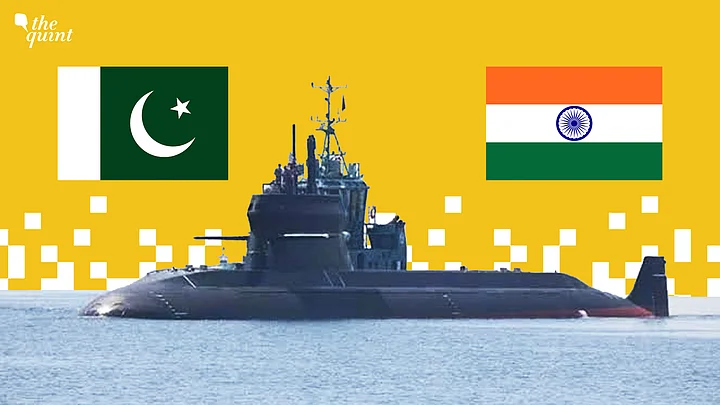
Pakistan’s latest submarine is the Chinese-origin PNS Hangor. Commissioned in April 2026 by the Pakistan Navy at China’s Sanya Naval Base, it arrived at Karachi Naval Base earlier this month.
PNS Hangor is named after the erstwhile Daphne-class submarine which had sunk the Indian Navy frigate, INS Khukri, in the Arabian Sea in December 1971—a solitary Pakistani success in that one-sided war which saw Pakistan split into two.
The Hangor-class (S-26)—which is an advanced diesel-electric attack submarine, and an export variant of the Chinese Type-039B Yuan-class—is 76 meters long, displaces around 2,800 tonnes, and is equipped with an air-independent propulsion system (AIP).
Pakistan had in 2015 signed a deal estimated at $5 billion with China for eight Hangor-class submarines, with four to be built by Wuchang Shipbuilding Industry at their Shuangliu Base in Wuhan. As of date, one has been commissioned; three—PNS Shushuk, PNS Mangro, and PNS Ghazi—are undergoing sea-trials, and the remanining will be assembled at Karachi Shipyards & Engineering Works (KSEW) under a technology transfer agreement.
The assembling of the submarines is aimed at developing Pakistan’s shipbuilding capacity. Delivery of the full fleet is expected by 2030.
The KSEW had in July 2017 contracted Norway’s TTS Group for construction of a Syncrolift ship-lift system, capable of handling ships of up to 7,300 tonnes. The rail-connected lift-system allows shifting of under-construction vessels between the 12 custom-designed workstations. However, the lockdown in Wuhan in the wake of COVID-19, and Germany’s denial of export licence to China for the locally manufactured MTU-396 diesel engines for the Hangor-class, delayed timely utilisation of this facility.
The Pakistan Navy then waited for China to certify its indigenously developed diesel engine, as well as affect further improvements to the Hangor design, including increasing displacement but shortening of the hull. Consequently, this facility was commissioned in August 2021, imbuing KSEW with the capability to build improved versions of the Hangor-class or even newer classes.
Why Air-Independent Propulsion Changes the Game
An AIP reduces the need for a conventionally powered submarine to surface frequently to snorkeling-depth for fresh-air intake and running its diesel engines for re-charging the batteries. This allows the submarine to stay submerged for longer periods, and in turn, improves its deep-strike and sea-denial capabilities.
Currently, three main types of AIP systems are prevalent:
Closed Cycle Steam Turbine: This French model burns ethanol and liquid oxygen to generate steam. While this system improves endurance, the heat and noise generated increase the submarine’s acoustic and thermal signatures.
Stirling Engine: This piston-based system is being used by countries like Sweden, China, Singapore, and Japan. It generates power by burning liquid oxygen with diesel fuel. The use of the latter as primary fuel simplifies fuel type carriage. Since the exhaust fumes are recycled and not released, its thermal and acoustic signatures are lesser than the French model.
Fuel cells: These operate on the basic principle of combining hydrogen and oxygen molecules to produce electrical energy, with water as its primary byproduct—and is the emergent, and most sought-after technology for AIPs.
The Pakistan Navy is not new to AIP-equipped submarines. Its three French-origin Khalid-class submarines (PNS Khalid, PNS Saad, and PNS Hamza) were retrofitted with the French AIPs and subjected to a mid-life upgrade by Turkey’s STM Defence.
The Hangor-class, however, uses the more efficient and advanced Stirling AIP.
It’s for this reason that Commodore Omer Farooq, who commanded the flotilla escorting this submarine from China, declared it a “game changer” capable of operating not just in Pakistan’s home waters, but eastwards in the Bay of Bengal. This statement needs to be seen in light of the ongoing Bangladesh-China-Pakistan rapprochement.
From Conventional to Nuclear
The Hangor-class are also equipped with six bow-mounted 533mm torpedo tubes.
Torpedo tubes on submarines range from 400mm to 660mm in diameter, with 533mm acting as the global standard for modern navies. These can be used for launching modern heavyweight torpedoes, anti-ship cruise missiles, and even nuclear-capable submarine-launched cruise missiles (SLCM).
Israel’s German-origin Dolphin-class submarines are fitted with six 533mm (21-inch) and four 650mm (26-inch) torpedo tubes. The latter oversized tubes are relatively rare in modern submarines—and seem intended as the primary delivery system for Israel's nuclear-warhead-tipped Popeye-Turbo SLCMs, and for deploying Swimmer Delivery Vehicles (SDVs) and naval commando teams.
The 533mm tubes of the Hangor-class, in conjunction with the Babur-3 SLCM, have the potential to enable the Pakistan Navy to field a very limited sea-based deterrence/second-strike capability. The Babur, with a diameter of roughly 520mm, can be accommodated in the 533mm torpedo tubes—and Pakistan had first tested feasibility of this configuration from an underwater platform in 2017.
Subsequent reports informed that Pakistan had fitted the Babur-III SLCM in at least one of its Agosta-90B/Khalid-class submarines—but accounts suggest that the French AIPs on the Agostas are beset by some technical issues.
Can The Hangor Alter Deterrence?
With a reported range of 450 km, the Babur-III SLCM on a Hangor-class would be able to cover Indian cities and critical infrastructure along the coastline up to a depth of 350 km with the submarine laying off at 100-km range.
That said, it merits noting that with even two-three Hangor-class submarines modified for this role, the Pakistan Navy would be able to rely solely on the ‘bastion’ model of deployment. The ‘Continuous At-Sea Deterrence’ model requires at least three to four nuclear-weapons-armed submarines, with one being on patrol at any time. Additionally, there is always the danger of such submarines being tracked when they deploy from known ‘bastion’ locations.
Nevertheless, an AIP-equipped conventional submarine armed with a nuclear-capable cruise missile can address Pakistan’s interim requirement for a second-strike capability against India. Pakistan and India are contiguous nations and the lower underwater endurance of an AIP-equipped submarine versus a nuclear-powered one will not be such a great limitation given Pakistan’s nuclear posture is primarily India-centric.
Such a platform would also facilitate the Pakistan Navy’s endeavours to limit India’s ability to establish a clear naval superiority while serving China’s strategic requirements of keeping India focused towards a Pakistani threat—even as the Pakistan Navy continues its quest for acquiring nuclear-powered submarines.
(Kuldip Singh is a retired Brigadier from the Indian Army. This is an opinion piece, and the views expressed are the author’s own. The Quint neither endorses nor is responsible for them.)
