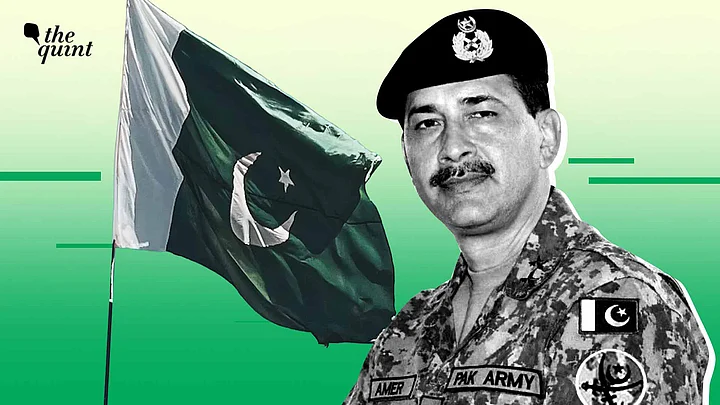
On 24 July 2026, Pakistan took another step towards completing the restructuring of its higher military command (initiated under last year’s 27th Constitutional Amendment), with Prime Minister Shehbaz Sharif promoting Lieutenant General Syed Aamer Raza to the rank of General, and simultaneously appointing him as Pakistan’s first Commander of the National Strategic Command (NSC), a newly created four-star office, that will oversee the operational integration of Pakistan’s strategic forces.
Thereafter on ‘X’, Prime Minister Shebaz Sharif ‘congratulated General Aamer Raza on his promotion and appointment and wished him the best for undertaking this important responsibility’.
The office of the Commander, NSC was created through the 27th Constitutional Amendment enacted in November last year, which fundamentally altered Pakistan’s higher defence architecture by abolishing the office of the Chairman Joint Chiefs of Staff Committee, and creating the new position of Chief of Defence Forces (CDF), concurrently held by the Chief of Army Staff, Field Marshal Asim Munir.
It has been termed as the most ambitious restructuring effort in decades. which elevated the Army Chief to a constitutionally approved position of supremacy.
Pakistan’s New Strategic Command
The NSC is the military body responsible for overseeing Pakistan’s strategic capabilities including the nuclear arsenal. It functions as the unified operational headquarters for the strategic forces by bringing together the Army, Navy and Air Force Strategic Commands under a single command structure while the National Command Authority, chaired by the Prime Minister, continues to retain the ultimate authority over nuclear policy and employment.
Under the Army Act, the Commander, NSC is appointed by the Prime Minister on the recommendation of the CDF from among serving army Generals, and he serves a three-year term.
With the constitutional architecture now largely operationalised, attention is increasingly turning towards amendments to the National Command Authority Act, 2010, which, in its current form, still reflects the pre-27th Amendment military hierarchy.
According to reports, those familiar with the process indicate that work on the amendments is under way, and the changes are primarily intended to bring the statute in line with the new military offices instead of the purely civilian-led character of the nuclear command and control system. The amendments, if implemented, would replace references to the abolished Chairman Joint Chiefs of Staff Committee, with the Chief of Defence Forces, who is likely to become the Deputy Chairman of the National Command Authority.
Officials maintain, however, that the broader institutional framework would remain unchanged, with the Prime Minister continuing as Chairman of the National Command Authority. The Strategic Plans Division will retain its role as the Secretariat, and the authority to employ nuclear weapons remaining vested in the National Command Authority.
Part of the restructuring in Pakistan was the abolition of office of the Chairman Joint Chiefs of Staff Committee (CJCSC), when General Shamshad Mirza, Pakistan’s 18th and final Chairman of the Joint Chiefs of Staff Committee retired in November 2025 and the subsequent appointment of General Munir as the CDF in December 2025, who also wears the hat of the Army Chief.
The restructuring introduced as part of broader constitutional and institutional reforms, is intended to improve jointness, integrate planning across strategic capabilities, streamline command in an increasingly multi-domain security environment and reinforce the credibility of Pakistan’s nuclear deterrent particularly post Operation Sindoor.
The General Chosen to Lead
A Cavalry officer from the Officers Training School, General Syed Aamer Raza was commissioned into 6 Lancers in 1988. His professional career includes command of an Armoured Regiment, an Armoured Brigade, an Infantry Brigade in South Waziristan, an Infantry Division and IV Corps in Lahore, where he replaced Lieutenant General Salman Fayyaz Ghani following the ransacking of the Corps Commanders residence also known as ‘Jinnah House’ in May 2023.
He has also headed Heavy Industries Taxila, and served as the Director General of Weapons and Equipment. Earlier he was the Chief of Staff II Corps at Multan. A graduate of Command & Staff College, Quetta and National Defence University Islamabad, he is a recipient of the Hilal-i-Imtiaz (Military) and the Sitara-i-Basalat for distinguished service.
At the time of his promotion to a four-star rank and appointment as the Commander, NSC, he was eighth in the Army’s seniority list of Lieutenant Generals and was serving as the Chief of General Staff (CGS) at Army Headquarters in Rawalpindi which is undoubtedly a key and coveted operational appointment.
It is here that he oversaw the implementation of organisational changes necessitated by the 27th Amendment and the restructuring that followed including the establishment of the Army Rocket Force Command (ARFC) which is presently being commanded by Lieutenant General Nauman Zakaria, GOC I Corps.
He has, however, not served in the Strategic Plans Division, or the Army Strategic Forces Command.
General Raza’s elevation superseded Lieutenant General Inam Haider Malik from the Engineers who is presently the Chairman of the National Disaster Management Authority, Lieutenant General Fayyaz Hussain Shah, GOC IV Corps in Lahore, Lieutenant General Nauman Zakaria, GOC I Corps at Mangala, Lieutenant General Muhammad Zafar Iqbal, Commander, Army Air Defence Command at Rawalpindi, Lieutenant General Ahsan Gulrez, GOC II Corps at Multan and Lieutenant General Shahid Imtiaz, the Military Secretary who had commanded X Corps. The seniormost officer, Lieutenant General Asim Malik, is the Director General of the Inter-Services Intelligence and National Security Adviser, who continues to perform his duties on an extended tenure.
General Raza’s appointment is also expected to trigger a cycle of changes in the Army’s senior leadership as to start with a new CGS will need to be posted. With the four-star appointments now completed a wider reshuffle of Principal Staff Officers and Corps Commanders is bound to take place.
What It Means For India
The positive takeaway for India is that Pakistan is taking correct responsibility of their nuclear assets, which will lead to mature and professional storage and handling of the nuclear assets, thus minimizing chances of accidents and pilferage.
However, the flip side is that this is yet another step towards establishing total and absolute military control over the nuclear arsenal. As time goes by, one can expect further changes to the National Command Authority.
Ever since 1945, nuclear warfighting has been taking place by manoeuvres and signals. Each such manoeuvre is met by a counter manoeuvre, and it goes on and on. Similar is the case with Pakistan and India. Therefore, India has to always be on its guard as far as Pakistan’s nuclear ambitions are concerned.
In the larger context it is also another method of nuclear signaling to the world in general and India in particular. With such developments Pakistan hopes to be recognised as a responsible nuclear nation. For India it is another sabre rattle to draw our attention towards their nuclear intention(s). All in all, it is old wine in a new bottle, because with India’s nuclear doctrine and firm resolve our stand remains unchanged.
A More Centralised Nuclear Hierarchy
Pakistan’s nuclear weapons policy is directed by the National Command Authority, the country’s top civilian-military body responsible for strategic decision-making, while the creation of the National Strategic Command forms part of a broader effort to reorganize military oversight of the country’s strategic forces under the constitutional reforms.
There is little doubt that the re-organisation is driven by Field Marshal Asim Munir and it is felt that this structural shift and appointment of General Raza will effectively bypass the traditional civilian-headed NCA framework, leaving oversight strictly informational rather than operational.
There are of course voices in Pakistan who have expressed reservations about how the delicate balance between the three Services, and between military and civilian components of the NCA would be maintained with both the CDF and CNSC being from the Army and being part of the NCA as the role of Navy and Air Force in decision making looks diminished.
Pakistan’s new strategic command structure now seems to be in place within a military hierarchy that is more centralised than earlier. The appointment of General Raza is also an indication how Field Marshal Munir has occupied the apex of Pakistan’s power structure and with the nuclear weapons now firmly in his grip, more inflammatory rhetoric can be expected.
(The authors are retired Major Generals of the Indian Army. This is an opinion piece, and the views expressed are the author’s own. The Quint neither endorses nor is responsible for them.)