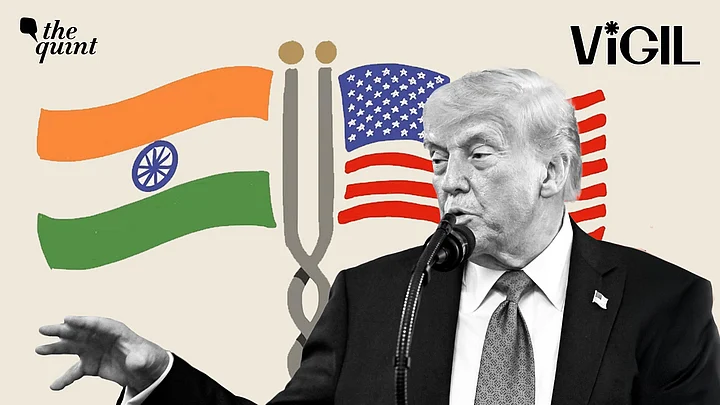
On April 22, US President Donald Trump shared a transcript of remarks made by podcaster Michael Savage, which included him saying, “A baby here becomes an instant citizen, and then they bring the entire family in from China or India or some other hellhole on the planet."
The comments have got several Indians riled up. Zoho founder Sridhar Vembu called for Indians living in the United States to “please come back home. Bharat Mata needs your talent.” He also said, “Like I did 37 years ago, you arrived in America with no money but with a good education and cultural heritage from Bharat… Yet today, a significant number of Americans, may be not the majority but not too far from it either, believe that Indians "take away" American jobs and our success in America was unfairly earned.”
There have been rumblings among the diaspora too. For instance, the right-wing Hindu American Foundation wrote that they were “deeply disturbed by @POTUS sharing this hateful, racist screed”.
Yet the protestations of diaspora Indians to Trump’s racist remarks against immigrants ring hollow if those protestations are only made when he speaks against Indians, and are coupled with a conspicuous silence when the administration’s anti-immigrant politics and policies target other communities, ethnicities and swathes of immigrants.
To be clear, this is not the first time that Indian immigrants in the US have been at the receiving end of Trump’s anti-immigrant rhetoric, politics or policies. In September last year, Trump’s sudden, chaotic and ambiguity-filled announcement on H1B visas requiring a $100,000 fee had sent H1B holders into a tizzy — an overwhelming majority of recent H1B visa awardees are Indian nationals. A few months prior to that, large numbers of Indians on student visas in the US found out that the Trump administration had been revoking their visa statuses over minor infractions.
Then, there are the Immigration and Customs Enforcement (ICE) arrests of Indians. From the day Trump took office in January 2025 to 10 March 2026, there have been 4,156 arrests of Indian nationals recorded by ICE. 88 percent of the arrests involved people with no criminal convictions, despite the Trump administration’s repeated claims that their immigration enforcement operations are focused on ‘the worst of the worst.’
At 10 arrests per day, the rate of ICE arrests of Indians has more than tripled under Trump compared to the rate under the Biden administration, reveals VIGIL’s analysis of federal government data provided by ICE in response to a public records request.
There is also the inaccurate view among some Indians in the diaspora, like Indian American comedian Zarna Garg, that Indian immigrants who are “legal immigrants in America” are unaffected by Trump’s crackdown. Garg had recently said, “When it comes to immigration, Indian people by and large are legal immigrants in America. Which means it was years of waiting, years of applying paperwork, hundreds and thousands of verifications, and ‘submit this’ and ‘submit that’.” Garg continued, “So the whole illegal immigration thing was something that we never really got on board with.” In an earlier piece on VIGIL, I had written about why Garg’s comments, and other arguments on similar lines, fall flat in the face of some scrutiny.
That the Trump administration has also been cracking down on those Garg and others would describe as “legal immigrants” is no secret. The Cato Institute, a libertarian thinktank wrote recently, “The Department of Homeland Security suspended processing many green card applications, allowing ICE to arrest legal immigrants, including refugees, parolees, and spouses of US citizens. This is a deliberate effort to boost ICE arrests by thwarting people’s efforts to stay on the right side of the law.” Now, the Trump administration is seeking to further its crackdown based on political speech as well.
Across the United States, Trump’s immigration enforcement crackdown has wreaked havoc among immigrant communities, and caused emotional, social, and financial harm. Immigrant-run and frequented businesses have faced massive losses, children have been scarred, and families separated.
Diaspora Indians, including individuals in positions of influence and reach such as the likes of tech CEOs Sundar Pichai and Satya Nadella, and organizations that pride themselves on being representatives of Indian Americans, must step up and speak out against the anti-immigrant onslaught carried out by the Trump administration. The crackdown is being conducted under a pretext of going after the “worst of the worst”, a ruse that the federal government’s own data has repeatedly proven false.
The majority of the rank and file of diaspora Indians in the United States would agree with such a view too. Sixty-four percent of Indian Americans polled in the 2026 Indian American Attitudes Survey by the Carnegie Endowment for International Peace say that they disapprove of Trump’s immigration policy. Interestingly, however, the same survey showed that of the Indian Americans who were polled, 84% of Democrats said they disapproved of Trump’s immigration policy, but only 19% of the Republicans did the same.
Mobilising against the anti-immigrant crackdown and providing support to imperilled immigrant communities — legal aid, mutual aid, and through other miscellaneous ways — is the need of the hour and a moral imperative. And Indian-Americans, those with US citizenship, would do well to step to the fore on behalf of their more vulnerable non-citizen immigrant neighbors.
Additionally, it is strategically significant too. If Indian diaspora organizations can make their presence and support felt in these spaces of immigrant solidarity, the crackdown on issues that disproportionately affect Indians will receive greater support as well. Because the reality of the matter is that some aspects of the crackdown hurt Indians far more disproportionately. For instance, the move against H1B visas or the impending threats and anxieties surrounding the Optional Practical Training (OPT) for foreigners on F-1 student visas, are issues that affect Indians more than immigrants of any other nationality.
To mobilize a broader coalition on these issues, Indian diaspora groups will need to rely on other immigration coalitions and organizations to lend their voices and support. So, as a strategy too, conditional solidarity by Indian diaspora representatives against anti-immigrant narratives is unlikely to yield dividends.
So, when Trump abruptly halts immigrant visa processing for 75 countries, even though that list doesn’t include India, I would argue it is in the interests of the Indian diaspora to speak up and mobilize against the move. The list, shared without sufficient substantiation, included countries such as Brazil, Bhutan, Kuwait, Nepal, and Thailand.
Or when ICE arrests more immigrants from Latin American countries than any others, even though a majority of those arrested have no criminal convictions — the top 12 countries with the most nationals arrested by ICE under the Trump administration are all Latin American — it is in the collective interest to oppose that too. At number 13 in the list of countries is India, with 4,156 arrests of Indian nationals.
Collective immigrant solidarity is, therefore, both a moral imperative and strategically sensible. The vocal indignation of the Indian diaspora at anti-immigrant politics and policies should not be reserved only when the attacks specifically target Indians.